
Ron Allen and Jeff Kupfer
Simmons University (Boston) and University of Colorado (Denver)
During a lecture in graduate school at the University of Florida, Dr. Marc Branch described several examples of differences between statistical and clinical significance. Branch noted that if we were working with an individual who engaged in self-injurious head hitting at a rate of 100 hits per hour, and after a year of diligent clinical work we had reduced head hits to a stable and statistically significant 95 hits per hour, we would be hard-pressed to assert that we had achieved a clinically significant outcome for our client. Naturally, we would be striving for zero hits per hour, an outcome both statistically and, more importantly, clinically significant. Branch went on to state: “Behavior Analysis is the science of Big Effects.” As an example of a big effect from the experimental analysis of behavior (EAB) Branch described the results from a Findley & Brady (1965) article entitled: Facilitation of large ratio performance by use of conditioned reinforcement. We would like to review the big effect of Findley and Brady (1965) (and at least one additional EAB big effect) but considering our recent blog lauding the classic 1966 text edited by W.K. Honig Operant Behavior: areas of research and application, we would like to connect the big effects to the chapter by Roger Kelleher: Chaining and Conditioned Reinforcement.
Roger T. Kelleher (1926-1994)
In 2006, Branch published a memorial to Roger Kelleher in which he acknowledges the “voluminous” career that Kelleher had compiled in behavioral pharmacology, but focused intentionally on the profound effects Kelleher had on the field of behavior analysis. Such contributions included fundamental analyses of the processes inherent in schedules of reinforcement (including, along with W.H. Morse the discovery of the enigmatic phenomena of shock-maintained behavior), as well as leading the experimental analysis of conditioned reinforcement with studies of chaining, token reinforcement, and brief-stimulus presentation schedules. Part of that latter contribution includes the chapter on conditioned reinforcement mentioned above.
In the aforementioned chapter, Kelleher reviews data and conceptualizations concerning the maintenance of long sequences of behavior. For example, he reviews studies concerning whether responding under fixed-interval (FI) schedules represents long chains of behavior organized via response-produced stimuli. Studies reviewed included those by Peter Dews (1962-also see later studies in 1965 and 1966) who examined the effects of interpolated s-delta blackout periods (interrupting responding) within the inter-food interval. To summarize: FI responding under such conditions was essentially unaffected by the interpolated s-delta periods, retaining its standard positive acceleration during the inter-food interval. Kelleher also reviewed studies of chained schedules (compound schedules with exteroceptive stimuli associated with each component schedule). See our first big effect below. Later in the chapter, Kelleher again defines second-order schedules as “…one in which the behavior specified by a schedule contingency is treated as a unitary response that is itself reinforced according to some schedule of primary reinforcement.” The advent of the nomenclature of second-order schedules unified the studies of chained, token reinforcement, and brief-stimulus schedules, as well as expanding the analysis of functional units of behavior.
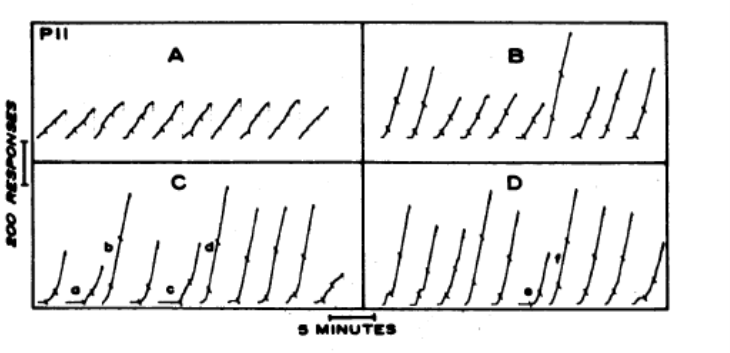
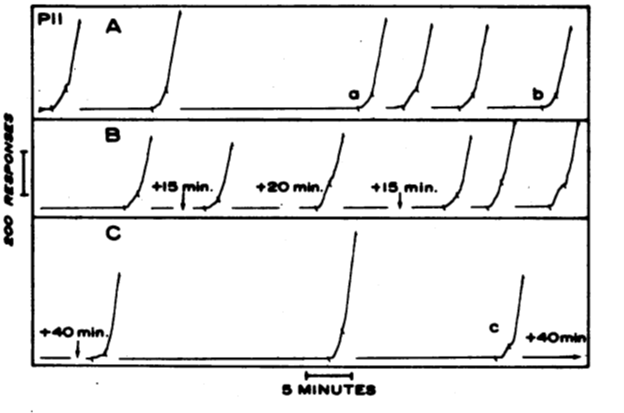
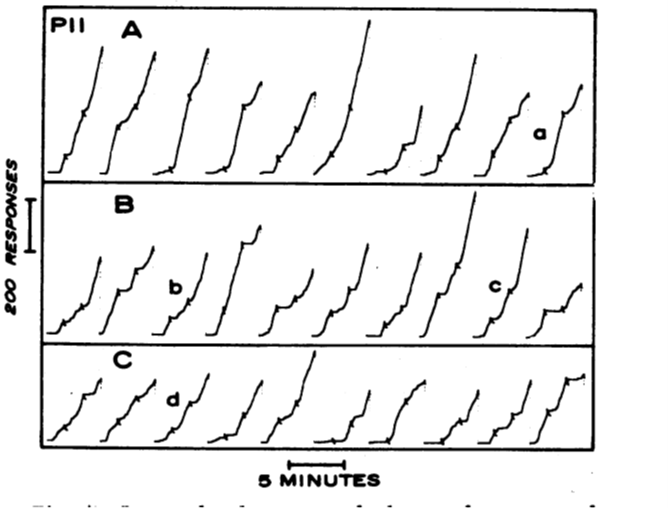
But now, back to our “big effects”. Our first offering of big effects comes from the results of a study by Kelleher and Fry (1962) entitled: Stimulus functions in chained fixed-interval schedules. The study compares the responding under three equivalent schedule arrangements: tandem FI FI FI, chained FI FI FI, and variable chained FI FI FI. In the nomenclature of second-order schedules, each of these would be FR 3 (FI) (e.g., tand FR 3 (FI) ). In the sessions we display in cumulative records below, the FI value was a constant 1.5 min. The primary experimental manipulation in these sessions was the modification of the component schedule stimulus conditions in effect during the three conditions. The response contingencies to progress through the schedule sequence remain the same across experimental conditions; a response following the lapse of the first component schedule initiates the second component schedule, a response following the lapse of the second component schedule initiates the third component schedule, and a response following the lapse of the third component schedule results in food delivery and resets the schedule sequence.
The first set of cumulative records directly below shows responding for P11 under the tandem FI FI FI schedule (A-D). Responding is well-maintained with pausing following food presentation and developing positive acceleration during the inter-food interval.
With the introduction of different keylights consistently associated with the three component schedules (See below) the overall schedule contingency becomes a chained FI FI FI. Responding between food deliveries develops a clear positive acceleration, dramatically reducing the rate of responding in the first component. To state it more clearly, first component responding is characterized by prolonged pausing (note the deleted pausing in record C of two 40 min periods). Thus, our first big effect is the profound reduction of responding resulting from the antecedent manipulation of signaling the components of the second order contingency. Seems like a great model for procrastination (or more accurately described as response initiation inhibition because once the first response advances the sequence toward the remaining components responding continues relatively unabated)
The second big effect in the study comes from another antecedent manipulation. Kelleher and Fry next randomized the sequence of the three colors/discriminative stimuli associated with the component schedules, creating what they term varied chain schedule. Thus, on one-third of the chain completions each of the 3 colors was paired with the delivery of food. Equally important may be that none of the discriminative stimuli were paired consistently with the initial component of the chain. This manipulation resulted in the maintenance of substantial responding in each of the component schedules (thus, no “procrastination”).
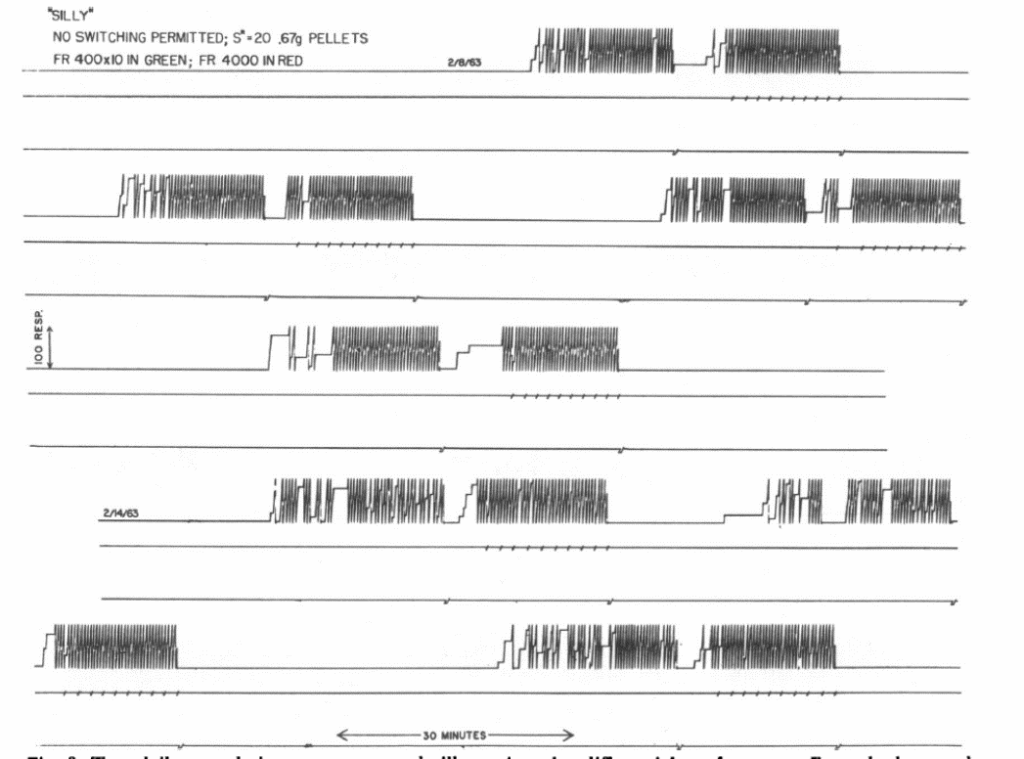
In our second study with big effects, Findley and Brady (1966) studied the large ratio performance of one adult male chimpanzee (“Silly”). The ratio behavior examined was a response (button pushing) requirement of 4000. Reinforcement consisted of 20- 0.67 g food pellets delivered into an illuminated hopper. Responding was maintained under a two-component multiple schedule. In a component signaled by a red light, the food was delivered after a standard fixed ratio (FR) 4000. The red component was alternated with a green component during which food was delivered after 4000 responses, but in addition each 400 responses produced a 0.5 s illumination of the hopper. The green schedule could be designated as a second order schedule FR 10 (FR 400:S). Cumulative records below show the performance. Responding in the green component can be identified by the deflections of the event pen corresponding to the brief illumination of the hopper. Responding was maintained under both components of the multiple schedule; however, responding during the red component was often preceded by pause times measured in hours (sometimes including sleep). Responding in the green component was preceded by pausing measured in a few minutes (e.g., 3 minutes) and no sleep. When provided a choice between red and green components, Silly exclusively choose green. Thus, the addition of a food-paired stimulus to the response requirements under green eliminated hours of pausing (and again, “procrastination”).
The maintenance of long sequences of behavior are near constant requirements in human behavior environments. So too, are procrastination, writer’s block, “all but dissertation” traps (ABT), poor work attendance, and erratic study habits. The analysis of stimulus functions in sequences of behavior could undoubtably have applied relevance in all our lives by establishing more effective ways to generate stimulus control and, ultimately rules to guide cultural practices.