
This post was written by guest authors Dr. Dan Mitteer and Dr. Adam Briggs.
Introduction
Five years ago, we published a paper that provided behavior analysts with updated strategies for making regular contact with the scholarly literature (Briggs & Mitteer, 2021). We organized that paper by detailing the barriers and solutions related to searching the literature, accessing journal content, and contacting contemporary literature. At that time, it had been a decade since the initial publication of this sort (Carr & Briggs, 2010). We were excited to share some new resources and technology that developed over those ten years. Some of the new solutions to keeping up with the literature were:
(a) introducing readers to the research-oriented social-media platform ResearchGate,
(b) orienting readers to summary materials for subspecialty areas developed by the Behavior Analyst Certification Board, and
(c) listening to professional podcasts or reading behavior-analytic blogs.
We also highlighted a research-collation service, Current Contents in ABA, which pushed new literature to busy professionals after the behavior analysts behind the service curated the content from peer-reviewed journals.
These were important developments to highlight in the decade between the two publications. However, in the five years since our “updated” publication in 2021, Artificial-Intelligence (AI) technology has rapidly developed to drastically address many of the barriers noted across the two papers related to searching, accessing, and consuming the literature. AI is a set of technologies that can examine incredible amounts of data to identify patterns and make relevant predictions or decisions in ways that used to require human intelligence (Google, 2026; Microsoft, 2026). Popular examples of artificial narrow intelligence include Google Gemini, Microsoft Co-Pilot, OpenAI’s ChatGPT, and Anthropic’s Claude. AI technology allows readers to search, access, and consume scholarly literature in ways that we frankly could never have imagined in 2021.
Example of AI’s Ability to Address Barriers
As an example, consider Resurgence as Choice (RaC), also described as Resurgence as Choice in Context or the Temporally Weighted Matching Law. When our group was conducting research on resurgence (i.e., relapse of challenging behavior when there’s a decrease in the value of alternative reinforcement) using Behavioral Momentum Theory, Drs. Tim Shahan and Andy Craig had been developing RaC and disseminating this more contemporary theory of resurgence via presentations and initial preprints. For those less in tune with quantitative modeling, looking at a RaC equation or trying to understand its contribution to the literature would be quite daunting. We were fortunate to host Dr. Shahan at our site for a workshop that taught us the critical concepts and mathematics and to later have Dr. Craig as a postdoctoral fellow who could support our continued learning. However, few clinicians, researchers, or students could have that level of support when understanding a complex contribution like Shahan and Craig (2017).
Now, we have Gemini Notebook (previously Google’s NotebookLM). Using the search feature, we typed “Resurgence as Choice,” which offered up three relevant sources (Greer & Shahan, 2019; Shahan & Craig, 2017; Shahan et al., 2020) and thereby addressed barriers related to searching the literature. Gemini Notebook automatically downloaded available copies to incorporate into its analysis, reducing barriers related to accessing the literature. Crucially, it then addressed what we find to be the main barrier for most behavior analysts: contacting and consuming the literature. Gemini Notebook has many features, one of which is an interactive report; here is a public link to ours on RaC. It even offered a recommended prompt for analysis (“Discuss what these sources say about Clinical Implications, in the larger context of Resurgence as Choice (RaC) Model). The report summarized the key elements of RaC in lay terms, detailed how it differs from Behavioral Momentum Theory and Context Theory, showed some of the mathematics, and offered learning across modalities like visuals, podcasts, flashcards, and quizzes. Here are a few products of this exercise:
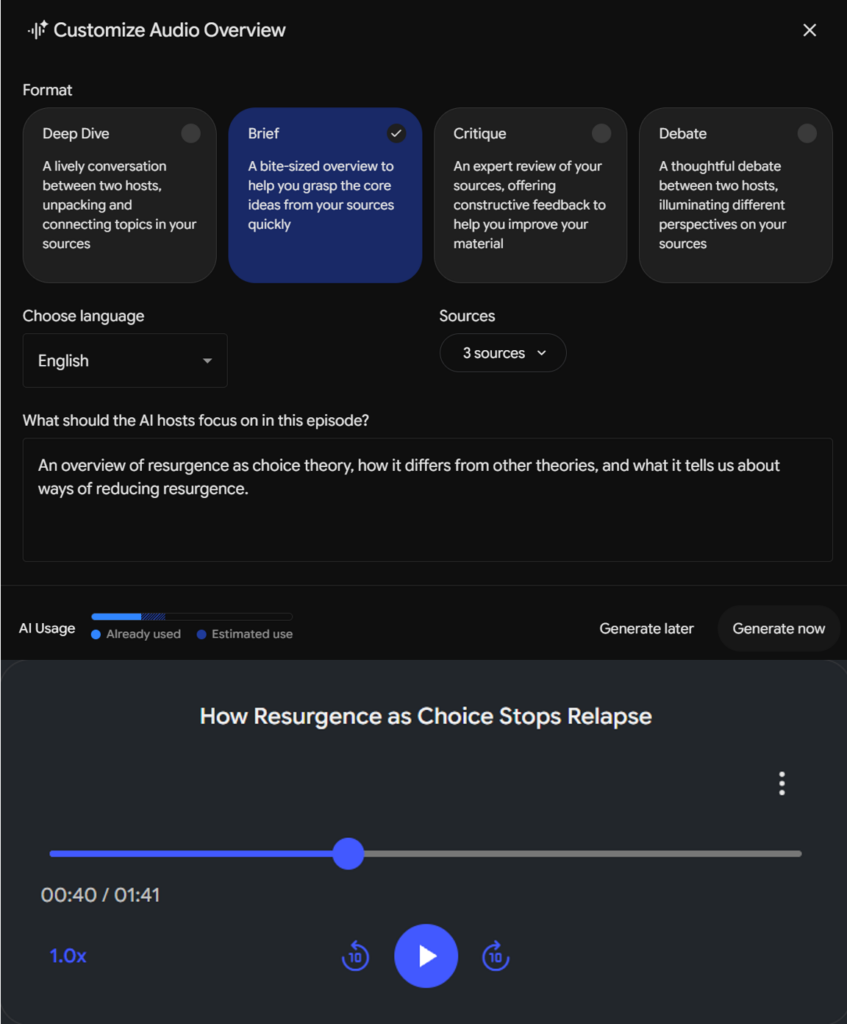
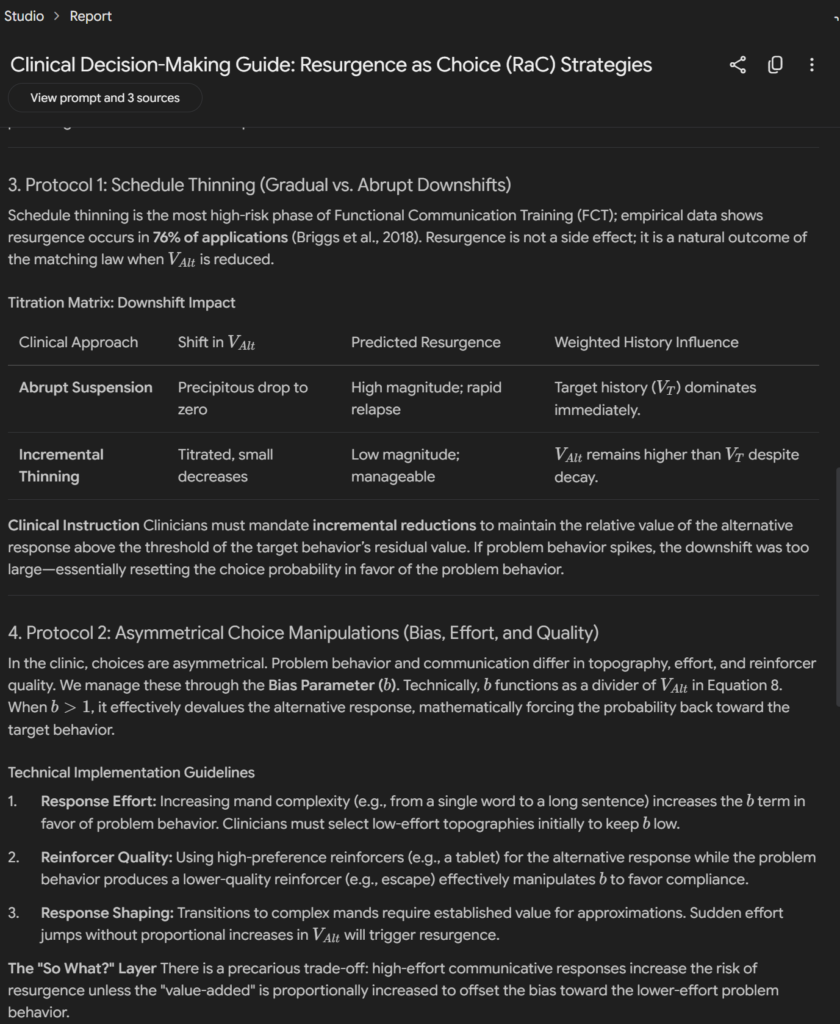
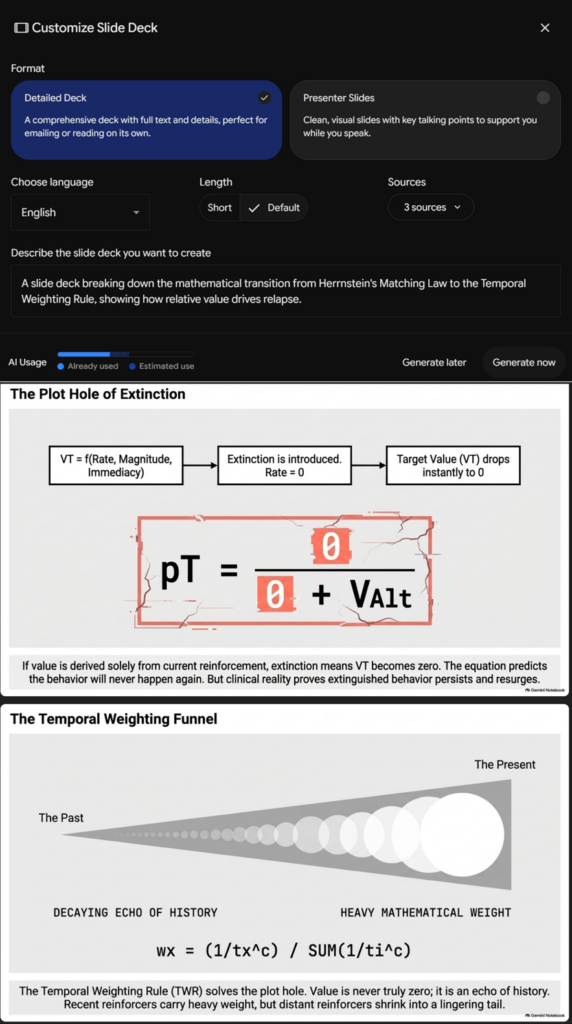
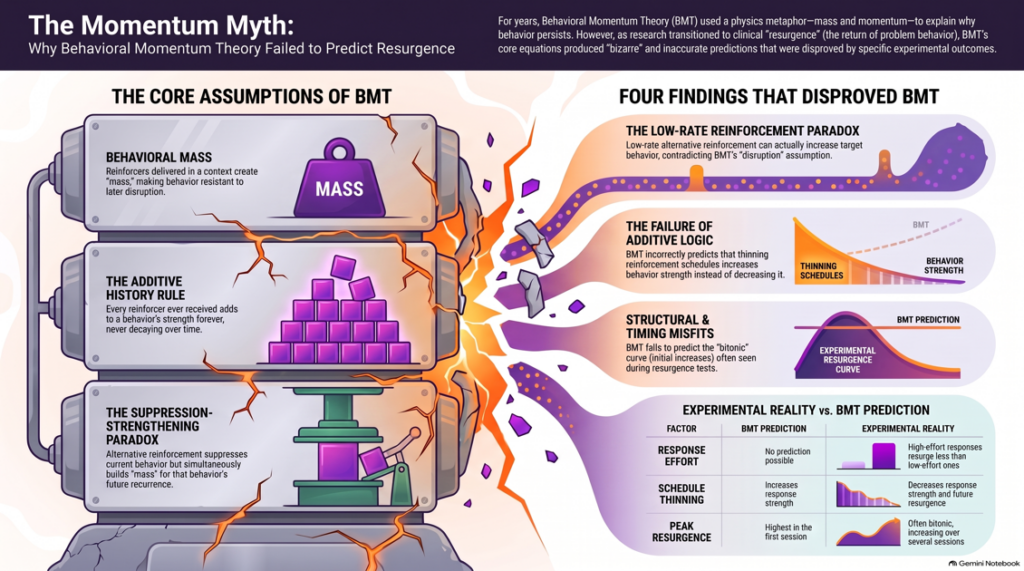
On top of this, the user could provide follow-up prompts like, “What is the arousal parameter and how can it be addressed to reduce resurgence?” or “What would RaC say about arranging only brief reinforcement with the functional reinforcer (e.g., 30-s escape) for target behavior but longer and better reinforcement (e.g., 5-min escape with the iPad) for alternative behavior?” to generate more specific information.
Google Scholar Labs
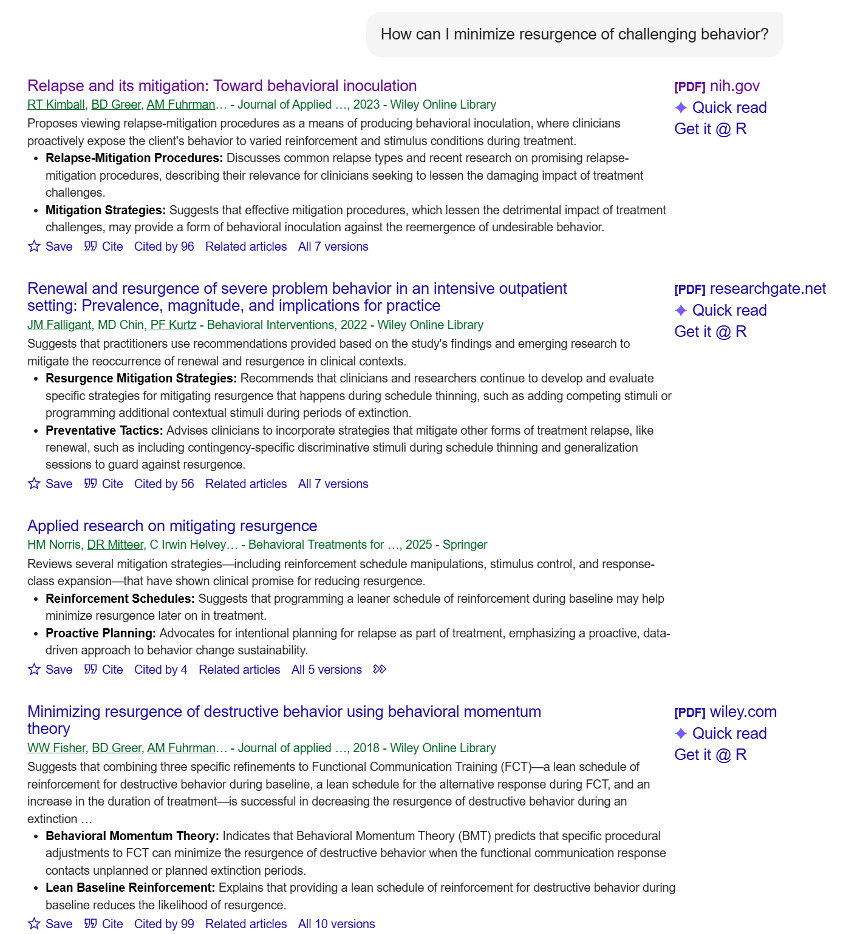
Another Google product, Google Scholar Labs makes finding, accessing, and consuming literature more efficient without the “fluff” of podcasts, visuals, quizzes, etc. Here’s an example of asking Google Scholar Labs to find literature on how to minimize resurgence of challenging behavior:
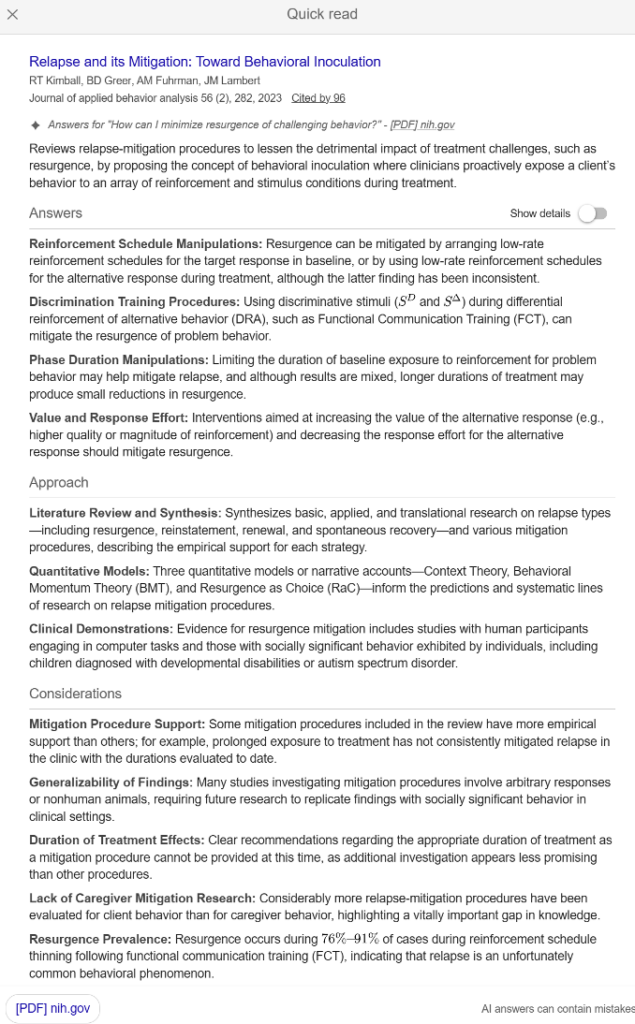
A newly launched “Quick Read” button summarizes key points without the user needing to access or download the paper:
Other AI Developments
As most readers are aware, AI is being infused into almost everything and many companies are eager to find their niche in that space. There are dozens of AI options that might suit a behavior analyst’s searching and consumption of research. Here are a few other relevant options:
- Consensus – searches and analyzes the literature, with the ability to generate a “Consensus Meter” visual to help practitioners understand level of support for independent variables/interventions
- Elicit – searches and summarizes research literature; can assist with data extraction
- Paper2Agent – recently published in Nature; offers ways of turning a scholarly paper into a live agent capable of answering questions about the research
A Word of Caution
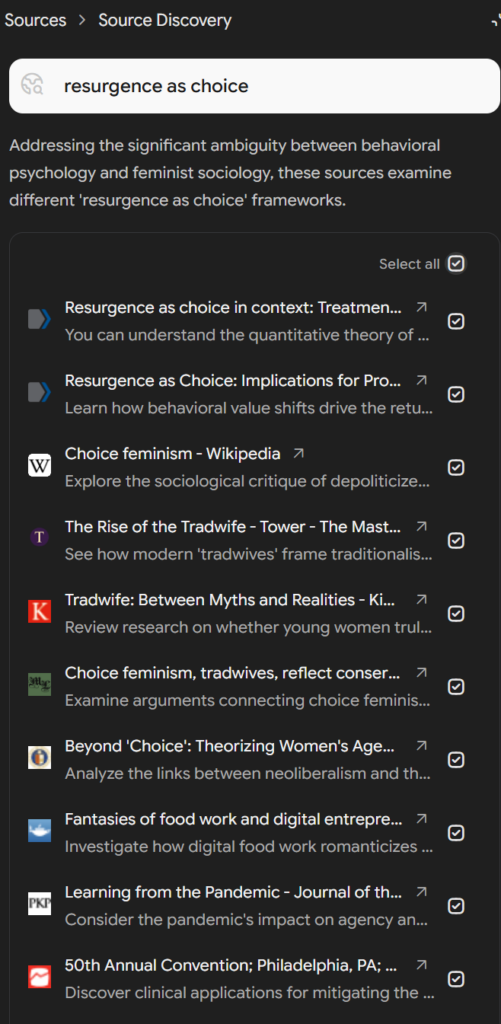
As with many technologies in our field, AI should be viewed as a tool and not a replacement for actively engaging with peer-reviewed literature. As with any tool, expertise is needed to determine its proper use. Despite the abundance of possibilities that AI affords, every outcome produced by AI needs to be taken with a grain of salt. As of now, it’s only as good as the initial prompts and follow-ups that generate the content, as well as the background technology. Even with the right prompts, it can stray from accuracy. For example, when searching for sources related to RaC above, Gemini Notebook offered some highly unrelated papers that could affect the summary and analysis of RaC:
As of now, the summaries, analyses, and supplemental material (e.g., podcasts, images) are pretty good but not always 100% accurate. AI has been known to falsify information or even generate nonexistent citations. A colleague humorously sent one of us a screenshot of an AI summary of a paper that we supposedly wrote in support of an assessment practice for which we have been overwhelmingly critical. Although this screenshot was sent in jest because that colleague knew this was not a real paper and opposite of our typical opinion, it raised alarms about the risks of misinformation when relying on AI.
Put simply, anyone using AI should still open and review the primary sources (i.e., the peer-reviewed articles) to ensure the AI summaries and interpretations are accurate.
Conclusion
In the past five years since our publication, AI technology has advanced rapidly, offering exciting new avenues for behavior analysts to remain in touch with contemporary peer-reviewed literature. This technology can help search, access, and analyze the papers. AI can generate learning tools for behavior analysts, answer clarifying questions they have about procedures or phenomena, and even extract and re-analyze data.
With that said, AI use is not a substitute for actively reading the literature. Right now, it does not provide the same experience as directly interacting with the source material as the authors and editors intended. Certainly, AI should not be solely used to determine procedures and methods that will be eventually used with clients or research participants. There are also many ethical, societal, economical, and environmental considerations associated with AI technology that informed readers might need to balance with productive incorporation of AI in practice. With these limitations in mind, behavior analysts might supplement their professional activities with AI to better contact the literature just as they might supplement formal continuing education with non-peer-reviewed material (e.g., podcasts, social media).
The Practice Board extends its sincere thanks to Dr. Mitteer and Dr. Briggs for contributing their time and expertise to discuss such a prevalent topic in our field.
Dan Mitteer, Ph.D., BCBA-D is a faculty member at Children’s Specialized Hospital – Rutgers University Center for Autism Research, Education, and Services (CSH-RUCARES). He is a Clinical Associate Professor at the Rutgers University Robert Wood Johnson Medical School and BCBA-D Clinical Manager at Children’s Specialized Hospital. Dan completed his M.A., Ph.D., and postdoctoral fellowship at the University of Nebraska Medical Center’s Munroe-Meyer Institute working with Drs. Brian Greer and Wayne Fisher. Dan has published over 50 peer-reviewed articles and invited book chapters and serves on the editorial board for the Journal of Applied Behavior Analysis, Journal of the Experimental Analysis of Behavior, Behavior Analysis in Practice, and Behavior Analysis: Research and Practice. His primary aims are to improve assessment and treatment procedures for severe challenging behavior, bolster caregiver adherence to behavioral recommendations, and mitigate relapse/readmissions. He co-authored Briggs and Mitteer (2021), which discussed strategies for keeping in touch with the scholarly literature; this blog post serves as an extension of this paper in the age of accessible and advanced AI.
Adam Briggs, PhD, BCBA-D, is an Associate Professor of Psychology at Eastern Michigan University. He earned his PhD at the University of Kansas under the mentorship of Dr. Claudia Dozier and subsequently completed a two-year postdoctoral fellowship at the University of Nebraska Medical Center’s Munroe-Meyer Institute under the mentorship of Dr. Wayne Fisher. Adam’s research focuses on (a) improving the safety, efficiency, and validity of functional assessment methods; (b) identifying variables that mitigate relapse of challenging behavior and promote the maintenance and generalization of treatment effects; and (c) developing effective and efficient strategies for training caregivers and professionals to implement behavioral interventions with high procedural fidelity. Adam has authored more than 30 peer-reviewed articles and book chapters. He currently serves as an Associate Editor for the Journal of Applied Behavior Analysis (JABA) and previously served as an Associate Editor for Behavior Analysis in Practice (BAP) and Education and Treatment of Children. He has also served on the editorial boards of JABA and BAP. In addition to his research and editorial work, Adam serves as Chair of the Severe Behavior Consortium of Michigan, Chair of the Nominations and Elections Committee for APA Division 25, and Co-Coordinator of ABAI’s Developmental Disabilities Program Area. Adam co-authored Carr and Briggs (2010) and Briggs and Mitteer (2021), which described practical strategies for keeping up with the ever-expanding scholarly literature. He is excited to build on that work by exploring how emerging AI tools can be incorporated into this framework to help practitioners more efficiently identify, evaluate, organize, and engage with the scientific literature.
References
Briggs, A. M., & Mitteer, D. R. (2022). Updated strategies for making regular contact with the scholarly literature. Behavior Analysis in Practice, 15(2), 541–552. https://doi.org/10.1007/s40617-021-00590-8
Carr, J. E., & Briggs, A. M. (2010). Strategies for making regular contact with the scholarly literature. Behavior Analysis in Practice, 3(2), 13–18. https://doi.org/10.1007/BF03391760
Google. (2026). What is artificial intelligence? https://cloud.google.com/learn/what-is-artificial-intelligence
Greer, B. D., & Shahan, T. A. (2019). Resurgence as choice: Implications for promoting durable behavior change. Journal of Applied Behavior Analysis, 52(3), 816–846. https://doi.org/10.1002/jaba.573
Microsoft. (2026). What is artificial intelligence? https://azure.microsoft.com/en-us/resources/cloud-computing-dictionary/what-is-artificial-intelligence
Shahan, T. A., Browning, K. O., & Nall, R. W. (2020). Resurgence as choice in context: Treatment duration and on/off alternative reinforcement. Journal of the Experimental Analysis of Behavior, 113(1), 57–76. https://doi.org/10.1002/jeab.563
Shahan, T. A., & Craig, A. R. (2017). Resurgence as choice. Behavioural processes, 141, 100-127. https://doi.org/10.1016/j.beproc.2016.10.006