
Guest Post Written by Meral Koldas

Meral Koldas, Ph.D., BCBA-D, LBA, is a tenure-track Assistant Professor at the University of Missouri–St. Louis. She earned her Ph.D. in Applied Behavior Analysis from Queen’s University Belfast and completed her postdoctoral fellowship at the University of Nebraska Medical Center. Her research interests include verbal behavior, language development, functional and social communication, naturalistic interventions, online training modalities, and the dissemination of evidence-based practices. She serves on the Practice Board of the Association for Behavior Analysis International (ABAI) and as a Board Member-at-Large of the World Behavior Analysis Day Alliance (WBADA). She is also an editorial board member of Behavior Analysis in Practice, The Analysis of Verbal Behavior, British Educational Research Journal, and European Journal of Special Needs Education, and a Guest Editor for the Verbal Behavior Special Issue of Tizard Learning Disability Review.
Imagine two children sitting next to each other making crafts. One has just finished coloring a dinosaur. The other is working on an apple. An adult leans toward the first child and says, “Tell your friend, ‘Look at my dinosaur.’”
“Look at my dinosaur,” the child repeats.
The peer looks over. The interaction has occurred. The child said exactly what we wanted them to say. But what happens when the adult stops prompting? What happens tomorrow when there is no dinosaur? When the child is making slime, talking to a different peer, or in a different classroom? Most importantly, what happens when the situation calls for something we never taught? These questions point to an important distinction in social communication intervention. Teaching a social response is not necessarily the same as establishing a social repertoire.
Knowing the Words Is Not Always Enough
Social communication is extraordinarily dynamic. Consider a seemingly simple statement such as, “Look at my train!” The variables controlling that response can change continuously—the person, activity, listener’s behavior, relevant features of the environment, and consequences of previous interactions may all differ from one social interaction to the next. Successful social communication therefore requires much more than producing a particular sentence correctly. The speaker must respond to relevant social and environmental stimuli, draw from previously established verbal repertoires, respond to the listener, and adjust as the interaction unfolds. This presents an interesting challenge for intervention.
We can teach a child to say, “Look at my train.”
We can teach “I like your picture.”
We can teach “What are you doing?”
But we cannot teach every sentence a person might need during every interaction they will encounter throughout their life. Nor should we try.
From Generalized Verbal Repertoires to Generative Social Communication
Behavior analysts already recognize this challenge in other areas of verbal behavior. A generalized tact repertoire allows a learner to respond to novel stimuli, while generalized mand and intraverbal repertoires support flexible responding across changing circumstances. The individual response may be novel, but it does not emerge from nowhere. It reflects an established learning history and generalized verbal repertoires.
Social communication presents the same challenge on a larger scale. Rather than teaching every possible social sentence, we want established verbal repertoires to combine flexibly under changing sources of stimulus control. This is what I mean by generative social behavior: socially appropriate responses that emerge even though that specific response has not been directly taught and reinforced in that particular form or situation. A learner’s tact, mand, intraverbal, echoic, and autoclitic repertoires may come under multiple control and combine or recombine as the social environment changes.
This flexibility may also give social communication characteristics of what Rosales-Ruiz and Baer (1997) described as a behavioral cusp—a behavior change that brings an individual into contact with new contingencies and opportunities for further learning. A social initiation may produce a response from a peer. That response may create an opportunity for another comment or question, extending the interaction and potentially providing access to new people, activities, relationships, information, and contingencies. The importance of teaching “Look at my train,” then, is not necessarily the sentence itself. It is what that behavior might make possible next.
But There Is a Problem with Adults’ Prompts
Several years ago, I became interested in teaching children with autism to use existing verbal responses more reciprocally. In one study, my colleagues and I (Koldas et al., 2024) taught children who already had established tact repertoires to respond to another speaker’s tact by labelling something different in the environment. For example, I might say:
“I see a tractor.”
Rather than simply echoing “tractor,” the goal was for the child to look at the environment and respond with something such as:
“I see an airplane.”
We systematically faded vocal model prompts until the instructor simply said, “I see a tractor,” and the child independently responded by tacting another stimulus. The children subsequently demonstrated the repertoire with novel materials. This was encouraging. We were not teaching a completely new tact repertoire. We were trying to change the conditions under which an existing repertoire was used—to move tacting beyond answering questions or labeling objects and toward reciprocal social communication.
But real conversations rarely consist of one exchange. Social interactions involve multiple responses occurring rapidly and under continuously changing conditions. As we moved toward teaching more complex interactions—sharing, complimenting, and commenting—we encountered a familiar challenge: prompt dependency. The learners often looked to the adult for the next prompt rather than responding independently to their peer or the social situation. Sometimes, they even echoed the prompt itself. If the adult said, “Say, ‘Look at my picture,’” a learner might repeat the whole prompt, “Say, ‘Look at my picture,’” rather than simply saying, “Look at my picture.”
We needed a way to provide enough support to help children enter and continue a social interaction without making the adult—and the adult’s verbal prompt—the stimulus they depended on. In behavioral terms, we needed to provide enough instructional support to establish these social repertoires while systematically transferring stimulus control from adult-delivered prompts to the naturally occurring social and environmental stimuli that should ultimately evoke them.
What If the Prompt Came from a Little Device?
One possible answer is audio scripts.
A script is a written or auditory word, phrase, or sentence that provides a prompt for initiating or maintaining an interaction (McClannahan & Krantz, 1993). Script-fading procedures systematically remove that support so that control of verbal responding can transfer from the script to naturally occurring discriminative stimuli (Krantz & McClannahan, 1993). The second part of that definition is particularly important. The goal of script fading is not simply to make a prompt shorter. The goal is to make the prompt no longer needed.
Audio scripts are especially interesting because they can provide a vocal model without requiring an adult to deliver that model directly. They can also be useful for learners who are not fluent readers and can capitalize on an existing echoic repertoire.
In a recent work (Koldas et al., in preparation), we used a small audio-script device called Talkido to teach peer-directed social communication to six children with autism between 5 and 9 years of age during group craft activities. We targeted three types of social responses: showing and sharing, complimenting, and descriptive commenting. Recorded phrases were associated with tags placed on the craft materials. When a child activated a tag, the device played an audio script. For example, a child might hear:
“Look at my dinosaur.”
“I like your strawberry.”
or:
“You colored it red.”
The child could echo the model and direct the comment toward a peer. But leaving the scripts there would defeat much of the purpose. So we began to make them disappear.
“Look at My Dinosaur” → “Look at My…” → “Look…” → No Audio
We systematically faded the audio.
“Look at my dinosaur.”
Then:
“Look at my…”
Then:
“Look…”
And eventually:
nothing.
At the final fading level, the device remained present, but no audio script played. That silence was important. The instructional support was disappearing, and the relevant question was whether the social behavior would remain.
When the Script Is Gone, What Takes Its Place?
This is where stimulus control becomes central to the story. A successful script-fading procedure should not simply produce a child who waits for a shorter prompt. As the script disappears, naturally occurring aspects of the social environment need to acquire control over responding.
The completed craft is there.
The peer is there.
The peer’s craft is there.
The activity is unfolding.
The other person has just said or done something.
Those are the stimuli that ultimately need to matter.
Across the study, the children engaged the targeted peer-directed responses as the audio scripts were systematically faded. But what interested me most was what happened beyond reproducing those scripts. The children demonstrated the social responses with materials that had not been directly used during teaching. They also demonstrated the skills during a very different activity—making slime—in a different room and with a different instructor. And sometimes they said things we had never programmed into Talkido. Those unscripted but contextually appropriate responses were especially interesting to me because they raise a broader question:
Does the Learner Begin Engaging in Responses we Never Directly Taught?
Generalization is essential, but flexible social communication may require something beyond reproducing a taught response across people, materials, and settings. A learner who uses the same sentence with ten different people in ten different settings may demonstrate generalization, but not necessarily a flexible social repertoire.
Imagine teaching “Look at my dinosaur” and later hearing “Check this out!” Or teaching “I think that’s cute” and later hearing a different, contextually appropriate compliment, such as “That is neat!” Those responses are not necessarily errors simply because their topographies differ from the training exemplars. Instead, they may indicate that the learner is drawing on a broader verbal repertoire under changing sources of stimulus control. This distinction matters because natural conversation requires variability: the relevant stimuli change, the listener’s behavior changes, and an effective response in one interaction may not be effective in the next. The goal, then, is not simply for a taught response to occur in more places or with more people. It is for established verbal repertoires to support flexible responding as the social environment changes.
We Cannot Teach Every Sentence
This changes how I think about social communication intervention. The goal should not be to build an ever-growing library of sentences for every possible social situation. Instead, our instructional task is to establish verbal repertoires and learning histories that allow learners to respond flexibly when novel situations arise. Scripts, prompts, and technology can help establish those repertoires. But their value ultimately depends on whether stimulus control transfers to the social and environmental variables that will still be present when intervention is not. That is why fading matters.
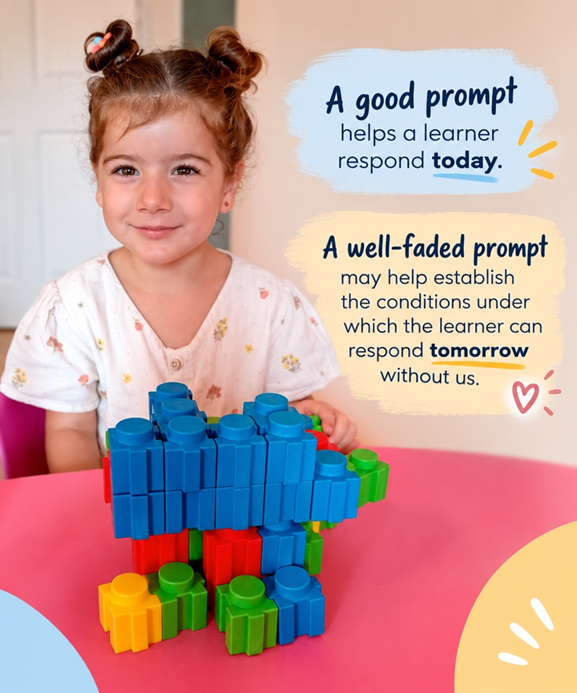
There is also an important distinction between teaching social communication and teaching someone to appear socially typical. The objective should not be to prescribe how an autistic person must talk, how frequently they must interact, or whether they should want every social interaction available to them. People differ in how, when, and with whom they want to communicate. The more meaningful question is whether an individual has access to verbal repertoires that allow them to communicate, participate, share interests, seek information, advocate for themselves, develop relationships, and access social communities in ways that matter to them.
A child does not need to share every craft they make. They do not need to compliment everything another person does in some contexts. Generative social skills—including choosing not to interact—are part of natural social behavior. What we can try to provide is greater behavioral flexibility: more ways to initiate when initiation matters, more ways to respond when someone reaches out, and more ways to continue an interaction when doing so produces meaningful consequences.
That is why I keep returning to the same idea:
We cannot teach every sentence. Fortunately, we do not need to.
We Can Teach Repertoires
We can arrange opportunities for those repertoires to contact natural social consequences. We can systematically fade the instructional supports we introduce. And we can pay closer attention not only to whether taught responses generalize, but also to whether new, appropriate responses begin to emerge. At the beginning of our story, an adult says:
“Tell your friend, ‘Look at my dinosaur.’”
Later, an audio script says:
“Look at my dinosaur.”
Then:
“Look at my…”
Then:
“Look…”
And eventually, there is no prompt.
What the learner says after that silence may tell us far more about the success of our intervention than how accurately they ever repeated the script. Perhaps the ultimate success of a script is not how well a learner learns it. It is what they can say when the script is gone.
References
Koldas, M., Connolly, S., de Oliveira, J. S. C., Trapp, W., & Shillingsburg, M. A. (2025). Teaching reciprocal tacting to children with autism. Behavioral Interventions, 40(1), e2069. https://doi.org/10.1002/bin.2069
Koldas, M., Connolly, S., & Shillingsburg, M. A. (in preperation). Increasing social communication skills in children with autism using audio scripts in naturalistic group settings.
Krantz, P. J., & McClannahan, L. E. (1993). Teaching children with autism to initiate to peers: Effects of a script-fading procedure. Journal of Applied Behavior Analysis, 26(1), 121–132. https://doi.org/10.1901/jaba.1993.26-121
McClannahan, L. E., & Krantz, P. J. (2005). Teaching conversation to children with autism: Scripts and script fading. Woodbine House.
Rosales-Ruiz, J., & Baer, D. M. (1997). Behavioral cusps: A developmental and pragmatic concept for behavior analysis. Journal of Applied Behavior Analysis, 30(3), 533–544. https://doi.org/10.1901/jaba.1997.30-533
Talkido (2026, January 31) Talking playmate for kids. Retrieved October 11, 2026 from https://talkido.com/