
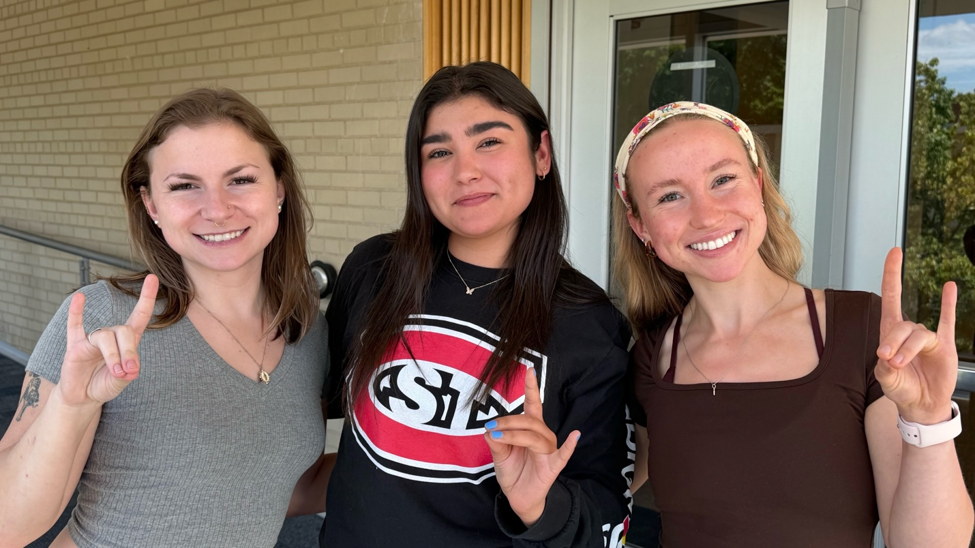
Written by: Lauren Duplessis (left), Aiyana Jollie-Trottier (middle), and Piper Steder (right), first year Applied Behavior Analysis graduate students in the MS Program at St. Cloud State University.
Edited by: Dr. Odessa Luna
As students in the Applied Behavior Analysis, ethical dilemmas are all around us. They can be as simple as navigating how to discuss a client’s program, collecting accurate data, or following a procedure. Even outside of our ABA roles, we encounter conversations in which ethics are involved, like that uncomfortable conversation you might have when someone has upset you.If you are an ABA student receiving supervision, there is a specific ethical standard that applies to you and your supervisor. It can be challenging to abide by an ethical standard when you don’t know it. The authors of this post are still learning and navigating ethics. Even experts in the field continue to learn! The ethical code adapts and changes as our field matures. With revisions to the ethical code, it may seem daunting to enter a conversation concerning an ethical situation, especially when one is unprepared. Preparing to enter a difficult situation requires a structured, problem-solving approach.
Conversations in which the stakes are high, emotions vary, and emotional responses are strong are called crucial conversations. These types of conversations are likely when discussing a difficult topic. Crucial conversations have significant impacts on relationships and require adequate planning to be successful (LeBlanc & Karsten, 2024).
Prior to starting supervision, ensure that you understand your supervision contract (Sellers et al., 2016). The Behavior Analyst Certification Board (BACB) provides a sample contract on their website, or you can choose to create your own. Make sure that it adheres to the same specifications the BACB outlines (BACB, 2026). After creating your contract, review it with your supervisor. We recommend addressing two crucial topics when going over your contract.
- The activities you are requesting: The BACB provides a current test content outline. Discussing which activities you want to participate in and opportunities that may arise further in supervision provides clarity for both you and your supervisor about your expectations and aspirations.
- The weekly fieldwork hours you expect: Supervision hours are determined based on your monthly fieldwork hours. The more you work; the more supervision hours are required. Having a clear expectation of how many hours you accumulate determines the number of hours your supervisor is committing to. Setting this expectation is crucial for both parties to adhere to their obligations in the contract.
Having this discussion before supervision begins can help set clear expectations and create a firm foundation for a positive and professional relationship. However, difficulties may still arise. We all make mistakes, and as ABA students, admitting them is important for learning and growth.
Consider the following scenario of Sage and Taylor and the steps necessary to have a productive conversation concerning an ethical violation with your fieldwork supervisor.
Scenario:
Sage, a master’s student in ABA has been working at an clinic to fulfill their fieldwork requirements. For the past ten months, Sage has been receiving direct supervision from Taylor, the clinic’s supervising Board Certified Behavior Analyst (BCBA). Taylor has been monitoring Sage’s progress, providing mentorship, observing their services, and meeting twice a month. In these ten months, Sage’s fieldwork hours have primarily consisted of delivering direct therapy and attending two, 2-hour meetings with Taylor.
About four months ago, Sage began requesting more unrestricted fieldwork hours from Taylor to gain experience in designing programs, conducting assessments, training staff, and analyzing data. Typically, unrestricted hours are activities that require a different skill set from the student and are often activities those who are BCBAs conduct primarily (e.g., data analysis, report writing, skill acquisition and behavior plan writing and adjusting). Each time Sage makes this request, Taylor assures them that they will get back to them and discuss it further during their next meeting. However, Sage is starting to feel anxious about meeting their 60% unrestricted requirements. Sage has recently expressed their frustration to their co-workers, even considering quitting.
Step 1: Define the Issue.
The first step Sage can take is to define the ethical violation is (LeBlanc & Karsten, 2024). In this scenario, Taylor agreed to supervise Sage under the BACB fieldwork requirements. The requirements state at least 60% of the total supervised fieldwork hours must be spent engaged in unrestricted activities (BACB, 2026). When Sage and Taylor signed their supervision agreement, Taylor agreed to provide fieldwork supervision in accordance with the requirements and the Ethics Code for Behavior Analysis. For Sage to reach the fieldwork requirements, at least 1,200 hours of unrestricted activities must be obtained out of the total 2,000 hours. The relevant ethical code is 4.01 – Compliance with Supervision Requirements (BACB, 2020, Section 4). BCBAs are ethically obligated to ensure that their supervision programs fully comply with the fieldwork requirements set by the BACB. By failing to provide Sage with the opportunity to develop as a practitioner with unrestricted tasks, Taylor fails to provide a compliant and comprehensive training experience.
Sage’s feelings of anxiety and thoughts of resigning are understandable. Especially if Sage has yet to acquire any unrestricted hours during this supervised fieldwork experience. However, before quitting, we recommend Sage formally request a meeting with Taylor to discuss this issue directly.
Step 2: Preparation for the Crucial Conversation
After defining the potential ethical violation, Sage now needs to prepare for the conversation they want to have with Taylor. Sage likely feels intimidated to have a crucial conversation with her supervising BCBA due to the power imbalance of the two roles. Sage’s thoughts of avoiding the aversive stimuli (disapproving looks, potential defensive verbal behavior) associated with this potential conversation by resigning make sense! The relationship with the supervising BCBA should be professional and grounded in clear expectations and mutual respect. We recommend defining potential solutions to the issue at hand. Walking into the meeting without preparing for the conversation might damage the professional relationships of those involved. Having an idea of the desired outcome and potential solutions to the issue at hand can reduce the supervising BCBA’s effort in generating solutions, and they may be more willing to agree to Sage’s proposed plan.
In this scenario, Sage should pay attention to their motives, getting unrestricted hours, and generate potential solutions (Grenny et al., 2021). Rather than simply telling Taylor they are not meeting their unrestricted requirements, Sage might also propose tasks that would count for unrestricted hours that are in their scope of competence, propose tasks that they are interested in gaining experience in, and provide a schedule of the number of hours they need in restricted vs. unrestricted hours a month.
Step 3: Opening the Conversation
Sometimes the hardest part of a conversation is starting it. In crucial conversations, it is best not to assume or blame the other party. When opening a conversation, we recommend trying to present the situation as objectively as possible and obtain information rather than making accusations.
This matters because accusations tend to cause the other party to become defensive, leading to an unsafe conversation. An unsafe conversation can be detected if silence, sarcasm, changing the topic, or emotional responses occur (LeBlanc & Karsten, 2024). Once the conversation becomes unsafe, it is no longer productive. If this happens, it is best to take a break or reschedule for when both parties are ready.
For Sage, this might mean opening with curiosity about Taylor’s workload or thoughts about the unrestricted hours rather than leading with the contractual shortfall. For example, Sage might say something like this: “Taylor, I’d love to get your perspective on how my unrestricted hours are progressing. How do you think we are doing?”
Step 4: Focus on the Facts and Ask Direct Questions
LeBlanc & Karsten (2024) mention that as humans, we are susceptible to filling in information, especially when our emotions are high. Reflect on the facts at hand, what the evidence of wrongdoing is, and if Sage had any role in this situation. In the scenario, Taylor might not be fully aware of Sage’s situation and how far behind they are in hours. It is important that Sage states the percentage of unrestricted hours they still need to acquire. This approach ensures that both parties understand the issue that is being addressed. Direct questions help the conversation stay productive and verifies Sage’s understanding. Sage can ask Taylor if they are still able to fulfill the supervision contract or if they need to discuss changes.
Step 5: Offering Solutions
After bringing the issue to light, proposing solutions that are in the interest of both parties can help direct the conversation toward actionable next steps. The primary goal of this step is to generate ideas and discuss them further. High emotions during this step can result in variability and impulsive decision-making. When generating potential solutions, it is crucial to remain calm and consult with others. Taylor and Sage could consult with BCBAs, colleagues, academics, or a neutral third party.
Step 6: Implement and Evaluate
Once a solution has been agreed upon, implementation can begin. As the solution is being implemented, we recommend that Sage document if behavioral changes occurred following its implementation. In the best-case scenario, the conversation led to an effective solution, and Sage is receiving a higher percentage of unrestricted hours. However, if no behavioral changes occur, the BACB provides a decision model for reporting an alleged violation. We want to stress the necessary steps in this model and the requirement of documentation. If Sage or Taylor never documented any interaction, any solution, or any behavioral change, the report cannot be filed.
Below you will find a sample example of Sage and Taylor having a crucial conversation about this potential ethical violation.

Example conversation:
Sage: Hey Taylor, I just wanted to touch base with you about some questions about the number of unrestricted hours I’ve acquired. How does that sound?
Taylor: Alright, I didn’t realize anything was wrong. You’ve been receiving positive feedback, haven’t you?
Sage: Yes, we have done quite a bit of supervision regarding observation and feedback of my implementation skills during direct sessions with clients. However, I do need 60% of my supervised fieldwork to consist of unrestricted hours, and the current percentage is far below that. We’ve discussed increasing these hours in our past meetings, but I’m still mainly doing direct therapy. I trust that you have good intentions as my supervisor, so I am wondering if there are reasons as to why I haven’t received tasks with more responsibility?
Taylor: Yes, Sage, I told you I’ll get to it. I’m very busy, and don’t have time to do it as soon as you ask. Do you know how many client programs and other behavior technicians I have to attend to everyday?
Sage: I do understand that you’re a busy person. Are you still in a position to meet the conditions of our contract? I would understand if you have too much on your plate right now, but I do need to know, so that I can plan my next steps.
Taylor: Yes, I’m still confident that I can meet the conditions. Things are just busier right now with all the new hires.
Sage: Maybe I can be helpful in that area, though. For example, I can assist in graphing and analyzing data, making needed changes to client programming, or train our new behavior techs. Would it be helpful to dedicate a portion of our regular meetings to plan out tasks that qualify as unrestricted hours?
Taylor: Okay, so maybe that could work. It would prioritize your unrestricted hours, rather than relying on me to come up with something each day. Let’s start with dedicating the last 20 minutes of our meetings to it. How does that sound to you?
Sage: I think 20 minutes spent planning would be a good start. I will send you an email soon to summarize what we’ve discussed today, so that our next meeting includes this change.
Navigating the complexities of ethics in ABA is an ongoing learning process for students and experts alike. The dynamic between Sage and Taylor depends on a proactive foundation. By understanding the supervision contract thoroughly before starting supervision, both supervisors and supervisees can align their expectations from the outset. When ethical discrepancies arise, using a structured, problem-solving approach to have a crucial conversation is highly effective and allows students to advocate for themselves safely and professionally. Admitting mistakes, embracing uncertainty, and working with others, ABA students can successfully maintain professionalism while continuing to learn and grow as future practitioners.
As students in an ABA graduate program ourselves, we understand the potential challenges when navigating the requirements of the BACB guidelines.
Have any of you had experiences like Sage’s during your BACB fieldwork supervision?
Let us know in the comments and share your own experiences with supervision, crucial conversations, and ethical dilemmas, we’d love to hear from you!
Note: Claude (Anthropic, 2026), a large language model, was used to assist with grammar editing and clarity revisions of this blog post.
Lauren holds a B.S. in Psychology from Louisiana State University (2025) and brings three years of experience working with individuals with disabilities. She is currently a student clinician at the Offerdahl Autism Discovery Center where she provides clinical services to individuals with disabilities. She aims to transition into a research career following graduate school.
Aiyana holds a B.A. in Psychology from Concordia College-Moorhead (2023). She is currently a student clinician at the Offerdahl Autism Discovery Center where she provides clinical services to children diagnosed with autism spectrum disorder.
Piper holds a B.S. in Psychology from University of Wisconsin-Green Bay (2025) and brings four years of experience working with individuals with disabilities. She is currently an Applied Behavior Analysis Intern at J and J Holmes Inc., where she provides direct care to adults with disabilities and staff trainings in therapeutic interventions.
References
Behavior Analyst Certification Board. (2026). Board Certified Behavior Analyst handbook. https://www.bacb.com/wp-content/uploads/2025/08/BCBAHandbook_260130-a.pdf
Behavior Analyst Certification Board. (2020). Ethics code for behavior analysts. https://bacb.com/wp-content/ethics-code-for-behavior-analysts/
Christina @ wocintechchat.com. (2019). Two women sitting on chair [Photograph]. Unsplash. https://unsplash.com/photos/two-women-sitting-on-chair-eF7HN40WbAQ
Grenny, J., Patterson, K., McMillan, R., Switzler, A., & Gregory, E. (2021.) Crucial conversations: Tools for talking when stakes are high, Third Edition. McGraw Hill.
LeBlanc, L. A., & Karsten, A. (2024). Ethics: Proactive and practical decision making for behavior analysts. Sloan Publishing
Sellers, T. P., Valentino, A. L., & LeBlanc, L. A. (2016). Recommended practices for individual supervision of aspiring behavior analysts. Behavior Analysis in Practice, 9(4), 274–286. https://doi.org/10.1007/s40617-016-0110-7