Ron Allen, Ph.D., BCBA-D and Jeff Kupfer, Ph.D., BCBA-D
Simmons University (Boston) and University of Colorado (Denver)
A science progresses with experimentation followed by application, which occasions more experimentation. We chronicle that endless cycle in our journals. Periodically, we summarize our data into inductions and publish such inductions in books. Like any other science, Behavior Analysis has many books. Some books exert little control over our behavior, others much more. However, some books are monumental and exert lasting control over our behavior. We thought we would pick what we consider the most monumental book in Behavior Analysis (well, at least in the Experimental Analysis of Behavior). But first, we cheated. We decided we would exclude books by Skinner-each book by Skinner was and is foundational. Other books can’t compete. For example, without The Behavior of Organisms (1938) there might not be Behavior Analysis.
Outside of Skinner’s books, there are other monumental works. Consider Gilbert and Millenson’s Reinforcement: Behavioral Analyses (1972), Honig and Staddon’s Handbook of Operant Behavior (1977), Johnston and Pennypacker’s Strategies and Tactics of Human Behavioral Research (1980), Sidman’s Tactics of Scientific Research (1960), and many, many more. All books we keep on the shelf.
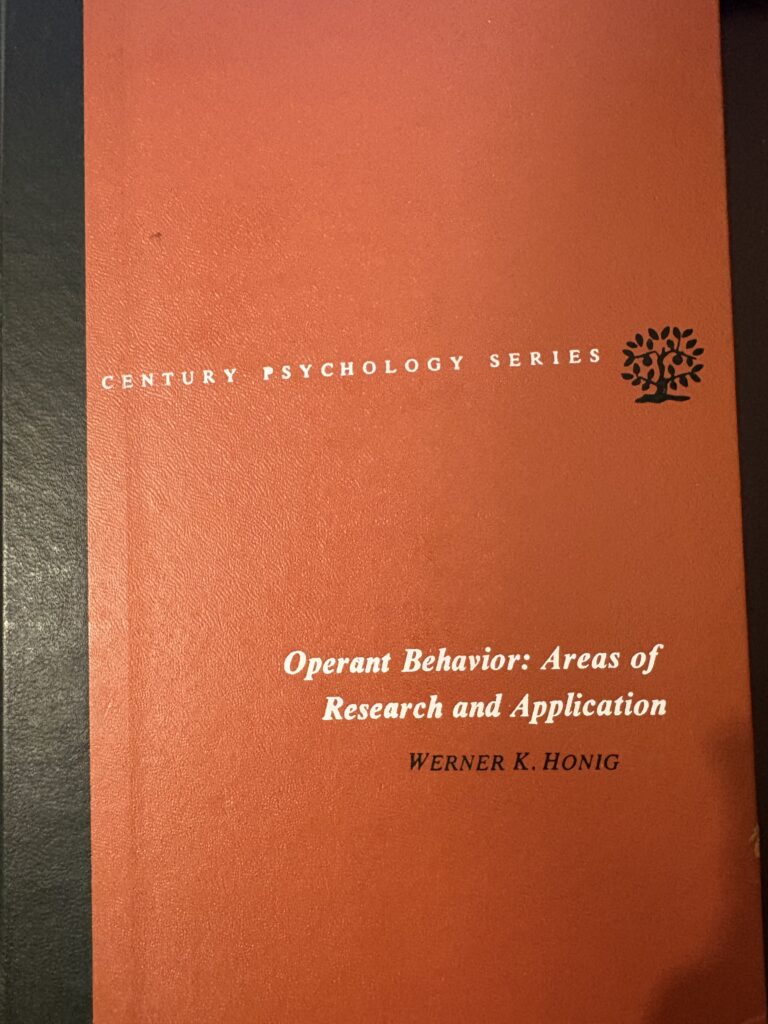
But, our vote for Best of the Books we keep was published in 1966, just eight years after the first volume of The Journal of the Experimental Analysis of Behavior. It is the book most read, most highlighted, most underlined, and most annotated in our collections. Operant Behavior: Areas of Research and Application edited by W.K. Honig was a broad review of the experimental analysis of behavior (EAB), with astonishing scope and deep in data. The book has 19 chapters written by many of the most prominent behavior scientists of the time. The list of authors and their chapter subjects include:
- B.F. Skinner-Operant Behavior
- R.J. Herrnstein-Superstition: A corollary of the principles of operant conditioning
- W.H. Morse-Intermittent Reinforcement
- G.B. Kish-Studies of Sensory Reinforcement
- R.T. Kelleher-Chaining and Conditioned Reinforcement
- A.C. Catania-Concurrent Operants
- H.S. Terrace-Stimulus Control
- D.S. Blough-The Study of Animal Sensory Processes by Operant Methods
- N.H. Azrin and W.C. Holz-Punishment
- M. Sidman-Avoidance Behavior
- H.S. Hoffman-The Analysis of Discriminated Avoidance
- J.J. Boren-The Study of Drugs with Operant Techniques
- P. Teitelbaum-The Use of Operant Methods in the Assessment and Control of Motivational States
- J.V. Brady-Operant Methodology and the Experimental Production of Altered Physiological States
- C.B. Ferster and C.E. Hammer, Jr.-Synthesizing the Components of Arithmetic Behavior
- F.H. Rohles-Operant Methods in Space Technology
- S.W. Bijou and D.M. Baer-Operant Methods in Child Behavior and Development
- W.C. Holz and N.H. Azrin-Conditioning Human Verbal Behavior
- J.D. Findley-Programmed Environments for the Experimental Analysis of Human Behavior
Honig’s book was publish only 28 years after The Behavior of Organisms. The diversity and breadth of the topics covered alone argue for its Best Book status. We intend an intermittent review of some of the individual chapters listed above. We hope to discuss where the data have taken us since 1966. We also hope to assess if our science has maintained its theoretical and methodological standards over the intervening 60 years. We also would like to invite any readers who wish to summarize a chapter to contact us at Ronald.allen@simmons.edu or Jeffrey,kupfer@ucdenver.edu.
In the meantime, take the book off your shelf.