
Guest post by Francesca degli Espinosa1
As I walk down the path in the park by our house, I see a cyclist in full gear, pedalling furiously and approaching fast from the far end. My dog, Darwin, and I are about fifty yards away from him, but on opposite sides of the path, which cuts between us.
I shout, “Wait!”
Darwin freezes. So does the cyclist, sort of. He slows, looks to his right at me, gives me the evil eye and shakes his head as he picks up speed and rides past. He does not turn to his left.
I am left trying to figure out what I did to deserve the cyclists’ disdain. I look at Darwin, still frozen in the wait position because I forgot to release him. To Darwin’s left there is a tall row of bushes. And then, as I take in the scene and the direction the cyclist had been coming from, it hits me!
The question I asked myself, and then answered, was: Why did the cyclist behave the way he did? Or, more colloquially: Why was he annoyed with me?
Look at the drawing and re-read the description.
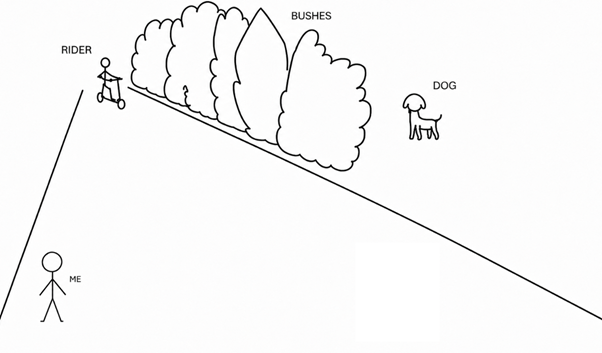
Can you answer it too?
You might say that the cyclist is annoyed because he thinks he is being told to slow down on a cycle path. He cannot see Darwin from where he is, so he does not know the instruction was not for him. He falsely believed I was shouting at him.
You can explain his behaviour (the hesitant slowing, the evil eye, the head shake) and his “feelings” on the basis of that false belief. But of course, the cyclist does not know his belief is false. For him it is simply true. It is false only from the perspective of the observers, you and me, because we have all the information, all the stimuli, available.
If you answered as I did, congratulations! You have just demonstrated what mainstream psychology calls Theory of Mind (ToM): the ability to generate a theory about someone else’s mind and use it to explain what they did, what they are doing, or what they will do.
Are you, a behaviour analyst, persuaded by that explanation? I would hope not.
The construct and its litmus test
Would it surprise you to learn that most of psychology has been perfectly satisfied with the notion that ToM exists; that it names a uniquely human ability to predict and infer how someone will behave or feel, based on an understanding that people hold mental states that differ from one’s own, and from the current state of the world?
The litmus test for ToM is the false-belief task. Wimmer and Perner devised the original unexpected-transfer task in the early 1980s, and it has since spawned endless variations. In its best-known version, popularised by Baron-Cohen and colleagues, Sally places a ball in a basket and leaves the room. While she is away, Anne moves the ball to a box. Sally returns, and the child is asked: “Where will Sally look for the ball?” A child who answers “in the basket” is said to understand that Sally’s belief about the ball’s location differs both from reality and from what the child knows, and that this belief will drive her behaviour.
There are now well over two hundred ToM tasks. They range from the simple, like Sally–Anne, to elaborate tasks that require tracking the mental states of several people at once, as in tasks involving deception, or in detective novels. Nearly all of them share the false-belief component, because for it to be a test of Theory of Mind, the participant must respond on the basis of what the character believes to be true, rather than what the participant knows to be true.
Outside the laboratory, this is something verbally competent humans do all the time. We are forever trying to explain and predict other people’s behaviour. Every time we buy a present for someone we love, we choose it according to their preferences, not ours. Every time we lie, we deliberately establish in the listener a narrative that departs from the facts. Every time we recount an event to someone who was not there, we add the details required for them to follow who was present, what happened, where and when.
Children’s stories work the same way. The Emperor’s New Clothes and Little Red Riding Hood both require the young listener to hold apart what is true from what a character takes to be true.
So, we cannot deny that we engage in the whole multitude of speaker–listener behaviours that sit under the ToM umbrella. Indeed, ToM is now such an established construct that it functions as a general marker of social cognition. But it would be a mistake for a science of behaviour to turn away from a repertoire this ubiquitous simply because the explanation offered for it is circular and mentalistic. The more interesting question is whether we can throw out the mentalistic bathwater and keep the Theory of Mind baby.
What are we actually doing?
Here is where a behaviour analyst might start.
What am I — and now you, the reader — doing when we say, “Because the cyclist doesn’t know the instruction is for the dog”? And what is the typically developing four-year-old doing when they say, “Sally will look in the basket, because that’s where she put the ball and she didn’t see Anne move it”?
To answer, we first have to cut the thread running through nearly every psychological account of human cognition: mental states cause behaviour, so to understand behaviour you must first understand the mental states that cause it. In the ToM tradition, the two basic mental states are beliefs and desires.
In behaviour analysis, the two main classes of controlling variable are motivating operations and discriminative stimuli. To understand someone’s behaviour is to identify what currently functions as a reinforcer for them, and what stimuli their sensory system is contacting that can exert discriminative control.
Then there is the word “understanding,” which is trickier. As Skinner would advise: Look at the conditions under which we use the term. In the ToM case, we use it when an observer reports the sources of stimulus control responsible for another person’s behaviour as different from those controlling their own. As in you and me saying, “He can’t see that the wait instruction was for the dog, but I can,” or the child saying, “Sally didn’t see the ball had been moved, but I did.”
That second part matters. For this to count as ToM, the speaker must differentiate the agent’s controlling variables from their own, within the same event. In behavioural terms, this is what we might call verbal conditional discrimination.
The cyclist’s causal mental states, behaviourally restated
So let us go back to the path, and ask the questions a behaviourist would ask.
What visual and auditory stimuli can the cyclist contact, and which can he not? This is what we are really doing when we ask what he believes. We tact the discriminative stimuli available to him that increase the propensity to behave in a certain way.
What does the cyclist see? Francesca, at the side of his path. What does he not see? The dog. Why not? Because of the bushes. What does he hear? “Wait.”
And now the second half, the discrepancy. What do you and I see? The dog and the cyclist. Who is Francesca saying “wait” to? The dog.
What we are doing, as the scene unfolds, is tacting the sources of control for every individual in it. So when we arrive at the ToM question — why is the cyclist annoyed? — we can report the discrepancy directly:
Because the only stimuli he contacts are the word “wait” and a person standing at the side of his path. Because the dog, hidden by the bushes, cannot participate in the conditional discrimination. The conditional discrimination that would render “wait” an instruction for the dog is therefore unavailable. What is left is a stranger interrupting the cyclist’s speed, his current reinforcer, in a context where it is not usually interrupted.
When you and I say, “He thought she was telling him to wait, because he couldn’t see the dog,” we are not reading the cyclist’s mind. We are tacting the sources of stimulus and motivational control for his behaviour, engaging in a multiply controlled (verbal and nonverbal) conditional discrimination with respect to those controlling our own, and reporting the discrepancy.
For me, standing there, those variables were plain: My “wait” was controlled by Darwin, by the approaching bicycle, and by the possibility that Darwin might cross the path. His slowing was controlled by my visible presence and by the word “wait,” in the absence of any visual contact with Darwin. You contact all of this only through my telling and drawing of it and that is enough. I can see Darwin; so can you. I can also see that he cannot see Darwin; so can you. I watch him slow, glare, shake his head and pedal hard away; you contact that through my narration.
My demonstration of ToM is controlled by my contact of the cyclist’s behaviour in relation to the stimuli he has and has not contacted, in relation to mine. My verbal response is under the control of that discrepancy, as is yours.
Theory of Mind as functional analysis
What psychology describes as understanding another person’s beliefs and desires in order to predict their behaviour can be restated behaviourally as tacting the sources of stimulus and motivational control for that person’s behaviour, and engaging in a verbal discrimination regarding the discrepancy between the sources controlling one’s own, and the other person’s behaviour.
Which is to say: it is what we do every time we conduct a functional analysis.
To demonstrate Theory of Mind, on this account, is to do a behaviour analysis: a rough and ready one, done on the fly, and only as accurate as the stimuli we happen to have access to. The four-year-old passing Sally–Anne is, in a way, an amateur behaviour analyst. So was I, standing on that path. And so were you, the reader.
That, I would argue, is the real power of our science: not that it lets us avoid talking about minds, but that it lets us say precisely what people are doing when they talk about them.
Of course, nobody actually speaks like this. Imagine a novel written as a chronology of stimulus control and motivating operations, stripped of every mentalistic adjective and emotional term. But then, try arranging the history that would teach someone to “mind-read.” You cannot manipulate a mental state. You can only arrange which events an agent contacts and which they do not, make sure the learner contacts both, and reinforce what the learner says about the difference. The language that makes for a terrible novel turns out to be the only one we can teach in.
- This post is based on: degli Espinosa, F. (2025). A verbal behavior analysis of Theory of Mind: Conceptual and applied implications. Perspectives on Behavior Science. https://doi.org/10.1007/s40614-025-00460-6 ↩︎