On a recent summer afternoon, while watching players prepare for Game 4 of the Woman’s Pro Baseball League Championship Series, I noticed a lot of tattoos on a lot of muscled arms.

Image credit: Rebecca Blackwell, Associated Press.
When I scanned the fans around me, in their shorts and tank tops, I saw fewer muscles but an equally bewildering array of body art. In fact, I could scarcely find an adult (other than me; see below) who wasn’t tattooed somewhere or other. And this got me to thinking.
Of Relics and Rubes
I am what people with body ink call “unmarked.” You might imagine that this traces to my borderline-pathological fear of needles, and I do not deny a healthy dose of experiential avoidance with respect to them. But nope, the critical thing is that, with rare exception, when I grew up in ‘60s and ‘70s West Virginia there were only two kinds of people with tattoos.
First there were Relics, grumpy old military veterans who’d been inked as a group-inclusion ritual during their service. This, of course, failed to impress a Vietnam-era kid whose generational identity was shaped by protest against armed conflict.

Then there were Rubes, backwoods bumpkins whose marks, forged at home of writing ink and a straight pin, incorporated crude artwork and the occasional misspelled word. I certainly had no desire to be confused with this group.
Yep, to Younger Me, body ink was the distillation of lameness, and back in the day it wasn’t only me who felt this way. In high school another kid and I applied to make extra cash as models for a college drawing class. I was accepted, but the other kid was turned away because he had the West Virginia state motto in Latin (Montani semper liberi — “Mountaineers are always free”) inked in small tasteful letters atop one impressive pectoral muscle. In dismissing him, the counterculture/beat-generation art professor, who you might expect would celebrate free self-expression, called it “vulgar.”
Ubiquitous and Overlooked
Well, as my afternoon at the ballpark demonstrates, times have changed. Tattoos are everywhere, leaping off the flesh of people from all walks of life. A significant portion of the population in many nations has at least one tattoo (below). Just about every celebrity of any merit displays one, and with my high school modeling experience as a point of comparison, try finding an advertisement these days in which the insanely attractive model doesn’t (yes, I think I just called myself “insanely attractive;” that was not intentional).

To someone for whom tattoo once meant taboo, this raises a fascinating question about behavior: How did body ink go from uncool and uncouth to unquestioned and unremarkable? And what exactly drives people to choose a tattoo, to bear the presumably unpleasant process of obtaining one, and to wear the result proudly?
Whenever I encounter behavior about which I’m curious, I begin by asking what my chosen science, behavior analysis, can tell me about it. As far as I can see, in this case the answer is “absolutely nothing.” A Web of Science search turned up no published work in any behavior analysis journal focusing on the behavioral functions of tattoos.

What we behavior analysts know, empirically speaking, about behaviors associated with tattoos would fill a lot less than this bookshelf.
Image credit: Buzzfeed.
Which, when you think about it, is an interesting mystery unto itself. To put things into concrete context, based on the chart presented above and the current U.S. population of 343 million, we should find at least one tattoo on close to 158,000,000 individuals in this one nation alone. Worldwide, the prevalence varies but tattooing occurs in most cultures and has been around for millennia. That encompasses a lot of colorful (literally!) human behavior, and it should not surprise, therefore, that people who are not behavior analysts have had a whole lot to say about tattoos. A July, 2026, a Web of Science search pointed me to 8,999 articles focusing on them in some way. But, again, none of those originated in behavior analysis.
And that sets the occasion, my fellow behavior analysts, for some soul searching. Tattoos are rarely a life-and-death matter, but they sit atop a massive iceberg of human behavior that gets little to no empirical attention in behavior analysis. Behavior analysts are very good at waiting for things to go off the rails for someone, behaviorally speaking, then swooping in and doing something helpful about that — think of challenging behaviors in people with autism, management failures in industry, and poor classroom management in education (see also Note 1).
Note 1
Some credit must be given for increasingly popular efforts at prevention, the attempt to stave off problems before they happen (e.g., see here and here and here). But even these are problem-focused and fail to address the vast array of mundane everyday behaviors that make up a pretty big chunk of the world’s supply of behavior.
It’s wonderful that we can help with such things. But whoever said that the subject matter of our discipline must always be problems? Somehow, we have reserved limited space in our discipline to pursue the understanding of very interesting things that everyday people do when they are not in crisis. Which is, of course, most of the behavior in the world of human beings.
Addiction to Intervention
How did we get here? Let’s start at the beginning. Our discipline’s first well-elaborated vision of a science of human behavior came from Skinner who, in works like Walden Two, Science and Human Behavior (duh), and Verbal Behavior, asked probing questions about not just human problems but the full constellation of behaviors that comprise the human experience. Our subsequent approach to human behavior in the everyday world, however, did not develop according to Skinner’s blueprint. As behavior analysts inched their way from bench to bedside in the 1950s through 1970s, their trajectory was heavily deflected by Baer, Wolf, and Risley’s (1968) seminal article proposing parameters for the emerging field of applied behavior analysis (ABA).
“Applied,” said Baer et al. (1968), means “examining behaviors which are socially important” (p. 91). This sounds fairly Skinnerian, and could potentially include anything from autism to tattoos, but Baer et al. clarified that “social importance” conveys the level of “interest which society shows in the problems being studied,” and furthermore, “If a behavior is socially important… behavior analysis will aim at its improvement” (p. 92, emphasis added). According to this dictum, it sure sounds as if ABA exists to address socially important problems. Later, when Wolf (1978) introduced social validity measurement as accountability for pursuing social importance, he echoed the Baer et al. problem/intervention perspective.
This early focus on fixing problems set the tone for just about everything to come in ABA. It had incredible influence in part because from 1968 to 1974 (see Note 2), Baer, Wolf, and Risley controlled the editorship of the field’s only applied journal (JABA). If you wanted your work published, you pretty much needed to fix problems.
Note 2
Actually the Kansas triumvirate’s hold on JABA started earlier, because Wolf was appointed editor in 1967 and began handling manuscript submissions well before the journal’s first issue was published in 1968. Their influence likely lasted well after 1974, when Risley’s terms ended, because the many of the editorial board appointed by Baer, Wolf, and Risley would have continued on for at least a year or two.
And to be fair, I believe Baer et al. (1968) had a very good reason for their interventionist stand. Early on, few people knew about ABA and even fewer had a positive impression of it. The shortest route to gaining a little respect was to solve problems that other people thought were unsolvable. Today’s vast economy of autism treatment stands as evidence that this was a wise strategy.
Still, you might imagine that once ABA gained a toehold in society there’d be room to expand it to something a bit closer to Skinner’s “all of human behavior” vision. The returns on that are uneven. While some folks have indeed explored things that are not problems (see Note 3), overall ABA remains a problem-focused enterprise.
Note 3
Credit Where It’s Due Department: When Heward et al. (2022) presented a list of “350 Domains of Socially Significant Behavior” to which behavior analysts have contributed, some of the relevant non-problem behaviors included joke telling, beginning reading instruction, sport skills (e.g., basketball, rugby, martial arts), and sexual partner selection. Still, check out the list for yourself; it is dominated by “problems,” and when you scratch the surface of the relevant literature, you find that non-problem topics often have been examined in only an isolated study or the research of an isolated research team. Even worse, a lot of relevant topics have been addressed only in “conceptual articles” that speculate about behavior functions but provide precisely zero empirical data. The mainstream of ABA is about problems.
And, in contemporary discussions (see here and here and here and here) you find basically no attention to expanding ABA’s definitions of social importance and social validity to include non-problematic behaviors.
So let me suggest a little test to put this all into perspective. If you have access to a large pool of more or less typically developing young adults, say college students, ask them to list the things about human behavior they wonder about. Now compare their answers to the subject indices of our applied journals (or ABA textbooks). I guarantee that most of your respondents are not consumed by questions about autism, and in fact they will be curious about all sorts of everyday behaviors, weighty and trivial, that scarcely qualify as problems (see Note 4).
Note 4
Sure, they will list problems, too, ranging from real (climate change, unequal distribution of wealth) to imagined (serial killer behind every tree!), but mostly real. They’re not idiots. The point is simply that think the problems that most interest them rarely line up with the things our discipline is working hardest to address. Here, for instance, is what a large sample of Americans answered when asked what they what they regarded as “the most important problem facing the world today.” How much behavior analytic work is exploring large-scale solutions to these problems?
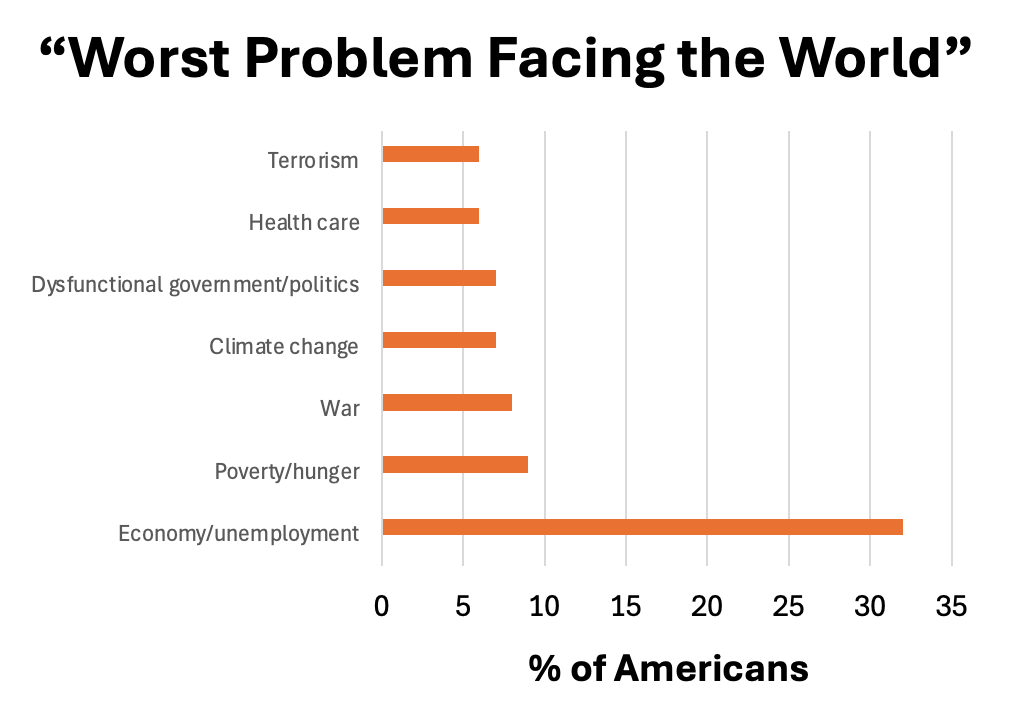
By this measure, ABA has had a bit of a tin ear when it comes to the interest society shows in the behavior we study.
Tattoo You
By now you’ve figured out that this post is not really about tattoos, but given my opening remarks I’d be remiss if I didn’t say something about the widely prevalent behaviors related to them. To be sure, among those 8,999 publications mentioned earlier there’s a lot that isn’t focused on behavior as we define it (e.g., dermatological safety research and interpretations of tattoos as the expression of subconscious psychodynamic processes, to cite just two examples). There’s also a host of mostly older studies, inspired by privileged middle-class researchers’ fears about scary street gangs and delinquent teens, that tried to shoehorn tattoos into the “problem” category by associating them with psychological deviance. However, you’ll also find quite a few explorations of why non-disordered people choose to get tattoos and why they like them, which speaks pretty transparently to the social importance dimension discussed earlier. In my reading, the findings point to at least two broad categories of effect about which behavior analysts seem well-positioned to provide insights (see Note 5).
- Automatic reinforcement. Many people say they have a tattoo because, in effect, they like looking at it. Tattoos may memorialize a loved one, mark an important life event like the birth of a child or recovery from a serious illness, or simply manifest art for art’s sake.
- Social facilitation. Many people say they have a tattoo because it connects them to other people. Some tattoos proclaim national, ethnic, religious, occupational, political, musical, or subcultural identities, which may invite the attention of people with shared identities. For other kinds of tattoos, people often say they enjoy it when others notice the mark and ask about it. And of course it has become popular for two or more people to get a tattoo as a shared experience.
Note 5
Perhaps illustrating some of both categories above, here’s what a news article said about baseball player Ashton Lansdale’s tattoos:
Ashton Lansdell is tattooed with reminders of her faith in herself. Her birthday, Feb. 22, makes the angel number 222 her “birthright,” she said. She also has a large leg tattoo that reads “dream until it’s your reality” that she got when she was 19. She saw a Pinterest post with the saying during her first year in junior college and it resonated with her. She always dreamed of being a baseball player and truly believed it would happen. The tattoo even has a crown on it, strengthening her belief that she’s right where she’s supposed to be, debuting for the new Women’s Pro Baseball League’s Los Angeles Queens.
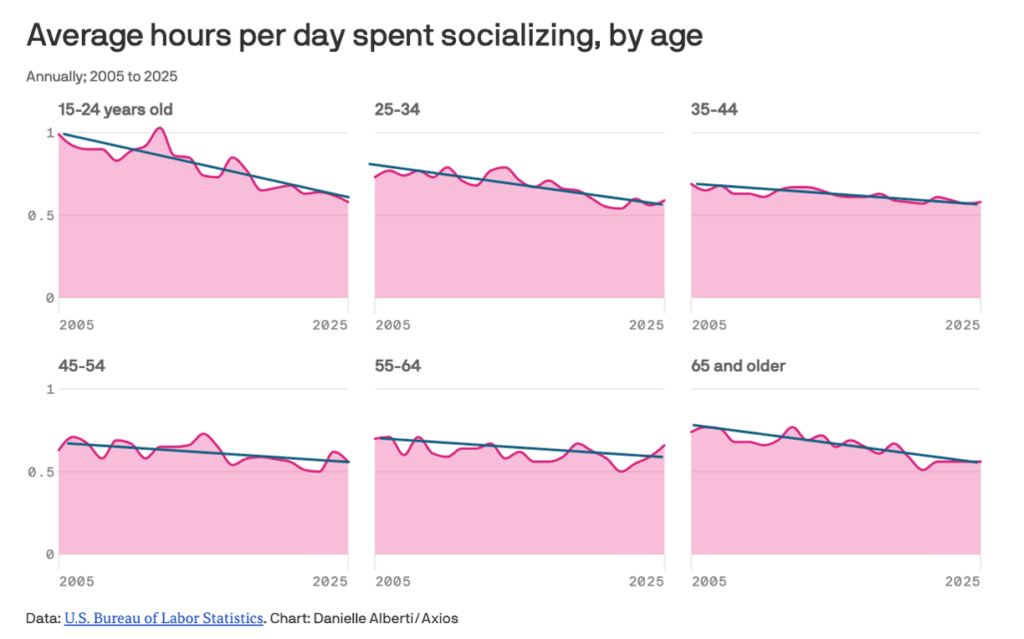
The social facilitation function could be of special importance in a screen-dominated age in which face to face human contact faces threat of extinction. For example, only about 1 in 4 Americans say they know all or most of their neighbors. Moreover, the typical American spends only about 40 minutes per day interacting with other people, and that has been on the decrease for a while now. I know this is just correlation, but as a marker for the growth of body inking, online searches for “tattoo parlor” have increased across roughly the same time span (for data, see Note 6).
Note 6
Traditional interpersonal interaction is on the wane.
Meanwhile, interest in how to get inked has been growing.

We might speculate that with old ways of connecting with people not working as well as they used to, and people still valuing interpersonal connections, alternative means of making social connections become more attractive. As one such alternative mechanism, tattoos fall smack in the middle of this “behavioral economics of social interactions.” I could be wrong about this — just spitballing — but I have no doubt that committed behavior analysts could reveal the behavioral functions of tattoos. And whatever those functions are, given the prevalence of tattoo-focused behavior the inquiry would reveal something important about the human experience. That would be useful, even if tattoos are not a “problem.”
The Social Validity of Behavior Analysis
Let’s summarize: Tattoos and behaviors related to them loom large in the everyday lives of a lot of people. If a self-proclaimed science of behavior provides no insight into something this big, well, how seriously can the typical observer be expected to take that science? This question should prompt critical thinking about what we mean, or ought to mean, when we speak of social validity. Historically, based on the Baer et al. (1968) perspective, we’ve meant something like “percentage of things we study that people say are important.” That’s not a terrible criterion, and in ABA we have social validity measures to hold us accountable for keeping that percentage high.
But there are other ways to parse the concept of social validity. Our science might look pretty different, for instance, if the social-validity criterion were “percentage of people who care passionately about each topic we study.” For instance, autism treatment is huge for us, but for the vast majority of humans in the everyday world, well, it’s hardly at the center of their interests and priorities.
Alternatively, the criterion might be, “percentage of the topics people think are important for which we offer meaningful insights.” That brings us back to things like tattoos, which we don’t study but obviously matter to many people.
By the way, there’s a transparent source of guidance as to what topics would meet those alternative criteria. People vote with their feet, so by default the things to which they direct lots of effort and attention are what they think is important. Logic and reason don’t necessarily apply, so what people treat as important needn’t be something that, in the abstract, seems “valuable” or earth-shaking. No, importance is objectively, behaviorally demonstrated in the simple math of the concurrent-operants behaviorsphere (see Note 7).
Note 7
In other words, how big does the behavior of interest loom in the big picture of everyday life? That can be defined in part by how prevalent a behavior is in the daily actions of an individual, as well as by how many individuals engage in it (below). Recalling that people vote with their feet, this is one way to quantify the “level of interest that people show” in a given behavior. Notice that this framework doesn’t preclude that the behavior of interest being a “problem;” nor does it demand that either.
| How many people do it? | Behavior is low frequency in those who do it | Behavior is high frequency in those who do it |
| Few | ||
| Many |
And a science that helps people understand their own high prevalence behaviors would be one that just about anyone, regardless of their education level or walk in life, could recognize as informative and useful.
Because people vote with their feet, there’s another implication: The number of people who seek out and use and say positive things about behavior analysis is a rock-solid measure of THE SOCIAL VALIDITY OF OUR DISCIPLINE. Not the social validity of some specific behavior analytic intervention (the Wolf model), but of our discipline overall… that is, the extent to which people think behavior analysis is socially important (in a good way; note how neurodiversity critics have called behavior analysis “important,” but as a bane, not a boon).
That, I suspect, could use some bolstering. I’m not aware of any hard data on this, but as I go through my daily routines (at work, the gym, the local watering hole, etc.) I virtually never meet anyone aside from parents of kids with autism who have a clue that behavior analysis exists, much less know what we actually do and how much it can help people to understand the particulars of their lives (see Note 8). None of them, it goes without saying, are actively singing our praises our pounding the pavement to find a qualified behavior analyst to help make sense of their lives..
Note 8
A lot of people have heard of the FBI’s Behavioral Analysis Unit, which as you might guess has nothing to do with us. It’s associated (in the public’s minds at least) primarily with profiling serial killers. When my daughter was about 11 and found out I am a behavior analyst, she could hardly contain herself with excitement. Once she learned that what I do had nothing to do with the FBI, she entirely lot interest.
If you want a sense of the space that behavior analysis occupies on the world stage (sans autism), check out a clip on the satirical site The Onion, depicting a news analysis show, called “Is Anyone Watching This?”
People who do have a rough idea of what behavior analysis is about may have a skewed impression of it. This hardly counts as systematic evidence, but check out my post on what happened in the Twitterverse when some colleagues and I published an article detailing some of the scores of great things ABA has accomplished over the years. Suffce it to say that when we do get noticed by peole out there, t’s not always for the best.
If ABA had its coming out party with the Baer et al. (1968) article, we’re now approaching 70 years of trying to grow it from blushing debutante to the doyenne of human behavioral sciences that Skinner told us it could be. Yet in all those years, despite the many ABA efforts they encompass, it seems society has scarcely noticed. To make a bigger splash we’ll need to have more to say about things more people care about, and that includes high prevalence behaviors (like getting a tattoo) that don’t count as a “problem.” These behaviors simply happen a lot and thereby telegraph something interesting about what it means to be human and what humans regard as “important.” By giving these phenomena short shrift we show that we still have a ways to go before behavior analysis matures into its Skinnerian aspirations and becomes a science of the whole human condition (see Note 9).
Note 9
We arrived at this point not just because of ABA addiction to intervention, but also, as a community of scientists, by focusing intently on a particular way of studying behavior: experimental designs demanding repeated measures over time and the replication of interventions. ABA has largely grown into the science that these designs allow it to be. Yet a lot of everyday behaviors are rather impervious to controlled manipulation and/or measurement in the way our designs demand (e.g., try designing an ABAB experiment on tattoo-related behaviors that could actually be put into action). Expanding the range of topics that we view as part of ABA would almost necessarily mean expanding the range of methods we employ.
Concept Sketches
Yet hold on — let’s not sell behavior analysts too short. I think there’s a disconnect between what our labs and clinics do and the level of curiosity that behavior analysts as people show in everyday behaviors. When I hobnob with other behavior analysts at the bar, for instance, there’s lots of spontaneous conversation about interesting, non-problematic everyday behaviors. You won’t find much evidence of this in our journals, but distribute a pint or two and bypass peer review and other forms of litmus-testing, and it’s clearly there. Case in point: My colleagues and I in the Behavior Analysis Blogs have shared a number of thoughts about the origins and functions of mundane-but-common everyday behaviors like these:
Now, blog posts aren’t science exactly, just science-adjacent chatter. In tattoo parlance, they’re a concept sketch of something that’s not yet ready to be permanently inked in. They’re much closer to a stimulating bar conversation than a research program. But bloggers, like regular human organisms, vote with their feet, so posts like these show that we behavior analysts do in fact have some pre-existing level of interest in widespread-but-mundane behaviors. Unleashing that more formally would be good for our science.
How to accomplish that I’m not sure, because precious few people get paid to explore behaviors like those listed above. But thinking back to the formative conception of ABA as problem- and intervention-focused, I suspect our journals are one bottleneck (see Note 10).
Note 10
Clinics could be mentioned here as well, since there are no funds, from insurance or elsewhere, to pay anyone to do anything other than address problems. That’s the medical model that drives most treatment in most disciplines in most countries.
I’ve submitted several empirical reports on mundane-but-common behaviors to behavior analysis journals, sometimes to reviewer reactions like, “This is really interesting, but it’s not a fit for this journal.” Researchers whose career advancement depends on publishing are likely to steer away from topics that get this kind of reception, especially when no natural alternative outlet is available. I think it would be incredibly fun to have a journal dedicated to interesting non-problem behaviors, as many of them as possible (see Note 11).
Note 11
But please let’s not let our fascinating new journal turn into a series of “conceptual articles.” These tell a plausible story of how some type of behavior maybe operates — emphasis on maybe. Unlike controlled empirical studies, conceptual articles cannot rule out alternative accounts that might better fit the facts of behavior. They cannot substitute for old fashioned scientific research.
Such a journal would signal to the behavior analysis community that analyses of mundane-but-common behaviors are valued (and, of course, intermittently rewarded). It would proclaim to everyone else that we have objective answers about many of the things they notice and wonder about in the world of behavior.
However we make it happen, collectively we should be focusing more on illuminating everyday behaviors that are not “problems.” And we absolutely can. Behavior analysts are masterful at devising creative empirical analyses, and the more ways that our science intersects with the everyday experience of regular people, the greater will be its visibility and level of social acceptance. So here’s a thought to tattoo on your brain: Our discipline’s gold standard is to provide data-driven answers. From the perspective of building a science of all behavior, like Skinner envisioned, non-problematic everyday behaviors deserve that commitment as much as problems do.
Have thoughts on a particular everyday behavior that should be of interest to us? Sharing about that in the Comments box will enrich your colleagues and your discipline. Or, develop your thoughts into a guest blog post! Contact Tom Critchfield (tscritc@ilstu.edu) to find out how.
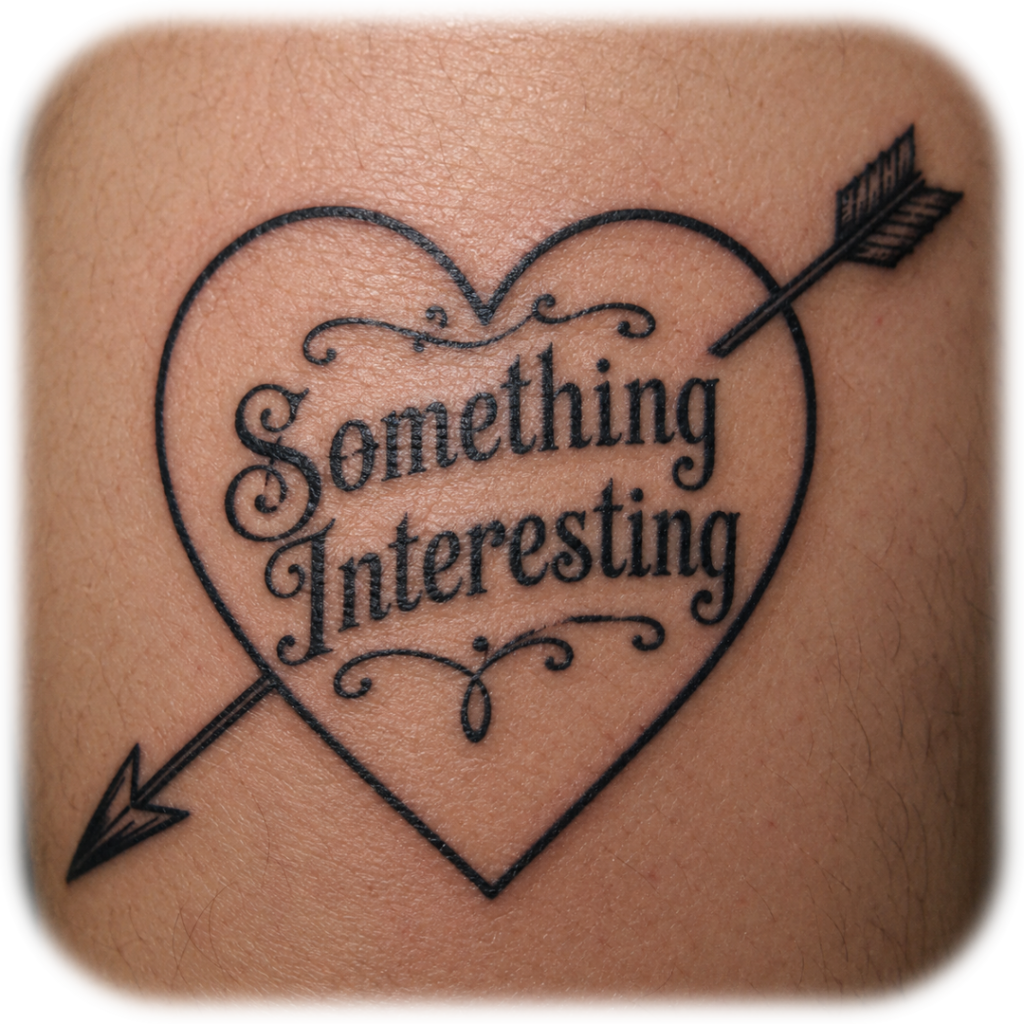
THEME ART