
Guest post by Hank Schlinger and Eb Blakely
As we go through our daily lives, we encounter countless problems. By problem we mean a situation where reinforcement is available, but the response necessary to produce the reinforcement is not forthcoming. Some problems are mathematical, for example, when we must calculate a tip at a restaurant. But other problems are more common and mundane, such as trying to locate misplaced glasses, keys, phones, etc. We also are faced with a problem when we can’t remember a name or a number. When one of us authors is playing his guitar and can’t remember the fingering of a chord, that’s a problem. When another author is doing aikido and momentarily forgets a move, that is a problem. If you are driving to a new location and didn’t write down the directions or don’t have navigation in your car, that is a problem. If you’re trying to put together something from Ikea, well that’s a problem!
In addition to facing countless problems in our daily lives, we also talk to ourselves constantly. Because we engage in an ongoing verbal monologue, we are most likely not aware of most of our self-talk even if it is sometimes overt. Mostly we talk to ourselves sub-audibly, however. Most people would call the constant internal monologue that we carry with us “thinking.” Sometimes, when we face a problem, our sub-audible self-talk becomes audible and if others hear us, they might ask, “What did you say?” We usually answer something like, “oh I was just thinking out loud.”

Much of our self-talk– whether over or covert—is evoked by stimuli or motivating operations (MOs) that we encounter as we move through our daily life. So, for example, if you need to read something in your office and your glasses are not available, you have a problem. Reinforcement in the form of being able to see the print clearly and read what you want to read is available, but the response necessary to produce that reinforcement—putting on your glasses—is not possible. In this instance, there is an MO, specifically an establishing operation (EO) —blurred vision—that we could colloquially call “glasses deprivation,” but no discriminative stimulus (SD)—the sight of the glasses—that, combined with the EO, can evoke picking them up and putting them on.
Problems like these evoke a range of responses, which are mostly verbal, although we frequently engage in imaginal responses simultaneously. In other words, we begin to talk to ourselves. For example, when you need to read something, you might say “Where did I leave my glasses? Let’s see, I know I had them when I was reading the newspaper in the kitchen. Maybe I left them in there.” That evokes going to the kitchen. But, of course, your verbal monologue doesn’t cease there. You probably talk to yourself all the way to the kitchen, and when you get there, the stimuli produced by yourself talk plus the landmarks in the room, evoke looking around, and if you see your glasses you probably say something like “oh there they are,” or “thank goodness I found them.” You then go back to where you were, but your internal monologue doesn’t stop there either. You either continue talking about the glasses or you begin talking to yourself about what you can now read or any one of countless other things.

Sometimes, when you are in bed at night and have trouble falling asleep, you are most likely talking to yourself about things that evoke sympathetic autonomic nervous system activity (e.g., increased heart rate and respiration), like what you have to do the next day or whether you have enough money that month to pay rent, etc., all of which make it difficult to fall asleep. To summarize, we encounter countless problems as we move through our daily lives and we also talked to ourselves constantly, even when we are asleep, especially during REM sleep when dreaming is most lucid.
In December 2024 we published an article in Journal of the Experimental Analysis of Behavior with the somewhat cumbersome title of “A Mediational Theory of Equivalence Relations and Transformation of Function,” in which we argued that all so-called emergent or derived relations resulting from matching-to-sample (MTS) procedures with humans and non-humans are mediated by responses that are not explicitly, but nonetheless directly, trained by the researchers. If true, then such relations did not emerge and were not derived if by those terms one means untrained or unreinforced. Such a conclusion has profound implications for theories of derived relations such as stimulus equivalence, relational frame theory, and even some variants of naming. We followed that article up with one in Perspectives on Behavior Science in early 2026 with the slightly somewhat more manageable title of “A Mediational Theory of Verbal Relations,” in which we argued that so-called emergent or derived relations resulting from verbal stimuli are also directly, though not necessarily, explicitly trained or taught. The mediational theory we described in both articles followed from the naming hypothesis proposed by Horne and Lowe in 1996 as well as a history in both psychology and learning and behavior in which mediational processes for a variety of experimental results with both human and nonhuman subjects have been proposed.
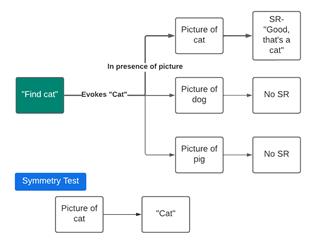
Two simple examples will suffice to illustrate the points of both articles. In the first example, a child is taught to select (i.e., point to) the picture of a cat out of an array of pictures of other animals or objects when a researcher or teacher says “cat.” As a result, the child can then say “cat” when the teacher points to the picture and ask the child what it is. In the parlance of stimulus equivalence, saying cat to the picture would be called symmetry, and such a relation would be said to be derived or to emerge from the initial training. However, as Horne and Lowe (and others) suggested, when the child hears the word “cat” from the teacher, she echoes “cat” which she does in the presence of the picture when she’s reinforced for selecting it. In other words, even though the teacher did not explicitly train a tact, a tact was in fact directly reinforced. Thus, saying “cat” to the picture did not emerge and was not derived. Rather, the incidental reinforcement of the echoic response, which we called the mediating response, was instrumental in creating the tact response, which we would call the mediated response. It’s like using an echoic prompting procedure, except that wasn’t what the researchers explicitly trained.
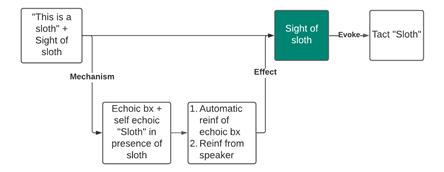
In the second example, suppose we show a picture of a sloth to an elementary school student and say to that student, “This is a sloth.” Later, if we show the picture to the student and ask her what it is called, she says “sloth.” But we did not explicitly teach her to say sloth; we only showed her the picture and said what it was. Some would say that her response “sloth” to the picture emerged or was derived. However, our argument, and that of Horne and Lowe (and others), is that when we showed her the picture, and called it a sloth the student echoed “sloth” (either audibly or sub-audibly) in the presence of the picture, which produced automatic reinforcement in the form of parity as Dave Palmer would call it (or if audible, maybe reinforcement from the teacher in the form of “right it is a sloth”). Thus, the form of the echoic response—“sloth”—was in fact directly reinforced in the presence of the picture. Once again, the echoic response was the mediating response, and the resulting tact was the mediated response. In both these examples, nothing emerged and nothing was derived if by those terms one means untrained or unreinforced.
A mediational theory is simply a theory of how we react to stimuli that we encounter in our daily lives and the resulting behavioral effects. A mediational theory is a parsimonious account of complex behavioral relations without appealing to any new terms, concepts, or principles, and solely based on the four-term contingency, that is, the operant unit of analysis.
Implications of a Mediational Theory for Clinical Practice
A mediational theory of complex behavioral relations has implications for a wide range of clinical procedures. Below, we briefly describe two such procedures.
First, sometimes differential observing responses (DORs) are utilized in clinical practice to facilitate discriminations. Suppose that a therapist is teaching listener responding tasks to a learner involving selecting a colored card (i.e., red, green, blue) on the table upon request. When the therapist says, “Show me red,” the participant will be taught to echo the instruction, such that she first echoes “Show me red” or just “red,” and is then reinforced for selecting the red card. The participant will similarly be taught to echo other instructions involving green or blue cards. In this example, the echoic response is the DOR, and research has shown that teaching learners to emit such responses facilitates acquisition of the discrimination, in the present case, selecting the correct color card.

Interestingly, DORs are a form of mediating behavior, as they are essentially reactions to stimuli that then result in the conditioning of other relations. DORs are a form of “listening,” as they ensure that the participant has contacted relevant stimuli by requiring them to make a response.[1] Moreover, if the DOR (e.g., “red”) is then echoed while scanning the array of colored cards, a joint control event could occur. That is, when seeing the red card, the learner says “red” for two reasons: as an echoic and a tact. When the learner “hears” herself say “red” to the auditory and visual stimuli, that in addition to seeing the red card, is discriminative for the selection response. In addition, given that the learner echoes “red” in the presence of the red card and a reinforcer is delivered for a correct selection response, a tact relation is most likely also conditioned.
A second example involving mediating behavior that has been researched and used in clinical practice is instructive feedback (IF). Suppose that a teacher is conducting sessions where students are learning the flowers for neighboring states. On a particular day, students are learning the state flower of Ohio. The teacher asks “What is the state flower of Ohio,” and then prompts the correct response “Scarlett Carnation.” She provides praise for correct responses and fades out the prompt. Occasionally, after the praise, she provides this IF: “The Scarlett Carnation honors President McKinley, who was from Ohio.” There is no specific response requirement to the statement, and if a student does react to it, there is no programmed consequence from the teacher. After several exposures to this task, later in the day the teacher asks a student “Hey, who does the Scarlett Carnation honor?” If a student can respond correctly with “President McKinley,” a mediational theory provides an account of how this happened in the absence of explicit teaching. When the teacher provides the IF, the student echoes the statement, such as “Scarlett Carnation honors President McKinley.” Given that echoic behavior provides automatic reinforcement (see above), the intraverbal relation between “Scarlett Carnation honors” and “President McKinley” is learned through what Skinner called contiguous usage.

DOR and IR are but two examples of the important role of mediating behavior in responding effectively, as in DOR, and in the development of new relations, as in both DOR and IF. Some might say that we get these new relations “for free.” Or in stimulus equivalence, some might say that we get symmetrical and transitive relations “for free.” If “for free” means that the relations are untrained, we disagree. They are still trained, just not explicitly. Moreover, concluding that the relations occur “for free” obscures the underlying process that involves direct conditioning.
A mediational theory has even broader implications for ABA practice. It suggests that it is unnecessary in most instances to provide multiple exemplar training, which sometimes can involve dozens if not hundreds of trials. Instead, a mediational theory suggests that practitioners can target directly the mediating responses necessary for the conditioning of the desired relations. In other words, as a practitioner you would be teaching problem-solving responses so that you would not have to rely on chance, luck, or accidental conditioning resulting from a great many multiple exemplar trials. In addition to implications for clinical practice, a mediational account has theoretical implications. For one, a mediational theory predicts that any verbal system, whether biological or computational, in which differential consequences are contingent on the terminal element of a sequential process should, under sufficient training, develop mediating behaviors that increase the probability of reinforced outcomes. To wit, a mediational theory has fascinating implications for what are called reasoning large-language models (LLMs) of artificial intelligence (AI). Conversely, research on current reasoning LLMs provide empirical support for a mediational theory. We will address these implications in a follow-up blog post.
[1] This is similar to the use of observing responses when pigeons are trained on MTS tasks. In such cases, the pigeon is required to peck the sample stimulus key for the comparison keys to be illuminated.