
Previous “Hall” Installments: Phil Hineline • Shahla Alai-Rosales • Matt O’Brien
About the Hall and how you can add someone to it
The Hall of Really Good People in Behavior Analysis honors people who make things better for other people. Its inspiration is one of my guilty pleasures, the NPR series “My Unsung Hero,” in which everyday folks relate “stories of people whose kindness left a lasting impression.” In a harsh world, it’s valuable to have models who show us that we matter and that everyone’s in this mess together. “Really Good People” may do big things over an extended period or extend a single gesture at a pivotal moment (in the latter case, note that even small social interactions can have a positive impact on happiness and mental health). The common denominator is behavioral function: actions that make a difference to other people. Install your favorite Really Good Person into the Hall by sharing your brief story of someone whose behavior made a difference to YOU. There are no rules about what behavior to celebrate, as long as it is impactful. Contact Tom Critchfield (tscritc@ilstu.edu) with your idea.
My gray-bearded mentor, Mike Perone, has just retired from his long and successful run in the Department of Psychology at West Virginia University. Mike’s career checks most of the standard accomplishment boxes (e.g., research grants, editorial positions, leadership roles, high-profile publications, and so forth), and his diverse talents in the game of behavior analysis deserve to be celebrated. But the present series of posts is not about lines on a curriculum vitae — in part because because those lines sometimes hide the dark-triad personality profile of a pretty horrible human being, and in part because what makes a good person, as defined in this series, is stuff that doesn’t feature prominently on a CV.
Good people are the ones you want as colleagues because they make the discipline a more pleasant and productive place. Among other things these people: overcome hurdles to get useful work done; devote significant time and effort toward creating opportunities for others; and approach the serious business of science with enjoyment and unpretentiousness. To illustrate how Mike has upheld these standards, let me share what some of what I learned from him, during my time at WVU and beyond, that is useful guidance for just about any career.
Lesson 1: Persevere, With Grace If Possible
Life in academia is not easy. Research and teaching are inherently challenging, and rarely is there ready access to all of the resources that these require. One important thing I learned from Mike is that if you want to work in academia you cannot be a delicate flower. When the conditions are not ideal you press on, you improvise, and you adapt. Just because things are difficult doesn’t excuse you from getting stuff done. Your department, your colleagues, and the discipline of behavior analysis all depend on you to produce research and train students well.
West Virginia University in the 1980s, when I was in graduate school, was a perfect place to display the kind of grit under adversity that I’m talking about. West Virginia isn’t a wealthy state and its universities historically have not been richly resourced. Infrastructure and working conditions during my time as a student were… not always reliable. For example, Mike’s rat lab happened to be located adjacent to a flaw in the ancient Psychology building’s drainage system, such that for a couple of years every time it rained several inches of water would pool dangerously on the floor below the lab’s electrical equipment. Poor weather, which is not rare in West Virginia, thus meant suspending experiments and potentially having to deal with shorted-out components or the risk of a nasty shock.
That is just one example among many. of how 1980s WVU was far from an ideal place to conduct well controlled research (future students, take heart: the current Psych building is a gem). However, never once did I hear Mike complain. Instead he confronted each adversity with a calm, “here’s what we need to do now.” Often he would put in long hours after the work day to bail a flooded lab, repair damaged equipment, or whatever else needed to be done to get experiments back up and running quickly.
What I took from Mike’s example is that, whatever the challenges, an academic job is a privilege. For every PhD with a university position, there’s a score of others who would gladly make a Van Goghian swap of their left ear for it. Sure, it’s a high maintenance gig and the pay is lousy. But it’s the extremely rare case of a job that’s defined by thinking and interacting with other thinking people. That’s valuable to you, to those other people, and dare I say, to the world generally. It’s therefore your responsibility to keep things from imploding.
This lesson served me well when, upon entering academia, I encountered my own series of infrastructure debacles, like my only lab computer bursting into flames, like a ceiling collapsing in my human lab (fortunately not on any participants!), and like the unexpected shuttering of my pigeon lab just weeks after I started a new job. Those are just a few examples. Through all of this I may not have displayed Mike’s level of grace under pressure, but I always pressed on and I never let these problems prevent me from getting useful things done.
Lesson 2: Put Others, And The Science, First
As a mentor, Mike was skilled at meeting students where they were. Confession: I arrived at Mike’s door as a piece of work. I hadn’t majored in Psychology as an undergraduate, so there was a lot I didn’t know, and I was far too confident in the things I thought I did know. I had a gnat’s attention span: interested in everything without much commitment to diving deeply into anything. This forced Mike to power heroically through many months of what must have been excruciating weekly meetings at which I would arrive, bright-eyed and bushy tailed, with some ill-formed research idea that was thoroughly unrelated to the previous week’s idea and in no way ready for prime time. But Mike’s a master shaper, and eventually we arrived at a solid plan that become my dissertation.
Note that to avoid all of this Mike could have simply assigned me the next scheduled investigation in his lab’s research program. Lots of mentors do that, and it’s a valid way to set up an apprenticeship, but Mike’s approach was to try to build on students’ interests so that they felt ownership over their projects. Sometimes (as in my case) the resulting experiments had nothing to do with the lab’s everyday agenda — and that, my friends, is one way not to pad a C.V. Reinforcing successive approximations costs your lab time and productivity, and you end up with a research track record that to an outsider can look fragmented. The process, however, teaches students how to design research, not just implement it, and thus explicitly prepares them for a not-far-off day when they will need to generate studies on their own. It’s a model I adopted when I had my own students.
Relatedly, it was also Mike who taught me how to write. As an undergraduate English Literature major, I arrived at grad school with a lot of writing experience, but I was much better at generating words per unit time than strategically choosing those words. Mike spent endless hours plowing through and providing feedback on my chaotic drafts, along the way explaining not only how to do certain things with my writing, but also why it’s important to do them. My English degree had taught me to think about writing as self-expression, but from Mike I learned that really it’s an exercise in theory of mind, an effort to engineer a useful effect on an audience. That simple maxim has been my compositional North Star throughout my career and I have tried to pass this perspective on to others (e.g., see this recent blog post).
As far as I know, Mike never refused a student who asked to work with him. In grad school I saw first hand that this included undergraduates who wouldn’t know an operant if it sat on their chest; students who were primarily committed to another lab but looking for a side project; or well-meaning but directionless initiates like me. Mike also never gave up on a student who was willing to persist. I saw Mike expend vast amounts of time and energy on students who might not have been cut out for graduate school, or who had a research brown thumb that inexplicably turned well designed experiments into dust. If you wanted to succeed, Mike was a dependable partner in engineering your success, no matter who you were.

Another way not to pad a C.V. is to engage in tons of professional service. The most “productive” people, as conventionally defined, tend to prioritize their individual pursuits. By contrast, when you review journal manuscripts, when you serve on boards and committees, when you hold positions of professional leadership, you divert time and energy that might help your own career into advancing the careers of other people. But Mike has always made time for the betterment of behavior analysis. For instance, here’s a crazy statistic: In a span of some 50 years, Mike turned down a total of exactly one journal-review invitation (and that was under special circumstances). ONE. Folks, I’m a pretty prolific reviewer, but to stay sane I turn down at least one review a month. How Mike always made time for things like this I do not know. Review invitations arrive unpredictably, so you cannot plan for them. You do the review when the journal needs it, even if that means tabling your own agenda for a while in order to do it.
Something that can be predicted is the distraction that professional leadership roles create. You don’t get paid to do these things, and your home university doesn’t reward you for doing them. They consume mountains of time and often subject you to considerable grief (see Note 1).
Note 1
In observing Mike I’ve also learned that the costs of service are sometimes measured in something more painful than lost time and energy, as illustrated by an instance in which Mike achieved considerable notoriety but simultaneously demonstrated just how committed he is to our science. A few years back, controversy was raging about the use (and possible misuse) of contingent electric shock in behavioral treatment plans. ABAI commissioned a task force to evaluate and comment upon what research tells us about the relevant effects of punishment. As an expert on the literature, Mike was asked to chair, and he agreed… but he must have known up front that he was in for misery. The ongoing debate was highly charged, and it was obvious that anyone who didn’t toe a certain philosophical line on punishment would be branded a monster. Thus when the task force report came out — mainly explaining the conditions under which punishment is and isn’t effective — it wasn’t hard to foresee what would follow. In a deeply ironic application of aversive control by critics whose publicly stated goal was to prevent the application of aversive control, the task force was taken brutally to task and Mike was personally vilified.
But I know what Mike was thinking through all of this: The science says what it says, and in behavior analysis the science is supposed to matter, and thus in this circumstance someone had to remind everyone of what the science says. Mike’s not one of those socially inept lab nebbishes who can’t read a room, so he knew the maelstrom of clashing perspectives that resides in the so-called aversives controversy (see Mike’s comment’s about that here). And that was actually kind of the point: In something this complicated, you have to be extra clear about all of the contributing considerations, key among them being the science… even if that upsets some folks by pointing in directions that are not “politically correct.” Look, I’m not trying to re-litigate the aversives controversy, only to note that regardless of where you stand with respect to it, you have to respect someone who’s willing to fall on his sword to uphold the science. Mike’s role on the task force cost him friends, and it showed a great deal of integrity.
Yet over the years Mike has contributed far more than his fair share of professional service. For example, at WVU he spent around two decades as Chair of the Department of Psychology and Associate Dean. Within ABAI, he served as a member of numerous boards and committees, as a representative to the Executive Council, and as President (twice!). He was a long-time officer of the Association for Assessment and Accreditation of Laboratory Animal Care International, which promotes ethical practices in animal research, and a representative to the Federation of Behavioral, Psychological, and Cognitive Sciences, which among other things lobbies for sensible federal science policy.
You get the idea. Mike’s time has never been entirely his own, but I’ve never heard him complain about that, and I’m sure he would say that you’re not truly part of a professional community unless you work to advance it. In my career I’ve tried to follow Mike’s example by being a decent servant to the discipline and I’ve tried to also be accepting of the personal costs which follow from that.
Lesson 3: Have Fun, Be a Human Being
Many people take professional life verrrrrry seriously, but just because science is serious doesn’t mean scientists have to always be. Few colleagues that I have known laugh as often or as easily as Mike does during the course of a work day. During my time at WVU I was struck by his capacity to have fun while doing weighty things. In Mike’s lab meetings and classes you could depend on the peppering of wry comments throughout an otherwise intellectual conversation. While it’s true that Mike’s sense of humor isn’t for everyone, the critical thing I saw was simply that he allowed himself to enjoy himself. Too often scientists treat their work as if it’s some kind of holy rite on which the existential fate of the universe hangs, but as Dick Malott has said, “It’s gotta be fun or else it won’t be fun” (see Note 2). I’m grateful for Mike’s example and I have tried to carry the same spirit of joyful reflection into my own interactions with students and other scientists.
Note 2
Sometimes Mike’s contributions have been more whimsical than ha-ha funny, but that doesn’t mean they’re pointless. For example, while helping to lead ABAI’s Experimental Analysis of Human Behavior Special Interest Group (EAHB-SIG), Mike and (I think) Dean Williams concocted a mythical, fez-bedecked senior scientist named Dr. Eahb Sig, whose regal visage sometimes graced dues reminders and various notices in the Experimental Analysis of Human Behavior Bulletin. Soon there appeared a physical fez — velvet maroon with a swashbuckling tassel — that each incoming EAHB-SIG President was expected to don in mock solemnity upon assuming office at the annual business meeting (Fez fans: Fortuitously, a brief history of the fez just appeared in the July, 2026, newsletter of the EAHB-SIG). It’s hard to fully explain, but at a time when human basic research did not get a lot of respect in behavior analysis, this and other quirky rituals imbued the SIG with an us-against-the-world vibe that, while superficially silly or ironic, somehow made its mission feel all the more important. Over the years I’ve seen a bunch of SIGs arise in a burst of good intentions, only to fizzle out just a few years later. The EAHB-SIG, however, is still chugging along, well into in its 5th decade. So, yeah, if it’s fun, it’ll be fun, and people will want to do it. Mike has always understood that and I’m grateful to have learned this lesson in motivating operations from him.

Mike did two additional things for students like me, the first of which was to simply be a person while functioning as a mentor. Mike has always seemed at ease with being himself and consequently with everyone else knowing his quirks. Fellow students and I knew about his unsuccessful Catholic indoctrination as a youth, about his affection for cats, and about his dream of restoring a vintage Volkswagen Beetle like the one he’d driven as a teen. We knew he had a brother, Doug, who was for all practical purposes a fraternal twin, and we knew that when Doug joined social gatherings, which was often, Mike would be lost to inside jokes and the consanguineal completing of sentences. We knew Mike was curiously obsessed with an annual musical theater production celebrating an obscure colonial fort, and we would sometimes hear him in the lab belting out one of its numbers (“It takes a lot of wood to built a fort!” went the refrain). And so on. By being visibly comfortable in his skin, Mike encouraged us to become so as well.
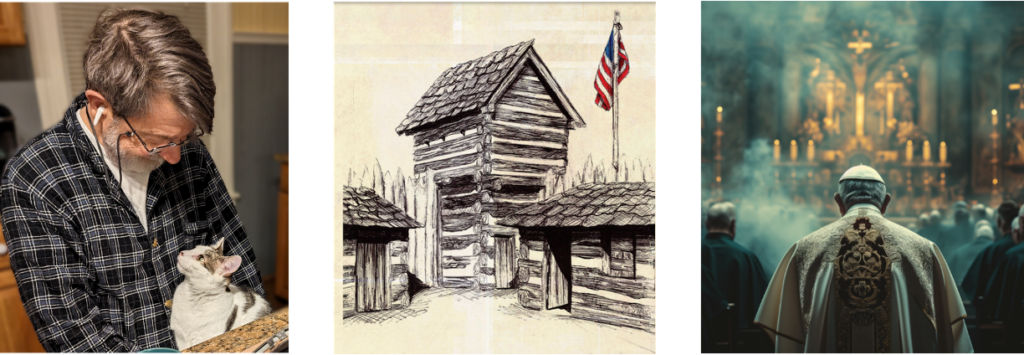
The second thing Mike did for students was to make science social by organizing frequent happy hours and various other gatherings. In these the conversation was far-ranging, from current events to scientific matters to funny stories about whatever, with the critical ingredient being that students were always equal participants. What we students gained was a sense that we belonged, that we had something worthwhile to say, that we needn’t be intimidated in conversation by people whose intellect and accomplishments could indeed feel intimidating. These experiences, it turned out, simulated how a lot gets done in the post-grad-school world — at conferences, faculty meetings, professional lunches and job interviews and such — and thus eased our transition from lowly student to independent professional. I knew Mike had prepared me well when, in the run-up to my dissertation defense, I was surprised to feel zero anxiety. Instead I could hardly wait for the big day to arrive because I would get to have four brilliant people all to myself for two hours to talk about things that interested me. That I couldn’t imagine anything more enjoyable showed that the student was ready to start his own career, which is of course a mentor’s ultimate achievement.
Building a Fort
I hope it’s obvious that in ways that genuinely matter I could not have had the career I did without what I learned from being Mike’s student and from watching how he has handled the tumultuous, illogical, unpredictable world of professional life. I’m grateful for all of that, but especially for the most elemental thing of all, possibly the one vestige of Catholic education that did stick with Mike: loyalty. Once you’re on Mike’s team you know you have an unwavering advocate, even if you should stumble (purely an instructive hypothetical; in graduate school I was of course entirely without sin or error).
Don’t let me leave the wrong impression here. Mike will be the first to admit he’s a curmudgeon at times, and he’s certainly not the type to blow rainbows up anyone’s skirt. Be you new grad student or distinguished professor, if you miss a step somewhere he will say so. But in the end, when the chips are really down, you can rest assured Mike has your back.
Mike has given much to many and thus, like all good people, as this series of posts defines them, he will leave behavior analysis better for his having been part of it. Sure, a science needs research publications and all of that; but Skinner taught us that science, at its core, is a social enterprise. It can’t truly thrive without people who advocate for it, who bolster its underpinnings, and who actively invest in the success of new generations. Because good people who contribute in this way are averse to self-promotion, the many ways they enrich our professional world can go unnoticed. They don’t always leave the most visible public footprint, but look carefully at a role model like Mike and you’re reminded that, true to the lyrics my fellow students and I heard in the lab all those years ago, it really does take a lot of wood to build a fort.

Postscript: Although this post reads a bit like an obituary, Mike remains alive, well, and feisty. In classic Mike fashion, “retirement” will mean continuing many of his service obligations (journals, there’s your invitation to send him more manuscripts to review), and for a casual little side gig he has taken on editorship of Perspectives on Behavior Science.
THEME MUSIC
I’m not going to explain this, but Mike will understand.