

Wanna know how to tell if you have
a successful science of behavior?
Here’s a test. Pick any random context featuring behavior, and see if your science has something to say about it. And I’m not talking about free-form interpretation (i.e., what behavior analysts like to call a “conceptual analysis”). No, I mean good old peer-reviewed primary empirical studies, i.e., data you can sink your teeth into.
Or maybe I should say “sink your fangs into,” because to make my point I’ve chosen, as a random behavioral context, Halloween (aka All Hallows Eve), that odd collection of rituals and superstitions that resurfaces each year on or around October 31, depending on your location.
If you’re not from someplace that observes Halloween (see Note 1), I won’t explain the holiday in detail (you can get the run-down here),
Note 1
Some places that celebrate Halloween include: the U.S., Canada, Mexico, United Kingdom, Australia, Belgium, Czech Republic, Ireland, Dominican Republic, France, Greece, India, Italy, Hong Kong, Poland, Japan, Malaysia, New Zealand, Romania, Serbia, Singapore, Poland, Sweden, South Korea, Switzerland, Taiwan, United Arab Emirates. A number of other nations blend Halloween with other holidays.
All you really need to know is that Halloween has a spooky vibe and (in the U.S. at least) is represented by a number of fear-inducing symbols and motifs like those shown below.
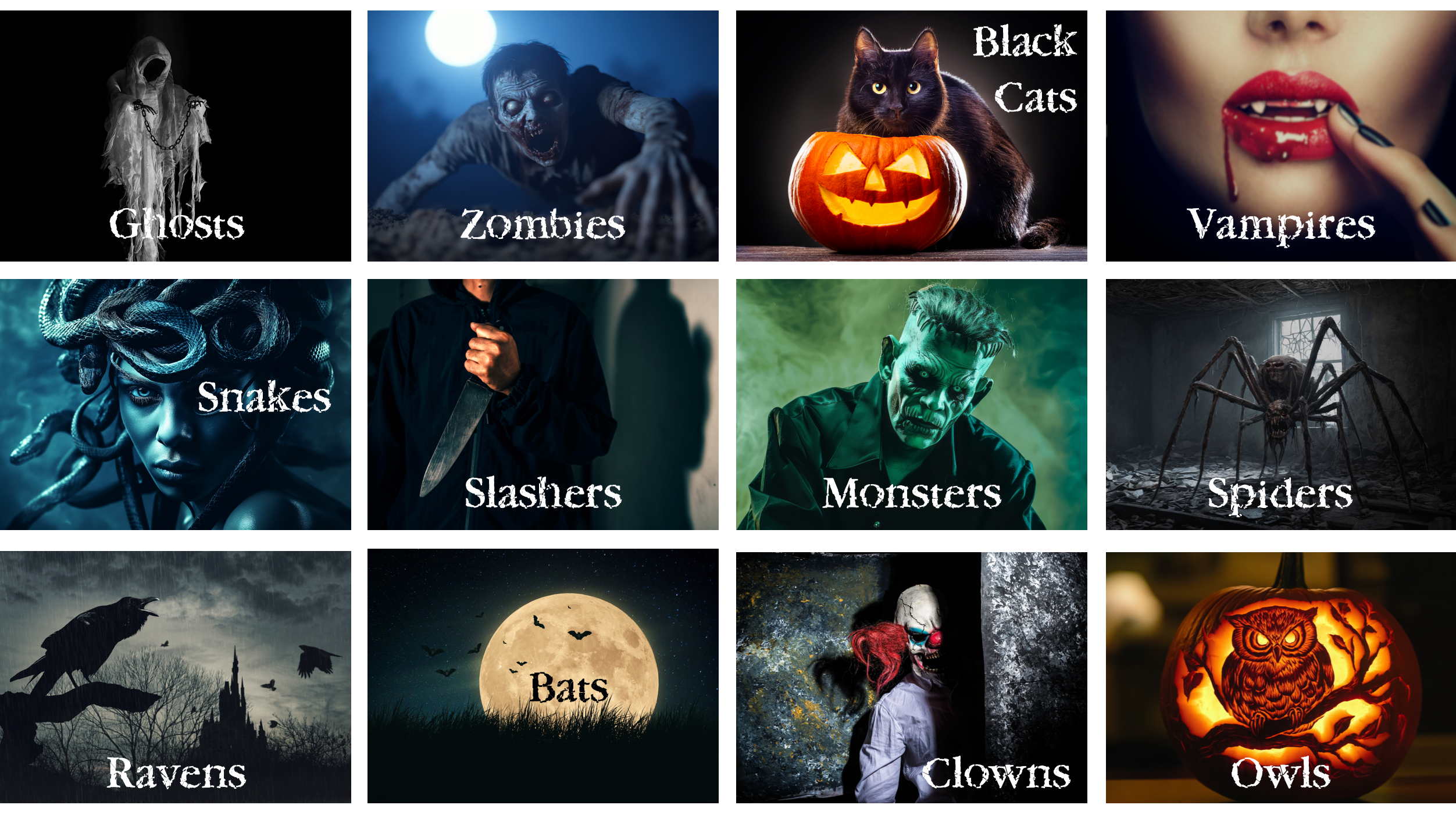
For my acid test of our science of behavior, I ask…
…What does our science have to say about those 12 topics shown above? You might imagine that’s a facetious question, a shameless click-grab to promote traffic to the good old ABAI blog site. But actually I’m dead (intentional Halloween pun! I’m hilarious!) serious.
At the end of this post, you’ll find selective bibliographies on research related to each of the 12 topics. Sure, in some cases I’ve stretched a little to find relevant studies, and yeah, I might have included one or two tongue-in-cheek references. Also, in my enthusiasm to compile the lists I let a few review/discussion type articles slip in, so it’s not all straight-up empirical reports. But otherwise the lists are 100% on the level.
And, by the way, most of them are far from comprehensive, having wrapped up because I got tired of looking rather than because I stopped finding sources. I could have included a ton more stuff.
And so what? Well, As I see it, there are two lessons to be derived from the lists.
LESSON 1: Yay for our team!
Given the apparently silliness of my test, it’s scary how well the science holds up [though see Note 2].
Note 2
The one classic Halloween theme on which I couldn’t find any behavior science was witches/witchcraft, except for one curious book that equated behavioral programs in correctional institutions, somehow, with witch burnings (and I swear that I am not making that up), and some near-miss sources involving magic, like these:
Miguel, C. F. (2017). The generalization of mands. The Analysis of Verbal Behavior, 33(2), 191-204.
Anyway, students, if you’re looking to make your mark with a novel thesis or dissertation topic, here’s your shot. You’re welcome!
I’m not saying that the science directly examines folk suppositions about Halloween, like whether blood-guzzling undead really lurk in the shadows, because if we did that, well, maybe we wouldn’t be a science any more. But for a random selection of behaviors and organisms and catch phrases, yeah, we have a fair amount to say.
And, to be clear, I didn’t even grab the lowest-hanging fruit. Our science has contributed to countless studies on how to treat fear and avoidance of things like those shown above, but to most people that’s so obvious that I didn’t bother to create a list. Doing so would have expanded this post by at least an order of magnitude.
The “we” seem to be everywhere should not really surprise. As I mentioned in a previous post, some years ago Cognitive Psychologist and President of the American Psychological Society Henry Roediger wrote that “behaviorism won.” To some observers, he said, it may seem as if behavioral psychology has faded into obscurity in this cognitive-crazy era, but that’s mainly because certain aspects of a behavioral perspective have succeeded so well that they are now part of the zeitgeist of contemporary infrastructure of psychological science. Because behavioral methods influence those of every credible scientific effort to study behavior, the influence tends to get taken for granted. Hints f that pervasive influence are all over the bibliographies shared here.
Lesson 2: Don’t pat yourself on the back just yet!
If you skim the bibliographies attentively, maybe you’ll pick up on the second important lesson. Did you notice that the vast majority of the sources listed were in journals you’ve never thought to crack open (or didn’t know existed)? Did you see a lot of authors you’ve never heard of? Perhaps behaviorally-adjacent research questions you hadn’t ever thought to ask?
And did it strike you that many of the investigations are inherently interdisciplinary in nature?
Those definitely were my reactions, and with them came a humbling — no, call it frightening — realization. If I’m unaware of vast literatures with clear relevance to behavior… if I’m not familiar with journals in which there’s clear behavior-science (or at least behavior-science-adjacent) action… and if I’m not participating in free-ranging interdisciplinary conversations about behavior… can I really call myself a behavior analyst?
And this leads me to propose that when you call yourself a behavior analyst, you first lean into two extremely broad characteristics, things that should define us even preliminary to what Skinner said about the experimental analysis of behavior and what Baer-Wolf-Risley said about applied behavior analysis“
- We may specialize in some topical domain, but what we know about behavior should be highly general, and therefore relevant to just about ANY topic that might pop up (even one relevant to Halloween. Or St. Patrick’s Day. Or National Transfer Money To Your Daughter Day).
- We should curious about anything and everything that happens with behavior and/or helps to make behavior make sense.
And herein lies the curse of “behaviorism won.” The science of behavior may already look vast to you, for instance:
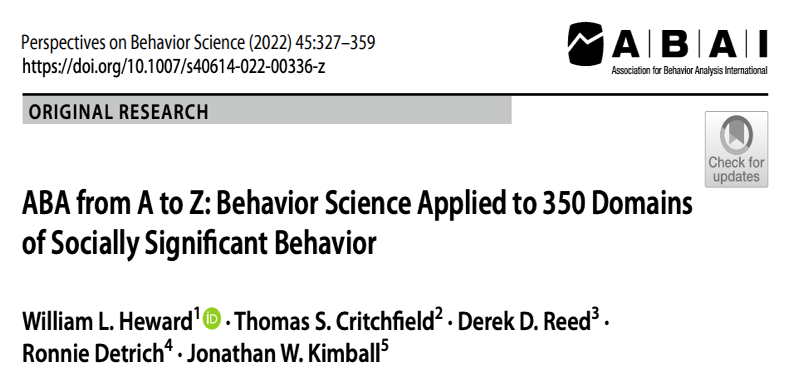
But it’s waaaay bigger than that, and it’s incumbent on each and everyone one of us who strives to earn the title “behavior analyst” to keep up.
As Roediger noted, a behavioral approach now influences research of most types in some way, and in many research areas a behavioral viewpoint has taken on a life of its ow. For instance, there are killer behavior analysts in behavioral pharmacology and behavioral economics and behavioral neuroscience who you’ve likely never heard of. Those scientists, like the authors of many of the papers in the bibliographies below, have never been to a behavior analysis conference or peeked into a behavior analysis journal. And they certainly don’t know that you exist. But they’re extending the understanding of behavior in important ways.
Which begs this question:
If the study of behavior has become so diffuse
and scattered that its parts no longer interact,
is it really one science?
It’s not now, but I say it CAN be, IF there is glue to hold all of the parts together, and I believe the adhesive should be us. Who better to evaluate and clarify how all of the varied expressions of behavior science fit together, how the parts inform a whole, than we who are Skinner’s most direct descendants and have, presumably, the firmest grasp on his conceptual system?
Yes, that is easy to propose, but not so easy to implement, given the vast amount of stuff out there that requires integrating. No one individual can read and integrate everything [see Note 3].
Note 3
About integrating: Whoever does this must have a knack for separating the wheat from the chaff. Because many domains in which behavior science has had an impact are interdisciplinary, you’ll some work that just doesn’t hold up on careful inspection. You’ll also find seemingly strange terms and concepts and a lot of different types of research design, and be tempted to reject the work in which those appear. Behavior Analysis Purists like to dismiss anything that’s this “impure,” meaning not done exactly as we would do it, and that’s a shame. Amidst the unfamiliar vocabulary and methodology you’ll find many interesting and replicable findings out there that can be incorporated into a thoroughgoing account of behavior… if you go to the trouble of learning about them and digesting what they really tell us. By ignoring this stuff we miss important opportunities to test the generality of our framework and, to be quite honest, to earn credibility in the mainstream. To scientists out there who know they are onto something we look foolish for being ignorant of their findings while proclaiming that we have THE science of behavior.
In separating wheat from chaff in work not conducted by inner-circle behavior analysts, you have to be able to distinguish among the following three things, all of which exist in quantity outside of our journals:
- Useful: Work that validates the theoretical framework we’ve already put into place (even if the researchers didn’t intend their work as a test of our ideas, or even if they don’t see the correct connection)
- Useful: Work that points toward concepts or phenomena not currently emphasized in our framework
- Not useful: Work that’s claimed to be relevant to our framework, but probably isn’t. For instance, it makes unjustified conceptual leaps (e.g., calling something operant learning that isn’t) or draws bogus conclusions from flawed experiments.
Like all discriminations, mastering this one requires practice with lots of exemplars, so there’s no time like the present to start working on your breadth.
To illustrate how what I’m calling for is beyond the reach of any individual, I will share a Sisyphean tale of terror, a real-life Twilight Zone episode, from my grad school days. I swear I am not making this up. When I arrived to begin my program, I met a student, let’s call her Jane Bierce, who was in her 11th year of graduate study. When I asked why her pursuit of a degree was taking so long,, she said, “My dissertation proposal is almost ready to go! But every time I think I’m finished, new journal issues come out and I have to update the literature review.” When I graduated four years later, Jane Bierce still had not proposed (insert Rod Serling outro commentary here). Yes, it’s every grad student’s nightmare, even scarier than black cats and evil clowns: the unending dissertation (cue sinister music, fade to black).
But there’s an alternative to everyone-reading-everything: crowdsourcing. We can all make a contribution by seeking out, and casually keeping up with, one or two areas of study that maybe don’t get a lot of attention in our main journals and our training programs. And whenever the occasion arises in our interactions with other behavior analysts, we can share what we’ve learned. I’ve written elsewhere about the value to individuals and to a discipline of intellectual breadth (see my “Connections” series of posts, in which I assert that the more things you know, the more likely you are to know something pertinent to some new problem). If we’re all just a tiny bit more broadly educated, the discipline becomes richer.
AND, if we do this, opportunities arise to make connections with all of those folks out there who are doing research from which we can learn. We have things to teach them, too, but they probably won’t seek us out, so the onus falls to us. We already do a bit of reaching across boundaries — the B.F. Skinner Lectures at the ABAI Convention are one of my favorite examples of bringing outsiders in to stretch our conception os what’s “behavioral” — but the 12 bibliographies (actually 13, counting a bonus section) show us that so much more is possible.
The result can be a unified science of behavior science that is widely distributed, rather than segregated into numerous little fiefdoms. And that, my friends, should it ever come to pass, would be quite a treat.

A Selective Bibliography of
“Halloween Behavior Analysis“
Within each section, items are listed in no particular order.
Bats
- Lattenkamp, E. Z., Vernes, S. C., & Wiegrebe, L. (2018). Volitional control of social vocalisations and vocal usage learning in bats. Journal of Experimental Biology, 221(14), jeb180729.
- Falk, B., Williams, T., Aytekin, M., & Moss, C. F. (2011). Adaptive behavior for texture discrimination by the free-flying big brown bat, Eptesicus fuscus. Journal of Comparative Physiology A, 197, 491-503.
- Winter, Y., von Merten, S., & Kleindienst, H. U. (2005). Visual landmark orientation by flying bats at a large-scale touch and walk screen for bats, birds and rodents. Journal of Neuroscience Methods, 141(2), 283-290.
- Bohn, K. M., Boughman, J. W., Wilkinson, G. S., & Moss, C. F. (2004). Auditory sensitivity and frequency selectivity in greater spear-nosed bats suggest specializations for acoustic communication. Journal of Comparative Physiology A, 190, 185-192.
- Ma, J., Naumann, R. T., & Kanwal, J. S. (2010). Fear conditioned discrimination of frequency modulated sweeps within species-specific calls of mustached bats. PloS one, 5(5), e10579.
- Ji, W., Gao, E., & Suga, N. (2001). Effects of acetylcholine and atropine on plasticity of central auditory neurons caused by conditioning in bats. Journal of Neurophysiology, 86(1), 211-225.
Black Cats
- Bollen, K. (2015). Training and behavior modification for shelter cats. In E. Weiss et al. (Eds.), Animal behavior for shelter veterinarians and staff (pp. 250-266). Wiley.
- Carini, R. M., Sinski, J., & Weber, J. D. (2020). Coat color and cat outcomes in an urban US shelter. Animals, 10(10), 1720.
OK, NOT BLACK PER SE, BUT DEFINITELY CATS.
LOTS AND LOTS OF CATS. THORNDIKE WOULD BE PLEASED.
- Willson, E. K., Stratton, R. B., Bolwell, C. F., & Stafford, K. J. (2017). Comparison of positive reinforcement training in cats: A pilot study. Journal of Veterinary Behavior, 21, 64-70.
- Adret, P. (1993). Vocal learning induced with operant techniques: an overview. Netherlands Journal of Zoology, 43, 125-142.
- Hackett, J. T., & Marczynski, T. J. (1971). Positive reinforcement and visual evoked potentials in cat. Brain Research, 26(1), 57-70.
- Eisenstein, B. L., Postillion, F. G., Norgren, K. S., & Wetzel, M. C. (1977). Kinematics of treadmill galloping by cats: II. Steady-state coordination under positive reinforcement control. Behavioral Biology, 21(1), 89-106.
- Wenzel, B. M. (1959). Tactile stimulation as reinforcement for cats and its relation to early feeding experience. Psychological Reports, 5(3), 297-300.
- Kogan, L., Kolus, C., & Schoenfeld-Tacher, R. (2017). Assessment of clicker training for shelter cats. Animals, 7(10), 73.
- O’Hanley, K. A., Pearl, D. L., & Niel, L. (2021). Risk factors for aggression in adult cats that were fostered through a shelter program as kittens. Applied Animal Behaviour Science, 236, 105251.
- Gazzano, A., Bianchi, L., Campa, S., & Mariti, C. (2015). The prevention of undesirable behaviors in cats: Effectiveness of veterinary behaviorists’ advice given to kitten owners. Journal of Veterinary Behavior, 10(6), 535-542.
- Riemer, S., Heritier, C., Windschnurer, I., Pratsch, L., Arhant, C., & Affenzeller, N. (2021). A review on mitigating fear and aggression in dogs and cats in a veterinary setting. Animals, 11(1), 158.
- Dantas, L. M., Delgado, M. M., Johnson, I., & Buffington, C. T. (2016). Food puzzles for cats: feeding for physical and emotional wellbeing. Journal of Feline Medicine and Surgery, 18(9), 723-732.
- Pratsch, L,et al. (2018). Carrier training cats reduces stress on transport to a veterinary practice. Applied Animal Behaviour Science, 206, 64-74.
- Lockhart, J., Wilson, K., & Lanman, C. (2013). The effects of operant training on blood collection for domestic cats. Applied Animal Behaviour Science, 143(2-4), 128-134.
- Overall, K. L., & Dyer, D. (2005). Enrichment strategies for laboratory animals from the viewpoint of clinical veterinary behavioral medicine: Emphasis on cats and dogs. ILAR journal, 46(2), 202-216.
- Stasiak, M. (2001). The effect of early specific feeding on food conditioning in cats. Developmental Psychobiology: The Journal of the International Society for Developmental Psychobiology, 39(3), 207-215.
- Callealta, I., Lueders, I., Luther-Binoir, I., & Ganswindt, A. (2020). Positive reinforcement conditioning as a tool for frequent minimally invasive blood and vaginal swab sampling in African lions (Panthera leo). Journal of Applied Animal Welfare Science, 23(4), 508-519.
- Broder, J. M., MacFadden, A. J., Cosens, L. M., Rosenstein, D. S., & Harrison, T. M. (2008). Use of positive reinforcement conditioning to monitor pregnancy in an unanesthetized snow leopard (Uncia uncia) via transabdominal ultrasound. Zoo Biology, 27(1), 78-85.
- Nakao, H. (1969). Delayed reinforcement of switch-off behavior in cats. Physiology & Behavior, 4(4), 471-476.
- Amat, M., & Manteca, X. (2019). Common feline problem behaviours: Owner-directed aggression. Journal of Feline Medicine and Surgery, 21(3), 245-255.
- Delgado, M. M., Han, B. S. G., & Bain, M. J. (2022). Domestic cats (Felis catus) prefer freely available food over food that requires effort. Animal Cognition, 25(1), 95-102.
- Kiranaputri, G., Sjahfirdi, L., Tumbelaka, L. I., Yana, A., Priyanto, S. K., Anggarsari, L. Y., & MARIZAL, M. (2022). Positive reinforcement conditioning as Sumatran tiger’s (Panthera tigris sumatrae) social enrichment at Tambling Wildlife Nature Conservation Rescue Centre, Lampung, Indonesia. Biodiversitas Journal of Biological Diversity, 23(1).
- Fritz, J. N., Fletcher, V. L., Dyer, S. P., Carpenter, K. A., Skrbec, M. L., & Yankelevitz, R. L. (2022). Functional analysis and treatment of aggression exhibited by cats toward humans during petting. Journal of applied behavior analysis, 55(1), 169-179.
- Meyer, P. M. (1963). Analysis of visual behavior in cats with extensive neocortical ablations. Journal of Comparative and Physiological Psychology, 56(2), 397.
- Coleman, J. R., & Lindsley, D. B. (1977). Behavioral and hippocampal electrical changes during operant learning in cats and effects of stimulating two hypothalamic-hippocampal systems. Electroencephalography and Clinical Neurophysiology, 42(3), 309-331.
- Knapp, T. M., & Lubar, J. F. (1976). Affective behavior changes in cats following operant conditioning of amygdaloid EEG activity. Physiology & Behavior, 17(1), 137-142.
- Ikegami, S., Nishioka, S., & Kawamura, H. (1977). Operant discriminative conditioning of vertical eye movements in the midpontine pretrigeminal cat. Brain Research, 124(1), 99-108.
- Buerger, A. A. (1970). Effects of preoperative training on relearning a successive discrimination by cats with hippocampal lesions. Journal of Comparative and Physiological Psychology, 72(3), 462-466.
- Olmstead, C. E., Villablanca, J. R., Marcus, R. J., & Avery, D. L. (1976). Effects of caudate nuclei or frontal cortex ablations in cats. IV. Bar pressing, maze learning, and performance. Experimental Neurology, 53(3), 670-693.
- Loop, M. S., & Sherman, S. M. (1977). Visual discriminations of cats with cortical and tectal lesions. Journal of Comparative Neurology, 174(1), 79-88.
- Warren, J. M., & McGonigle, B. (1969). Effects of differential and nondifferential reinforcement on generalization test performance by cats. Journal of Comparative and Physiological Psychology, 69(4 Part 1), 709-712.
- Seward, J. P., & Braude, R. M. (1968). Changes in heart rate during discriminative reward training and extinction in the cat. Journal of Comparative and Physiological Psychology, 66(2), 396-401.
Clowns
- Egli, M., Joseph, B., & Thompson, T. (1997). Transfer of social attributions in stimulus equivalence classes by preschool children. Psychological Reports, 80(1), 3-21.
- Heward, W. L. (1978). Operant conditioning of a. 300 hitter? The effects of reinforcement on the offensive efficiency of a barnstorming baseball team. Behavior Modification, 2(1), 25-40.
- Wagner, G. A., & Morris, E. K. (1987). “Superstitious” behavior in children. The Psychological Record, 37, 471-488.
Ghosts
- Dickinson, A., & Mackintosh, N. J. (1988). Exorcizing Watson’s ghost. Behavioral and Brain Sciences, 11(3), 452-453.
- Alksnis, N., & Reynolds, J. (2021). Revaluing the behaviorist ghost in enactivism and embodied cognition. Synthese, 198(6), 5785-5807.
- Schnaitter, R. (1985). The haunted clockwork: Reflections on Gilbert Ryle’s The concept of mind. Journal of the Experimental Analysis of Behavior, 43(1), 145-153.
- Caculă, A.V. (1940). Învățare mediată de funcție într-o fantomă. Romanian Journal of Genetic Psychology, 8, 202-217.
“Monsters”
- Willmott, D., Boduszek, D., & Robinson, R. (2018). A psychodynamic-behaviourist investigation of Russian sexual serial killer Andrei Chikatilo. The Journal of Forensic Psychiatry & Psychology, 29(3), 498-507.
- Castle, T., & Hensley, C. (2002). Serial killers with military experience: Applying learning theory to serial murder. International Journal of offender therapy and comparative criminology, 46(4), 453-465.
- Ross, R. R., & Doody, K. F. (1973). Persistance in the psychopathic personality. Canadian Journal of Criminology and Corrections, 15(1), 292-305.
- Mitchell, D. G., Richell, R. A., Leonard, A., & Blair, R. J. R. (2006). Emotion at the expense of cognition: psychopathic individuals outperform controls on an operant response task. Journal of Abnormal Psychology, 115(3), 559.
- Mitchell, D. G. V., Fine, C., Richell, R. A., Newman, C., Lumsden, J., Blair, K. S., & Blair, R. J. R. (2006). Instrumental learning and relearning in individuals with psychopathy and in patients with lesions involving the amygdala or orbitofrontal cortex..
- Jurjako, M., & Malatesti, L. (2016). Instrumental rationality in psychopathy: implications from learning tasks. Philosophical Psychology, 29(5), 717-731.
- Persons, R. W., & Bruning, J. L. (1966). Instrumental learning with sociopaths: A test of clinical theory. Journal of Abnormal Psychology, 71(3), 165-168.
- Stewart, D. J., & Resnick, J. H. (1970). Verbal conditioning of psychopaths as a function of experimenter-subject sex differences. Journal of Abnormal Psychology, 75(1), 90.
- Bernard, J. L., & Eisenman, R. (1967). Verbal conditioning in sociopaths with social and monetary reinforcement. Journal of Personality and Social psychology, 6(2), 203.
- Hare, R. D., & Quinn, M. J. (1971). Psychopathy and autonomic conditioning. Journal of abnormal psychology, 77(3), 223-235.
- Stewart, D. J. (1972). Effects of social reinforcement on dependency and aggressive responses of psychopathic neurotic, and subcultural delinquents. Journal of Abnormal Psychology, 79(1), 76-83.
- Siegel, R. A. (1978). Probability of punishment and suppression of behavior in psychopathic and nonpsychopathic offenders. Journal of Abnormal Psychology, 87(5), 514-522.
- Çankaya, S. (2023). A brief review on psychological treatment based on behavioral change applied to offenders with psychopathic traits. Adli Bilimler ve Suç Araştırmaları, 5(2), 95-123.
SEE ALSO
- Bushman, B. J. (2019). “Boom, Headshot!”: Violent first‐person shooter (FPS) video games that reward headshots train individuals to aim for the head when shooting a realistic firearm. Aggressive Behavior, 45(1), 33-41.
- Sorgendal, I., & Boks, C. (2014). Challenging interfaces are more fun! Operant conditioning for the interaction designer. International Journal of Learning Technology, 9(2), 94-110.
- Novo-Olivas, C. A. (2014). Diagnosing and treating closed head injury: Exposing and defeating the mild huge monster. In Clinical neurotherapy (pp. 191-211). Academic Press.
Owls
Ravens (and Crows)
- Fritz, J. & Kotrschal, K. “Social learning in common ravens, Corvus corax.” Animal Behaviour 57.4 (1999): 785-793.
- Range, F., Bugnyar, T., & Kotrschal, K. (2008). The performance of ravens on simple discrimination tasks: A preliminary study. Acta Ethologica, 11(1), 34-41.
- Lozano, J. H., Hernandez, J. M., Rubio, V. J., & Santacreu, J. (2011). Fluid intelligence and discriminative operant learning of reinforcement contingencies in a fixed ratio 3 schedule. Learning and Individual Differences, 21(5), 585-589.
- Di Lascio, F., Nyffeler, F., Bshary, R., & Bugnyar, T. (2013). Ravens (Corvus corax) are indifferent to the gains of conspecific recipients or human partners in experimental tasks. Animal cognition, 16, 35-43.
- Powell, R. W. (1972). Operant conditioning in the common crow (Corvus brachyrhynchos). The Auk, 738-742.
- Powell, R. W., & Kelly, W. A. (1979). Crows learn not to respond under response-independent reinforcement. Bulletin of the Psychonomic Society, 13(6), 397-400.
- Powell, R. W. (1972). Responding under basic schedules of reinforcement in the crow. Journal of Comparative and Physiological Psychology, 79(1), 156-164.
- Neves Filho, H. B., Knaus, Y. C., & Taylor, A. H. (2019). New Caledonian crows can interconnect behaviors learned in different contexts, with different consequences and after exposure to failure. International Journal of Comparative Psychology, 32.
- Pendergraft, L. T., Lehnert, A. L., & Marzluff, J. M. (2020). Individual and social factors affecting the ability of American crows to solve and master a string pulling task. Ethology, 126(2), 229-245.
- Powell, R. W. (1974). Comparison of differential reinforcement of low rates (DRL) performance in pigeons (Columba livia) and crows (Corvus brachyrhynchos). Journal of Comparative and Physiological Psychology, 86(4), 736-746.
- Powell, R. W., Kelly, W., & Santisteban, D. (1975). Response-independent reinforcement in the crow: Failure to obtain autoshaping or positive automaintenance. Bulletin of the Psychonomic Society, 6, 513-516.
- Brecht, K. F., Hage, S. R., Gavrilov, N., & Nieder, A. (2019). Volitional control of vocalizations in corvid songbirds. PLoS Biology, 17(8), e3000375.
- Wascher, C. A., & Bugnyar, T. (2013). Behavioral responses to inequity in reward distribution and working effort in crows and ravens. PLoS One, 8(2), e56885.
Slashers
- Levy, I. M., Pryor, K. W., & McKeon, T. R. (2016). Is teaching simple surgical skills using an operant learning program more effective than teaching by demonstration?. Clinical Orthopaedics and Related Research, 474, 945-955.
- Kao, D. S., Appelbaum, N. P., Kates, S. L., & Domson, G. F. (2021). Surgery Resident Perceptions of the Clicker Evaluation System: A Novel Approach to Collecting and Utilizing Clinical Faculty Performance Data. Journal of Surgical Education, 78(1), 113-118.
Snakes
- Emer, S. A., Mora, C. V., Harvey, M. T., & Grace, M. S. (2015). Predators in training: operant conditioning of novel behavior in wild Burmese pythons (Python molurus bivitattus). Animal Cognition, 18, 269-278.
- Williams, M. L., Torrini, L. A., Nolan, E. J., & Loughman, Z. J. (2022). Using classical and operant conditioning to train a shifting behavior in juvenile false water cobras (Hydrodynastes gigas). Animals, 12(10), 1229.
- Sinclair, L. (2023). The Use of Operant Conditioning to Enhance the Management and Welfare of Captive Kingsnakes. Animal Behaviour and Welfare Cases, (2023), abwcases20230024.
- Szabo, B., Noble, D. W., & Whiting, M. J. (2021). Learning in non‐avian reptiles 40 years on: advances and promising new directions. Biological Reviews, 96(2), 331-356.
- Hellmuth, H., Augustine, L., Watkins, B., & Hope, K. (2012). Using operant conditioning and desensitization to facilitate veterinary care with captive reptiles. Veterinary Clinics of North America: Exotic Animal Practice, 15(3), 425-443.
- Begun, D., Kubie, J. L., O’Keefe, M. P., & Halpern, M. (1988). Conditioned discrimination of airborne odorants by garter snakes (Thamnophis radix and T. sirtalis sirtalis). Journal of Comparative Psychology, 102(1), 35-43.
- Fuenzalida, C. E., & Ulrich, G. (1975). Escape learning in the plains garter snake, Thamnophis radix. Bulletin of the Psychonomic Society, 6(2), 134-136.
- Reiserer, R. S., & Schuett, G. W. (2008). Aggressive mimicry in neonates of the sidewinder rattlesnake, Crotalus cerastes (Serpentes: Viperidae): stimulus control and visual perception of prey luring. Biological Journal of the Linnean Society, 95(1), 81-9
- Kubie, J., & Halpern, M. (1975). Laboratory observations of trailing behavior in garter snakes. Journal of Comparative and Physiological Psychology, 89(7), 667-674.
- Plaud, J. J. (1995). The formation of stimulus equivalences: Fear-relevant versus fear-irrelevant stimulus classes. The Psychological Record, 45, 207-222.
- Plaud, J. J. (1997). Behavioral analysis of fear-related responding using a modified matching-to-sample procedure. Cognitive Behaviour Therapy, 26(4), 157-170.
Spiders
- Long, S. M., Leonard, A., Carey, A., & Jakob, E. M. (2015). Vibration as an effective stimulus for aversive conditioning in jumping spiders. The Journal of Arachnology, 43(1), 111-114.
- Nakamura, T., Yamashita, S. Learning and discrimination of colored papers in jumping spiders (Araneae, Salticidae). J Comp Physiol A 186, 897–901 (2000).
- VanderSal, N. D., & Hebets, E. A. (2007). Cross-modal effects on learning: a seismic stimulus improves color discrimination learning in a jumping spider. Journal of Experimental Biology, 210(20), 3689-3695.
- Alligood, C., & Leighty, K. (2015). Putting the “E” in SPIDER: Evolving trends in the evaluation of environmental enrichment efficacy in zoological settings. Animal Behaviour & Cognition 2(3), 200-217.
Vampires
- Shumake, S. A., & Caudill, C. J. (1974). Operant conditioning of licking in vampire bats, Desmodus rotundus. Behavior Research Methods & Instrumentation, 6(5), 467-470.
- Carter, G. (2021). Blood Sharing by Vampire Bats. In Encyclopedia of Evolutionary Psychological Science, 669-671.
- Carter, G. G., Wilkinson, G. S., & Page, R. A. (2017). Food-sharing vampire bats are more nepotistic under conditions of perceived risk. Behavioral Ecology, 28(2), 565-569.
Zombies
Bonus 13th Topic: Trick or Treat
- Weisz, J. R. (1978). Choosing problem-solving rewards and Halloween prizes: Delay of gratification and preference for symbolic reward as a function of development, motivation, and personal investment. Developmental Psychology, 14(1), 66-78.
- Jamison, J., & Karlan, D. (2016). Candy elasticity: Halloween experiments on public political statements. Economic Inquiry, 54(1), 543-547.
- Wansink, B., & Cherry, L. Fat-Proofing Halloween, Thanksgiving, and Christmas: Exploring Behavioral Solutions to Holiday Weight Gain. Epidemiology and Public Health, 2(1), 1019.
- Estle, S. J., Green, L., Myerson, J., & Holt, D. D. (2007). Discounting of monetary and directly consumable rewards. Psychological science, 18(1), 58-63.
- Luking, K. R., & Barch, D. M. (2013). Candy and the brain: neural response to candy gains and losses. Cognitive, Affective, & Behavioral Neuroscience, 13, 437-451.
- Luking, K. R., Luby, J. L., & Barch, D. M. (2014). Kids, candy, brain and behavior: Age differences in responses to candy gains and losses. Developmental CognitiveNeuroscience, 9, 82-92.
- St. Clair, M., Massoudi, K., Tarbox, J., Najdowski, A., Simchoni, L., Jackson, M., & Persicke, A. (2024). Making Deception Fun: Teaching Autistic Individuals How to Play Friendly Tricks. Behavior Analysis in Practice.