

To get more out of the analysis of behavior, maybe we need less Behavior Analysis.
Author Note: A version of this essay is set to appear in the Journal of Behaviorology.
A conversation behavior analysts can’t seem to get enough of concerns how to boost the societal stock of our discipline. The uncontroversial baseline observation is that behavior analysis seems eternally mired in shadow. Actuarial truths include that relatively few people seek out training in how to scientifically study behavior and, outside of autism treatment, the work of behaviorists gets little attention from scholars or members of the general public. Although most behavior analysts agree on the parameters of this problem, it’s less obvious what to do about it. But in keeping with our discipline’s emphasis on functional analysis, to arrive at solutions we should first examine how we got into this pickle.
A Hasty Retreat
Let’s begin by revisiting one the most pivotal episodes in the history of behavior analysis:
In the early- and late-1950s, the group of psychologists who had been attracted to the study of operant conditioning found that the journals that seemed most appropriate as outlets for their work were not hospitable toward it. [Those journals] did publish studies by some of the most creative contributors to the new field. But, by and large, few members of their editorial boards had much sympathy toward an approach that stressed the behavior of individual organisms and eschewed formal design and hypothesis testing, both hallmarks of most of the work being published in these journals. By the beginning of 1957, this unhappiness had become so intense that a group met… and decided to start a new journal. This they did, the Journal of the Experimental Analysis of Behavior (JEAB) first appearing in 1958. Ten years later… they founded a second journal, the Journal of Applied Behavior Analysis (JABA). (Laties, 1987, p. 495)
I submit that this heady era, circa 1958-1968, during which some of our first discipline-specific institutions were created, is precisely when behavioral psychology began to lose its mojo. Prior to this period, an upstart science had clawed its way from nothingness to relevance. Behaviorism as a general perspective won many converts, and like or hate the science of behavior, respectable investigators and theorists had to acknowledge what behavioral research was accomplishing (Leahey, 1992). Up until this pivotal period, the science of behavior was something of a player in the large-scale drama of psychological inquiry.
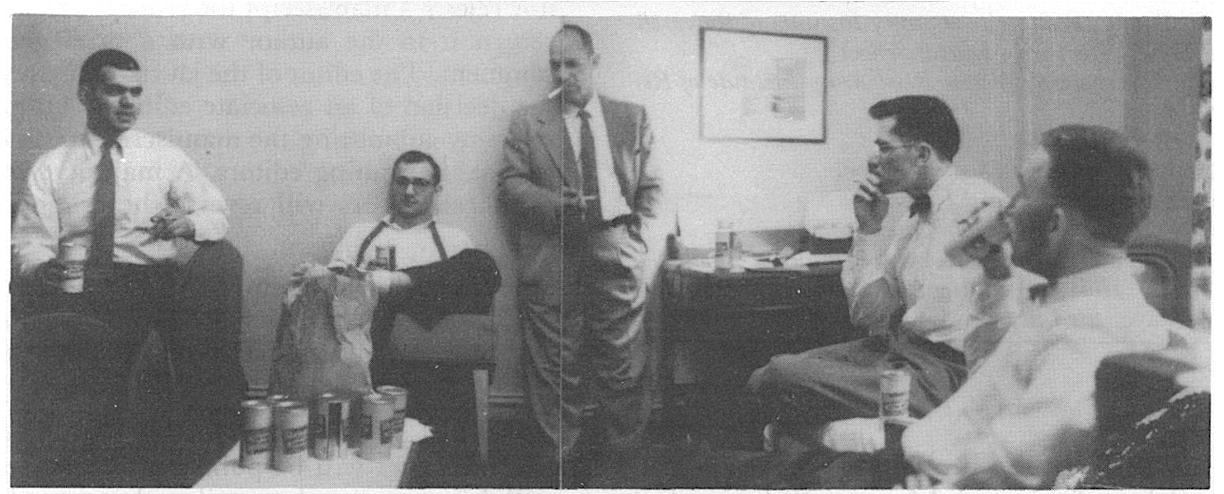
Beginning with the founding of JEAB and JABA, however, behavior analysis began to retreat to the shadows. Those who convened to create JEAB (Laties, 1987) had the best of intentions, of course, but they unwittingly hammered the first of many coffin nails into a movement that originally was intended to engage with, and ultimately change, Psychology and the world (Skinner, 1976). That is to say, behavioral journals pushed in the opposite direction of Skinner’s (1976) youthful plan to “remake Psychology.” To give credit where it’s due, those journals succeeded as an incubator, giving people who were already sold on the science of behavior a convenient way to share ideas and data. But placing articles into specialized publications with limited circulation assured that relatively few eyes would fall upon them (especially in the days before digital sharing).
Perhaps more importantly, this practice insulated authors from having to persuade skeptical outsiders of the value of, in Laties’ words, “an approach that stressed the behavior of individual organisms and eschewed formal design and hypothesis testing.” It’s incredibly informative, in the quote above, that, prior to 1958, mainstream journals “did publish studies by some of the most creative contributors to the new field” (emphasis added). What this shows is that some behaviorists were in fact cracking the code of mainstream persuasion, only to have the motivation for doing so undermined by the availability of JEAB and JABA.
Over time, we have created a cornucopia of ways to insulate ourselves from the mainstream. School Applications of Learning Theory (which later became Education & Treatment of Children) launched in 1969; Behaviorism in 1972; and Behavior Modification 1977. Today I count more than 20 “in house” journals. Division 25 (Behavior Analysis) of the American Psychological Association began in 1964[1], and ABAI in 1974, followed by countless other organizations, boards, foundations, and committees devoted specifically to the science of behavior. Each of those entities has only drawn our work further from the mainstream, and made behaviorists more comfortable with avoiding the challenges of selling a behavioral approach to a skeptical world.
Bivouac in No Man’s Land
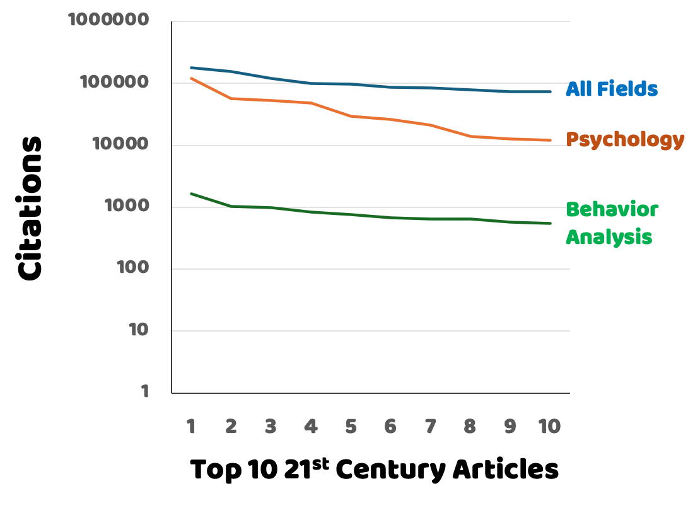
We’ve also been left more lonely. To borrow a phrase from Swift (1729), it is a melancholy object, to those who walk through this great discipline, to see fellow behaviorists plaintively importuning every passerby for some breadcrumb of approval. And we don’t get many breadcrumbs, The figure below helps to illustrate. Using the Dimensions Citations online application, I determined the 10 most-cited articles of the 21st Century in science journals overall, in Psychology journals, and in behavioral journals. The most-noticed Psychology papers have been cited more often, by a factor of at least x22, than those in behavioral journals. For papers in science overall, it’s a difference at least x100 (and a recent, more though analysis suggests it could be more like x170; see Pearson et al., 2025).
Here’s a slightly different vantage point on the same problem (also from Dimensions Citations). So far in the 21st Century the most-cited behavioral journal, JABA, has totaled about 2700 citations per year, which sounds like a lot, and it is compared to what most other behavioral journals achieve. But in the context of applied psychology journals generally, JABA is something of an also-ran. Behavior Research & Therapy, for instance, has averaged over 10,000 citations per year, and Journal of Applied Psychology, more than twice that. For 2023, the most recent year for which I could find data, JABA ranked as only the 3213th most cited scholarly journal. Data like these show that a lot of people are interested in behavior science, broadly defined. We just aren’t reaching many of those people.
Overall, the conclusion is inescapable: We behavior analysts inhabit an intellectual ghetto, far removed from the shiny streets of mainstream science. Those aren’t my words. They’re the words of B.F. Skinner, who in late career became disillusioned at his failure to remake Psychology, which he concluded was terminally infected with failed ideas. He memorably proclaimed that:
We have been accused of building our own ghetto, of refusing to make contact with other kinds of psychology. Rather than break out of the ghetto, I think we should strengthen its walls. (Skinner, 1993, p. 5)
Skinner suggested that isolation is not just tolerable — it’s somehow noble. Better, he seemed to say, that we refine our craft in isolation than engage with a world that might resist or pollute our approach.
Yet I don’t think that we’ve ever fully bought Skinner’s take on this. Yes, we proclaim our proud independence from mainstream psychological science… but we also bemoan our failures to gain mainstream acceptance. Deep down, despite having actively participated in the raising of our own ghetto walls, we know that a ghetto is less a safe haven than a prison. Alone behind our walls we may survive and evolve, but isolation is never a springboard to world changing.
The (Re)Shaping of Behaviorism
Which brings me to a modest proposal. Having turned my thoughts for many years upon this important subject, I submit that there is a simple solution: Reverse the factors that brought us to our present state. In other words, we must immediately dissolve all journals, associations, boards, committees and other institutions devoted specifically to the care and feeding of the science of behavior.

Once the troublesome entities are eliminated, overnight we will have reset the calendar to a better time, when behavior analysts who wished to register the importance of their work had to work for the privilege. In this old-yet-new reality, behavior analysts will be fully exposed to the contingencies of cultural selection. No longer will they be able to get their papers and posters accepted at professional meetings based on little more than the price of organizational membership dues. No longer they be able to grease the wheels of peer review by parroting the obscure verbal practices of previous behavioral articles. Nay, if behavior analysts want their work to find an audience, they will need to scrape and claw as Skinner did in the earliest days of his research program. They will have to try all sorts of approaches to theory and research design and manuscript construction, but over time selection by consequences will yield a verbal community that knows how to act effectively on that bigger stage.
Of course, it goes without saying — and I can’t stress this enough — that it’s also essential to eliminate institutions and structures designed to prop up applied behavioral practice. Professional credentialing exists mainly to protect practitioners’ market share (Critchfield, 2011) and to assure a steady supply of third-party payment — in other words, to insulate behavioral practitioners from the contingencies inherent in fair competition with other kinds of service providers. This sidesteps the need for practitioners to be the absolute best they can be, and therefore weakens the discipline.
Henceforth, I propose, the practice world will work quite differently than it has over the past couple of decades. Practitioners will need to obtain a degree that is marketable because consumers recognize and value it (say, clinical or school psychology), not because it is preferentially treated in third-party pay systems. Once practicing, they will have to directly outcompete others with similar credentials through competence and effective communication with the public. To stay in business in an open marketplace, they will have to grow and innovate in ways that will spur their technology forward to become more effective and more tailored to a variety of real-world problems beyond autism.
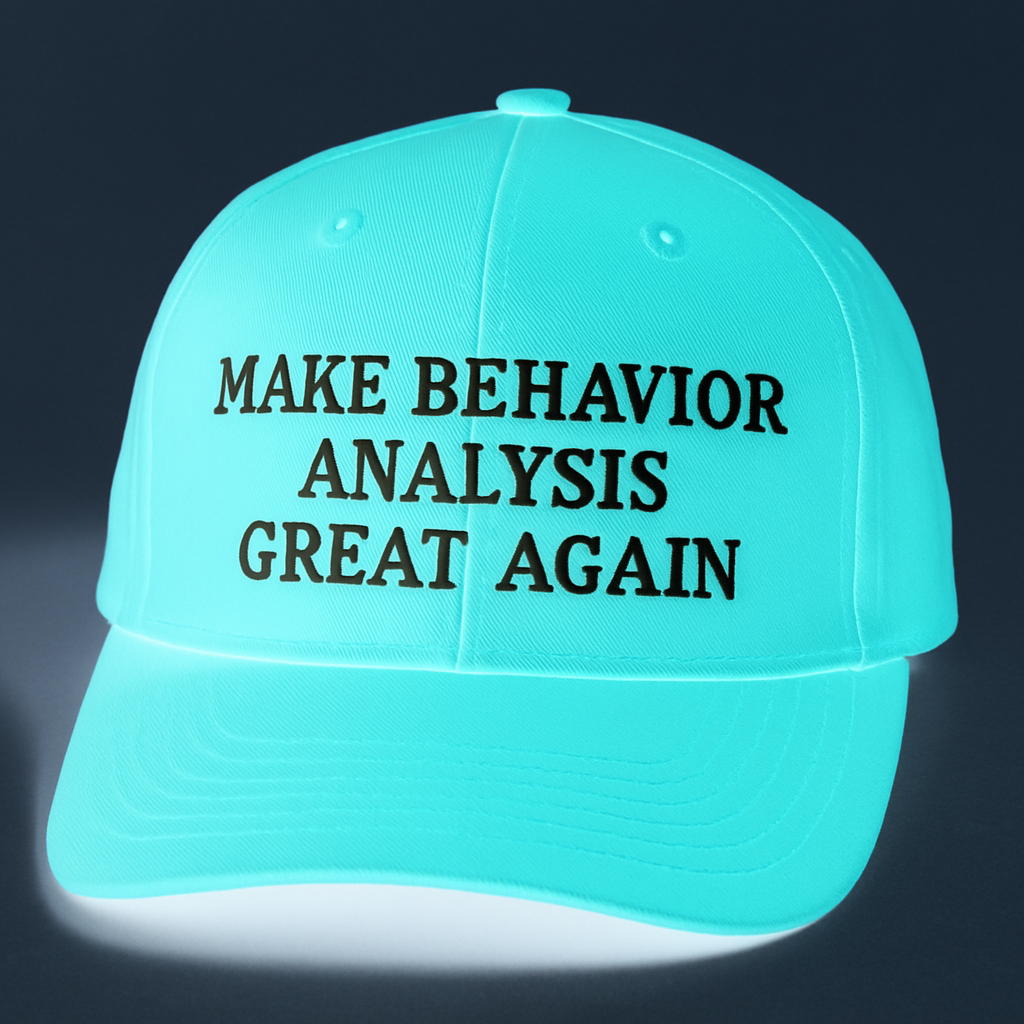
Make Behavior Analysis Great Again
To summarize, the best way to strengthen behavior analysis is to expose it to selection pressures that have been seriously restricted since the founding of behavioral publications and institutions. We know three things about behavior that are relevant here. First, as Aubrey Daniels (2007) liked to say, behavior goes where reinforcement flows. Currently the behavior of behavior analysts is being shaped mostly by other behavior analysts, leaving little surprise that it’s not connecting well with the behavior of people outside our ghetto. Second, behavior is almost infinitely shapeable. While currently we may be struggling to gain acceptance for our science (Detrich & Critchfield, 2025), if pigeons can be taught ping pong (Skinner, 1962) and lowly undergraduates can be taught trigonometry (Ninness et al., 2009), well, anything is possible, isn’t it? Third, selection by consequences requires behavioral variation (Skinner, 1984), and the echo chambers embedded in behavioral publications and institutions are not reinforcing the right kinds of variation in our collective repertoires. All told, we have many decades’ worth of evidence that isolated enclaves of behavior analysts will not remake the world or recruit allies to our scientific cause. It is time to disband those enclaves.
You may argue that the program I propose could never be implemented, and I agree that substantial challenges are involved. Many individuals derive professional status and identity from the relevant entities, whose dissolution they are sure to resist. But such interests have nothing to do with the conduct and dissemination of our science, and therefore can be safely ignored. To be sure, once my program is in place, those individuals who once orchestrated behavioral journals, associations, boards, committees, and other institutions may struggle at first to rejigger their sense of purpose. They will, however, soon discover time and energy newly freed up for figuring out how to put the best of their science before scientists and citizens everywhere. This desirable end justifies any temporarily uncomfortable means. I therefore call on the leaders and constituents of all behavioral journals, associations, boards, committees and other institutions to prioritize the common good and take appropriate action in order to assure the survival and well-being of our discipline.
Footnote
[1] The first conference devoted specifically to behavioral research was held in 1947 (Dinsmoor, 1987). Scattered meetings occurred thereafter but apparently nothing reliable was established before Division 25 came along with its small annual program of presentations at the annual APA Convention.
References
Critchfield, T.S. (2011). Interesting times: Practice, science, and professional associations in behavior analysis. The Behavior Analyst, 34(2), 297-310.
Daniels, A.C. (2007). Other people’s behavior. Performance Management Publications.
Detrich, R., & Critchfield, T.S. (2025). Seven dimensions are not enough: Actively disseminating applied behavior analysis. Perspectives on Behavior Science. Advance online publication.
Dinsmoor, J.A. (1987). A visit to Bloomington: The first conference on the experimental analysis of behavior. Journal of the Experimental Analysis of Behavior, 48(3), 441-445.
Laties, V.G. (1987). Society for the Experimental Analysis of Behavior: The first thirty years (1957–1987). Journal of the Experimental Analysis of Behavior, 48(3), 495-512.
Leahey, T.H. (1992). The mythical revolutions of American psychology. American Psychologist, 47(2), 308-318.
Ninness, C., Dixon, M., Barnes‐Holmes, D., Rehfeldt, R. A., Rumph, R., McCuller, G., Holland, J., Smith, R., Ninness, S.K., & McGinty, J. (2009). Constructing and deriving reciprocal trigonometric relations: A functional analytic approach. Journal of Applied Behavior Analysis, 42(2), 191-208.
Pearson, H., Ledford, H., Hutson, M., & Van Noorden, R. (2025). Exclusive: the most-cited papers of the twenty-first century. Nature, 640(8059), 588-592.
Skinner, B. F. (1962). Two “synthetic social relations.” Journal of the Experimental Analysis of Behavior, 5(4), 531-533.
Skinner, B.F. (1976). Particulars of my life. Knopf.
Skinner, B. F. (1984). Selection by consequences. Behavioral and Brain Sciences, 7(4), 477-481.
Skinner, B.F. (1993). A world of our own. Behaviorology, 1, 1-5.
Swift, J. (1729). A modest proposal for preventing the children of poor people from being a burden to their parents or country, and for making them beneficial to the publick. S. Harding and J. Roberts.
THEME MUSIC