
Guest Post by by Stephanie Xie, Current board member of Behavior Analysis for Sustainable Societies: https://baforsustainablesocieties.org/
LinkedIn: https://www.linkedin.com/in/stephanie-xie/
I am based in Auckland, Aotearoa New Zealand. I work as a behavior science specialist with an environmental organization, where I design evidence-based interventions, co-create solutions with community partners, and translate behavioral frameworks for organizations tackling sustainability challenges. My recently submitted PhD centered on community-based projects demonstrating the real-world potential of behavior analysis for environmental work. The views expressed here are my own.
There was a moment, not long after I left the familiar confines of applying my ABA training in the clinical space, when I felt as though I had wandered out of a tidy room into a tangled forest. The room I was familiar with was neat, orderly, measurable. Behaviours were clearly defined. We identified functions, measured outcomes, designed experiments, and believed in the power of contingencies. I believed (and still do) that this training uniquely positions us to strengthen sustainability-related work.
But outside that room, in the forest, I found a whole world of models in behaviour change, or behaviour insights practitioners. Terminologies came at me that felt foreign and unfamiliar:
- “Use the COM-B framework. It’s part of the Behaviour Change Wheel” (Michie et al., 2011)
- “Introducing… the Se-COM-B framework” (Nguyen-Trung et al., 2025)
- “MINDSPACE: 9 robust effects that influence behaviour in mostly automatic ways” (Dolan et al., 2012)
- “There’s the Behaviour Change Model (BCM) too, it incorporates contextual factors into the explanation of behaviour” (Fogg, 2009)
And there I was, trained to look for functions and discriminative stimuli, asking myself: are we really talking about the same thing? This felt different from what I knew.
Take COM-B: Capability, Opportunity, Motivation. It was intuitive, digestible and almost like a cheat sheet to explain how interventions can be designed quickly. Behaviour is framed as emerging when these three conditions align. And yet, over time, I realised that behaviour analysis has always had language for these components:
| COM-B component | Behaviour analytic equivalent |
| Capability | Behavioural repertoire / skill acquisition |
| Opportunity | Antecedents / environmental contingencies |
| Motivation | Motivating operations and reinforcement history |
Behaviour analysis has always worked with these ideas, just under different names. What COM-B calls motivation, we understand through motivating operations and reinforcement history. What they call capability, we foster through shaping, prompting, and chaining. And opportunity, can be understood through environmental arrangement (i.e., the contexts and contingencies we design).
But I also noticed something missing in many COM-B-based interventions: precise behavioural measurement and careful analysis of what’s maintaining behaviour. I think about a public transport campaign I was involved in. The COM-B framework identified capability (route information provided), opportunity (new bus shelters installed), and motivation (ads emphasising environmental benefits or not having to drive after a night out for safety reasons)… but ridership remained low.
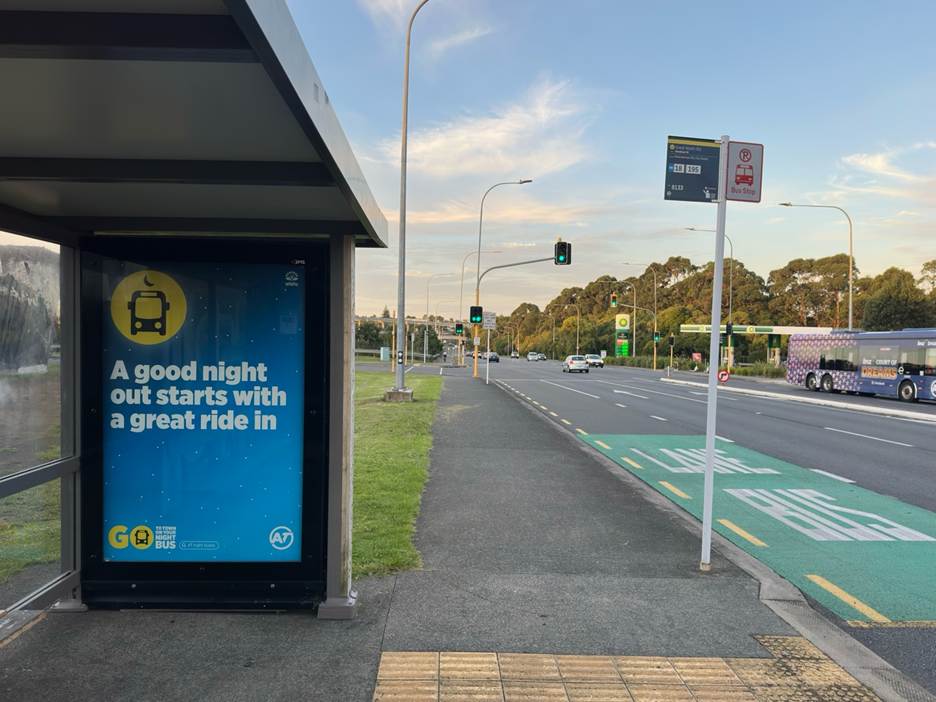
Figure 1. Bus shelter advertisement from the public transport campaign emphasising safety benefits for nighttime travel.
A deeper COM-B analysis might have identified some barriers, but what was missing was a clear contingency analysis. Why was driving preferred? Immediate control, personal space, direct routes. Why was busing avoided? Infrequent service (30+ minute waits), frequent cancellations/bus no shows, comparable cost, weather exposure, crowding during rush hour (increasing the likelihood of getting sick). The campaign assumed the problem was awareness and comfort, hence ads and shelters. But the real issue was structural: if busing takes twice as long, costs nearly as much, and means standing in the rain, no amount of messaging will shift behaviour. A contingency analysis makes this visible immediately and points to what needs to change.
And this is where behaviour analysts have much to offer: contingency analysis, measurement precision, reinforcement design. Tools that can strengthen sustainability and behaviour change efforts.
As sustainability initiatives increasingly recognise the importance of behaviour change, opportunities are emerging for behaviour analysts to apply their expertise beyond clinical settings. So I find myself leaning into both spaces. In meetings, I’ve learned to ask, ‘What need does the current behaviour meet?’ instead of ‘What’s the function?’, to discuss ‘incentives and barriers’ rather than ‘reinforcement contingencies’, and to nod when someone mentions COM-B before asking: okay also, what’s maintaining the current behaviour? What will reinforce the new one?
If we want to influence sustainability work, we can’t show up insisting everyone adopt our vocabulary first. I translate, not to dilute the science, but to make it usable in rooms where programmes are designed and decisions are being made. My goal isn’t to insist others learn my language, but to learn theirs well enough to show them what precision, measurement, and contingency analysis can add.
The forest is messy. But we have ways of mapping it.

Figure 2. Beyond the tidy room, we have the tangled forest of applied sustainability work.
References
Dolan, P., Hallsworth, M., Halpern, D., King, D., Metcalfe, R., & Vlaev, I. (2012). Influencing behaviour: The MINDSPACE way. Journal of Economic Psychology, 33(1), 264–277. https://doi.org/10.1016/j.joep.2011.10.009
Fogg, B. J. (2009). A behavior model for persuasive design. In S. Chatterjee & P. Dev (Eds.), Proceedings of the 4th International Conference on Persuasive Technology (Persuasive ’09) (pp. 40–47). Association for Computing Machinery. https://doi.org/10.1145/1541948.1541999
Michie, S., van Stralen, M. M., & West, R. (2011). The behaviour change wheel: A new method for characterising and designing behaviour change interventions. Implementation Science, 6(1), 42. https://doi.org/10.1186/1748-5908-6-42
Nguyen-Trung, K., Saeri, A. K., Zhao, K., Boulet, M., & Kaufman, S. (2025). SeCOM-B: An integrated model for understanding human behaviour change in wicked socio-ecological problems. Socio-Ecological Practice Research, 7, 367–386. https://doi.org/10.1007/s42532-025-00227-y