Periodically in these posts I’ve argued that it’s important to take objective stock of what in our discipline is making a splash in science and society. You might say that behavior analysis exists only at the pleasure of the world around it — to do our important work, we need to eat, and for that we depend on research grants and university positions and third-party pay mechanisms and so forth. All of that comes from outside sources, so we need to monitor what in our discipline is making an impression, in terms of both scientific impact (as measured through scholarly citations; e.g., see here) and dissemination impact (e.g., as measured through altmetric statistics; see here and here).
In the present post, to commemorate the dawn of a new year, let’s look back at the behavior analysis articles that got the most citation attention during 2025, according to Web of Science. On January 1, 2026, for each of the behavior analysis journals that Web of Science indexes (Postscript 1), I searched for its articles (of any publication date) that got the most citations during 2025. At bottom you’ll find a list of the Top 30 most-cited articles overall.
A few observations about those articles:
- It’s worth asking how much of the interest in those Top 30 articles comes from within behavior analysis versus the mainstream. I didn’t have the patience to examine all of the nearly 1500 citations represented in the Top 30 table, but among the Top 10 articles, about 78% of citations came from someplace other than behavior analysis journals. Only two of the Top 10 articles received a majority of their 2025 citations from behavior analysis journals (Baer et al [1968] = 77%, Iwata et al. [1994] = 71%). So here’s a decent working hypothesis to derive from these numbers: If your research sheds valuable light on something people are interested in, they will pay attention. Persistent claims by behavior analysts that people in the mainstream are biased against their work because it is behavior analytic just don’t hold up to the citation data.
- Nearly half of the Top 30 articles (14) addressed methodological issues, whereas fewer took the form of theoretical or review papers (9) or primary empirical reports (7). This is a reminder that although the phenomena scientists study are important, scientists recognize that science is always a work in progress, and nothing gets their attention like how to do it better science.
- Common topics, as conveyed in Top 30 article titles and abstracts, included autism and other developmental disabilities (5 articles), Acceptance and Commitment Therapy and related constructs (6 articles), and delay discounting (5 articles).
- Unsurprisingly, those old-reliable legacy journals, JABA (9 articles) and JEAB (8 articles), were well represented among the Top 30. Both JEAB and JABA contributed 28% of the articles that were cited 30 times or more. As I have noted in past posts, however, Journal of Contextual Science (JCBS, 16% of articles cited 30+ times) has in recent years become a heavy hitter as well, which accentuates calls for making better connections between ABA and Acceptance and Commitment Therapy (e.g., here and here and here).
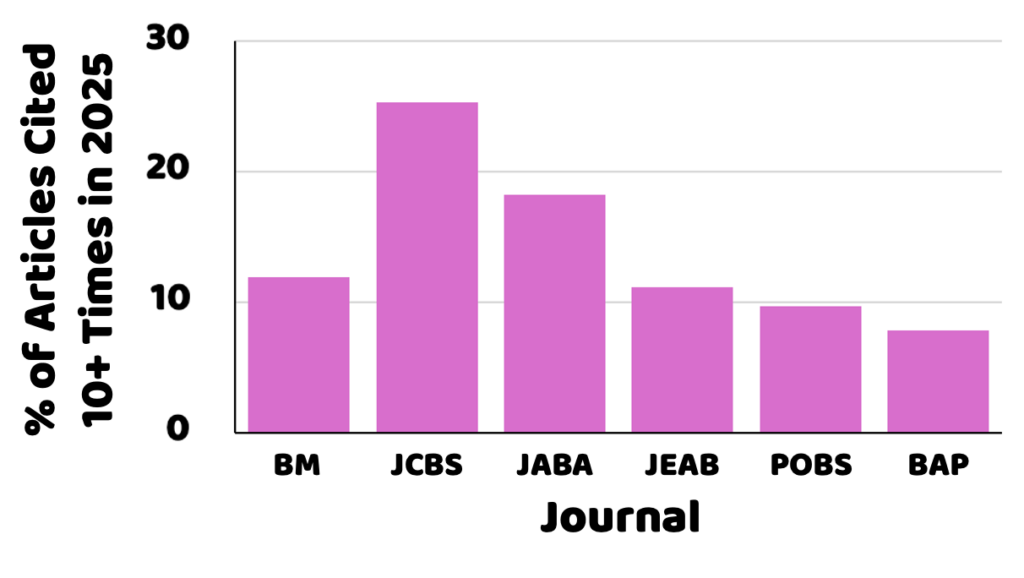
- There’s no ignoring that there are haves and have nots among behavior analysis journals. In 2025, six journals shown below dominated, collectively producing 84% of the 269 articles cited 10 or more times (below). That leaves just 16% divided among a dozen or more other journals.
- A large minority of the Top 30 articles (13) were published before 2010. It’s hard to know how to interpret this. Maybe it’s healthy to rely on foundational sources; or maybe en emphasis on older sources suggests the science is getting stuck. Because scientific progress is almost always incremental, it’s understandable that some older sources would retain impact over time. But sciences move forward or die, and Steve Hayes once wrote (somewhere; I forget where) that if the foundational works of a science are a half century old, you have to wonder how energetically that science is moving forward. It’s at least interesting that of the three common topical foci mentioned above, one (autism and other disabilities) traces back to the 1950s and 1960s, and another (delay discounting) to the 1970s. Obviously ACT is a more recent development, one that folks out there are still struggling to determine how to integrate with the rest of behavior analysis (e.g., here and here and here).
- Keep in mind that today’s citations are, in a sense, yesterday’s news. If a citation is science’s trail of breadcrumbs — a record of what influenced a given experiment or article — well, remember that years can elapse between the beginning of a scholarly project and its final publication. Thus 2025’s citation data tell us something about what people were thinking about circa 2015-2020. To get a feel for what is currently of interest, you have to look elsewhere, to data on what scientific publications people are currently accessing. For each indexed article, Web of Science tracks the number of full-text accesses and exports of citation information to reference managers during the past 180 days (Note: It ranks a journal’s articles in terms of relative usage but doesn’t provide quantitative usage data). For several behavior analysis journals, Postscript 2 lists the three most accessed articles during the second half of 2025. Note that only 7 of 42 listed articles were published before 2010. Also, no idea what to make of this, but for the two least-applied behavior analysis journals (JEAB and Behavior & Philosophy), 4 of the 6 most-accessed articles in 2025 were book reviews.
- What if “best” isn’t good enough? To put the Top 30 list into perspective, consider the following. The top five articles on that list were cited an average of 108 times during the past year. And I’d kill for my own work to get that kind of attention. But look at the 2025 citation rates for impactful mainstream Psychology journals like American Psychologist (top 5 articles, M = 1443) and Frontiers in Psychology (M = 743). By these standards, articles in behavior analysis journals don’t get much notice, which highlights that it may be valuable to our discipline to sometimes share its advances via mechanisms besides behavior analysis journals (see here for one example).
- Another comment on topics of mainstream interest: If you look at 2025’s most cited articles in American Psychologist and Frontiers in Psychology, they address things like positive emotions, self-efficacy/self-determination, racial microaggressions, metacognition, psychophysiological methods, rating scale methods, Bayesian statistics, and perception. These are not research areas in which behavior analysts have exerted much leadership… but some could be. Consider, as one example, the technology of obtaining useful data via verbal reports (see here and here). We’re verbal behavior people, right? Why not prove that by showing the world how to do the best verbal-report measurement possible?
Top 30 Most-Cited Behavior Analysis Articles During 2025
| CITATIONS | ARTICLE |
|---|---|
| 188 | Drevon, D., et al., (2017). Intercoder reliability and validity of WebPlotDigitizer in extracting graphed data. BM, 41(2), 323-339. |
| 104 | Gloster, A.T., et al. (2020). The empirical status of acceptance and commitment therapy: A review of meta-analyses. JCBS, 18, 181-192. |
| 96 | Wolf, M.M. (1978). Social validity: the case for subjective measurement or how applied behavior analysis is finding its heart. JABA, 11(2), 203-214. |
| 83 | Baer, D.M., et al. (1968). Some current dimensions of applied behavior analysis. JABA, 1(1), 91-98. |
| 67 | Francis, A.W., et al., (2016). The development and validation of the Comprehensive Assessment of Acceptance and Commitment Therapy processes (CompACT). JCBS, 5(3), 134-145. |
| 63 | Myerson, J., et al. (2001). Area under the curve as a measure of discounting. JEAB, 76(2), 235-243. |
| 62 | Herman, K.C., et al. (2018). Empirically derived profiles of teacher stress, burnout, self-efficacy, and coping and associated student outcomes. JPBI, 20(2), 90-100. |
| 56 | Iwata, B.A., et al. (1994). Toward a functional analysis of self‐injury. JABA, 27(2), 197-209. |
| 48 | Akbari, M., et al. (2022). Experiential avoidance in depression, anxiety, obsessive-compulsive related, and posttraumatic stress disorders: A comprehensive systematic review and meta-analysis. JCBS, 24, 65-78. |
| 47 | Davis, A.K., et al. (2020). Psychological flexibility mediates the relations between acute psychedelic effects and subjective decreases in depression and anxiety. JCBS, 15, 39-45. |
| 46 | Aydin, O., & Yassikaya, M.Y. (2022). Validity and reliability analysis of the PlotDigitizer software program for data extraction from single-case graphs. POBS, 45(1), 239-257. |
| 45 | Parker, R.I., et al. (2011). Effect size in single-case research: A review of nine nonoverlap techniques. BM, 35(4), 303-322. |
| 42 | Stokes, T F., & Baer, D.M. (1977). An implicit technology of generalization. JABA, 10(2), 349-367. |
| 41 | Gloster, A.T., et al. (2021). Psy-Flex: A contextually sensitive measure of psychological flexibility. JCBS, 22, 13-23. |
| 41 | Odum, A. L. (2011). Delay discounting: I’m a k, you’re a k. JEAB, 96(3), 427-439. |
| 40 | Rajaraman, A., et al. (2022). Toward trauma‐informed applications of behavior analysis. JABA, 55(1), 40-61. |
| 40 | Odum, A.L., et al. (2020). Delay discounting of different outcomes: Review and theory. JEAB, 113(3), 657-679. |
| 39 | Tyndall, I., et al. (2019). The Acceptance and Action Questionnaire-II (AAQ-II) as a measure of experiential avoidance: Concerns over discriminant validity. JCBS, 12, 278-284. |
| 39 | Melanson, I.J., & Fahmie, T.A. (2023). Functional analysis of problem behavior: A 40‐year review. JABA, 56(2), 262-281. |
| 39 | Slocum, T.A., et al. (2022). Threats to internal validity in multiple-baseline design variations. POBS, 45(3), 619-638. |
| 35 | Carr, E.G., & Durand, V.M. (1985). Reducing behavior problems through functional communication training. JABA, 18(2), 111-126. |
| 35 | DeLeon, I.G., & Iwata, B.A. (1996). Evaluation of a multiple‐stimulus presentation format for assessing reinforcer preferences. JABA, 29(4), 519-533. |
| 34 | Fisher, W., et al. (1992). A comparison of two approaches for identifying reinforcers for persons with severe and profound disabilities. JABA, 25(2), 491-498. |
| 34 | Kazdin, A.E. (2021). Single‐case experimental designs: Characteristics, changes, and challenges. JEAB, 115(1), 56-85. |
| 33 | Herrnstein, R.J. (1970). On the law of effect. JEAB, 13(2), 243-266. |
| 33 | Baum, W.M. (1974). On two types of deviation from the matching law: bias and undermatching. JEAB, 22(1), 231-242. |
| 32 | Kaplan, B.A., et al. (2016). Automating scoring of delay discounting for the 21-and 27-item monetary choice questionnaires. POBS (The Behavior Analyst), 39(2), 293-304. |
| 32 | Fleshler, M., & Hoffman, H.S. (1962). A progression for generating variable-interval schedules. JEAB, 5(4), 529-530. |
| 30 | Herrnstein, R.J. (1961). Relative and absolute strength of response as a function of frequency of reinforcement. JEAB, 4(3), 267-272. |
| 30 | Sidman, M., & Tailby, W. (1982). Conditional discrimination vs. matching to sample: An expansion of the testing paradigm. JEAB, 37(1), 5-22. |
Postscript 1: Web of Science Doesn’t Index Everything
It’s important to recognize that Web of Science doesn’t index some of the behavior analysis journals with which you might be familiar. By default these journals are not represented in the Top 30 list above, though it’s unlikely they would be if actually indexed since citation impact is one of the factors considered in choices of journals for Web of science to index. Also, Web of Science does not index all past volumes of all journals, making it possible, at least in principle, that an older article from some journal might qualify for the Top 30 list but be missed by Web of Science. Oh, and finally, note that of the various scholarly indexing services that are out there, Web of Science is the least inclusive, meaning that other services (like Dimensions or Google Scholar) might return higher citation counts overall.
Postscript 2: Possible Future Citation Classics
For several behavior analysis journals, here are the three articles that potential citers accessed most during 2025. There’s some evidence that this kind of usage predicts future citation rates.
| JOURNAL | ARTICLE |
|---|---|
| JABA | Melanson, I.J., & Fahmie, T.A. (2023). Functional analysis of problem behavior: A 40‐year review. JABA, 56(2), 262-281. |
| Lee, G.T. et al. (2025). Using matrix training to promote recombinative generalization by children on the autism spectrum in China. JABA, 58(4), 794-804. | |
| Kurt, O., et al. (2024). Effectiveness of video modeling in teaching earthquake and postearthquake evacuation safety skills for children with autism. JABA, 57(2), 331-340. | |
| JEAB | Costall, A. P. (1984). Are theories of perception necessary? A review of Gibson’s The ecological approach to visual perception. JEAB, 41(1), 109-115. |
| Bernstein, D. J. (1990). Of carrots and sticks: A review of Deci and Ryan’s intrinsic motivation and self-determination in human behavior. JEAB, 54(3), 323. | |
| Staddon, J. E. R. (2020). The dynamics of behavior: Review of Sutton and Barto: Reinforcement Learning: An Introduction. JEAB, 113(2), 485-491. | |
| JCBS | Qi, W.G., et al (2025). Longitudinal associations between psychological flexibility and inflexibility dimensions: A cross-lagged panel network analysis. JCBS, 35, 100877. |
| Gloster, A.T., et al (2020). The empirical status of acceptance and commitment therapy: A review of meta-analyses. JCBS, 18, 181-192. | |
| Ding, D., & Fang, S. (2025). Adolescents’ Psychological Flexibility and Non-Suicidal Self-Injury: Exploring Between-Person and Within-Person Association. JCBS, 100916. | |
| POBS* | Cox, D.J. (2025). Ethical Behavior Analysis in the Age of Artificial Intelligence (AI): The Importance of Understanding Model Building while Formal AI Literacy Curricula are Developed. POBS, 48(3), 621-631. |
| Gitimoghaddam, M., et al (2022). Applied behavior analysis in children and youth with autism spectrum disorders: a scoping review. POBS, 45(3), 521-557. | |
| Willis-Moore, M.E., et al (2024). Recent experience affects delay discounting: Evidence across temporal framing, signs, and magnitudes. POBS, 47(2), 365-392. | |
| BAP | Stalford, D., et al (2024). A discussion of positive behavior support and applied behavior analysis in the context of autism spectrum disorder in the UK and Ireland. BAP, 17(2), 442-455. |
| Gayle, R.I., et al (2025). Virtual reality training of safety and social communication skills in children with autism: An examination of acceptability, usability, and generalization. BAP, 18(1), 179-195. | |
| Slowiak, J.M., & DeLongchamp, A.C. (2022). Self-care strategies and job-crafting practices among behavior analysts: Do they predict perceptions of work–life balance, work engagement, and burnout?. BAP, 15(2), 414-432. | |
| BM | Chen, J., et al (2024). School Refusal Behaviors: The Roles of Adolescent and Parental Factors. BM, 48(5-6), 561-580. |
| Reeves, R., et al (2022). A meta-analysis of the efficacy of virtual reality and in vivo exposure therapy as psychological interventions for public speaking anxiety. BM, 46(4), 937-965. | |
| Bowman-Perrott, L., et al (2023). Peer tutoring interventions for students with or at-risk for emotional and behavioral disorders: A systematic review of reviews. BM, 47(3), 777-815. | |
| JPBI | Herman, K.C., et al (2018). Empirically derived profiles of teacher stress, burnout, self-efficacy, and coping and associated student outcomes. Journal of Positive Behavior Interventions, 20(2), 90-100. |
| Ash, T.L., et al (2024). School Teams’ Reported Implementation of Family–School Partnerships in PBIS: Current Practices and Opportunities for Growth. Journal of Positive Behavior Interventions, 26(4), 194-203. | |
| Binnendyk, L., & Lucyshyn, J.M. (2009). A family-centered positive behavior support approach to the amelioration of food refusal behavior: An empirical case study. Journal of Positive Behavior Interventions, 11(1), 47-62. | |
| BI | Pane, H.M., et al (2025). Teaching Toy Play Skills to Children With Autism Spectrum Disorder: A Scoping Review of the Literature. Behavioral Interventions, 40(2), e70016. |
| Nicolosi, M., & Dillenburger, K. (2024). The effect of phonics skills intervention on early reading comprehension in an adolescent with autism: A longitudinal study. Behavioral Interventions, 39(3), e2007. | |
| Phillips, L.A., et al (2019). Diaphragmatic breathing as treatment for escape‐maintained aggression. Behavioral Interventions, 34(2), 216-230. | |
| JOBE | Ai, J., et al (2024). Professional Development Improves Teachers’ Embedded Instruction and Children’s Outcomes in a Chinese Inclusive Preschool. Journal of Behavioral Education, 33(2), 374-395. |
| Yuan, C., et al (2024). Promoting reciprocity during pretend play in children with autism. Journal of Behavioral Education, 34, 798-815. | |
| Alwahbi, A.A. (2024). The efficacy of virtual positive behavior support in a special school for students with ASD. Journal of Behavioral Education, 33(1), 123-141. | |
| TPR | Kyonka, E.G. (2021). Behavioral Psychology and Cell Phone Use: A Matter of Opportunity. The Psychological Record, 71(2), 189-190. |
| Smith, A. (2006). Cognitive empathy and emotional empathy in human behavior and evolution. The Psychological Record, 56(1), 3-21. | |
| Newby, J.L., & Klein, R.G. (2014). Competitiveness reconceptualized: Psychometric development of the competitiveness orientation measure as a unified measure of trait competitiveness. The Psychological Record, 64(4), 879-895. | |
| BSI | Mattaini, M.A. (2023). Constructing global climate justice: the challenging role of behavior science. Behavior and Social Issues, 32(2), 560-582. |
| Breaux, C A. (2025). A Pilot Study in Changing Self-Reported Assent Practices in ABA via an Asynchronous Continuing Education Unit. Behavior and Social Issues, 34(1), 47-52. | |
| Castro-Hostetler, M., & Contreras, B.P. (2025). A Cultural Adaptation of Acceptance and Commitment Training (ACTr) for Latino Caregivers of Children with Autism Spectrum Disorders. Behavior and Social Issues, 34, 357-387. | |
| ETC | Johnson, Z.G., et al (2024). Improving student on-task behavior, teacher engagement, and math achievement through blended learning: a single-case design study. Education and Treatment of Children, 47(4), 343-361. |
| Hirsch, S.E., et al. (2021). Professional learning and development in classroom management for novice teachers: A systematic review. Education and Treatment of Children, 44(4), 291-307. | |
| Bigelow, K.M., et al (2025). Interventions promoting early social-emotional development. Education and Treatment of Children, 48, 259-268. | |
| B&P | Malone Jr, J.C., & Cruchon, N.M. (2001). Radical Behaviorism and the Rest of Psychology: A Review/Précis of Skinner’s” About Behaviorism”. Behavior and Philosophy, 29, 31-57. |
| Kitchener, R.F. (2004). Logical positivism, naturalistic epistemology, and the foundations of psychology. Behavior and Philosophy, 32, 37-54. | |
| Palmer, D.K. (2004). On the organism-environment distinction in psychology. Behavior and Philosophy, 32, 317-347. | |
| TAVB | Osos, J.A., et al (2024). The use of matrix training to teach color–shape tacts through telehealth. The Analysis of Verbal Behavior, 40(2), 118-134. |
| Schoneberger, T. (2025). Defining Verbal Behavior: Two Conflicting Approaches. The Analysis of Verbal Behavior, 41, 117-141. | |
| Mason, L., et al (2025). Understanding Echoics: Identifying Predictive Indicators of Vocal Imitation. The Analysis of Verbal Behavior, 41(1), 84-100. |
*Note: Web of Science separately indexes POBS and its predecessor title, The Behavior Analyst (TBA). Since for each title, relative article usage is presented as ranked order only, so it’s impossible to know if any TBA titles belong amongst the top POBS articles for late-2025 usage. For what it’s worth, here are the top 3 TBA articles in terms of late-2025 usage.
- Maple, T. L., & Segura, V. D. (2015). Advancing behavior analysis in zoos and aquariums. The Behavior Analyst, 38(1), 77-91.
- Sigurdsson, V., Vishnu Menon, R. G., & Fagerstrøm, A. (2017). Online healthy food experiments: Capturing complexity by using choice-based conjoint analysis. The Behavior Analyst, 40(2), 373-391.
- Morford, Z. H., Witts, B. N., Killingsworth, K. J., & Alavosius, M. P. (2014). Gamification: The intersection between behavior analysis and game design technologies. The Behavior Analyst, 37(1), 25-40.