

Derek D. Reed (Institute for Behavior Resources) and Thomas S. Critchfield (Illinois State University)
The idealistic 1960s brimmed with optimism that humanity might finally achieve peaceful coexistence. But did enough Aquarian energy exist to power a collaboration between scholarly behemoths who the historical record portrays as the most bitter of enemies?
There are certain things you expect to find while conducting archival research in elite university collections. You expect dull memoranda, crumbling hand-written correspondence, and the occasional sharp-tongued marginal note from a senior scholar irritated that someone has misused the phrase in principle. You do not, repeat do not, expect to discover a recording of arch rivals B.F. Skinner and Noam Chomsky performing a protest-folk duet under the band name Stimulus and Syntax. And yet that is precisely what we found during a recent visit to the Harvard University Archives.
To appreciate the magnitude of this discovery, you have to recall the conventional historical narrative. Skinner, architect of radical behaviorism and author of Verbal Behavior, sought to explain language in terms of functional relations, reinforcement histories, and socially mediated contingencies. Chomsky, in his now-famous review of Verbal Behavior, argued that such an account failed to address the innate, rule-driven, and structurally creative features of human language. Chomsky’s review was seen by many as a turning point, the moment in which behaviorism was finally debunked and replaced by a “cognitive revolution.”
Skinner and Chomsky did in fact disagree about nearly everything, right up to their respective deaths (e.g., see this interview with Chomsky, conducted by shortly before he passed). But what the history books don’t mention — because until now no one knew — is that these titans of theory may also have spent at least one evening singing politely-devastating verses at each other in what we can only describe as a deeply committed act of musical détente.
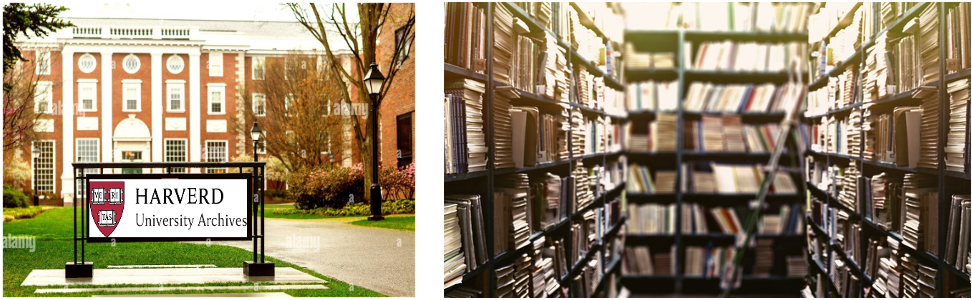
June, 2025. A balmy day in Boston, where we planned to take in one of those classic Red Sox/Yankees showdowns at Fenway Park. We had some time to kill before the game, so we dropped in at the Harvard University Library Archives to see what interesting Skinner artifacts might be stashed there.
Suffice it to say, we never made it to Fenway.
On a whim we requested several boxes of uncatalogued material from a collection vaguely described as “Miscellaneous Faculty Recordings, 1957–1974,” and a friendly archivist set us up in a listening booth with headphones and an era-appropriate reel-to-reel tape machine.
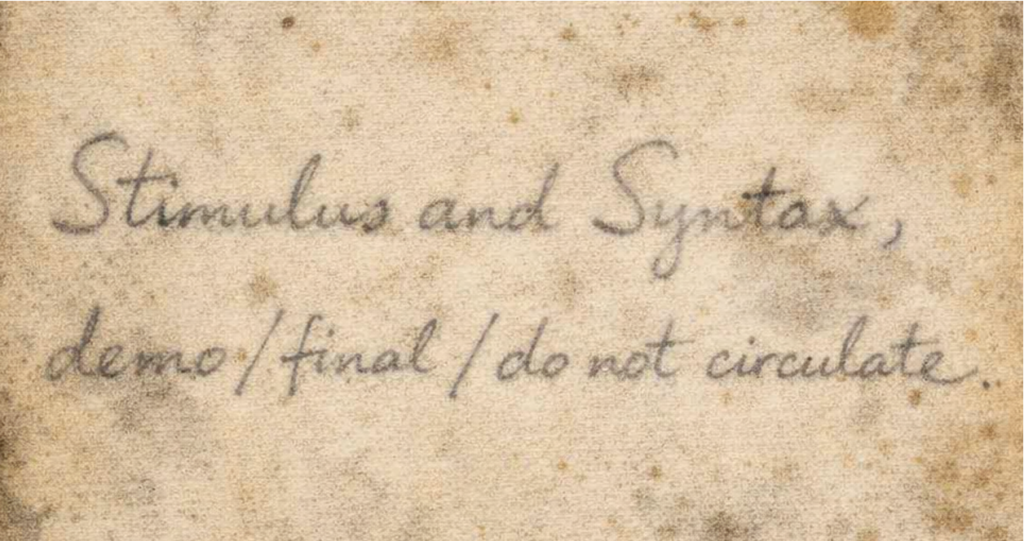
After four hours of reviewing nothing special — pretentious lectures, room-tone tests, and a disorienting recording of three philosophers singing a madrigal in Serbo-Croatian — we happened upon a narrow cardboard carton bearing the handwritten label shown at right. Inside was a neatly spooled reel, a mimeographed lyric sheet, a grainy black and white photo, and a small index card reading, “The Generative Divide — take 4 (best blend).”
Based on the oxymoronic label Stimulus and Syntax, we though the reel might contain some puerile graduate-student parody of the Skinner-Chomsky debate. But what emerged from our headphones was far from parody. It was, impossibly, a sincere and musically committed folk duet in which Skinner and Chomsky expounded, in alternating verses — on language, theory, and the nature of scientific explanation — before arriving at a chorus of principled disagreement in close harmony. There was guitar. There was harmonica. There was a tempo best described as “Cambridge coffeehouse with unresolved theoretical tension.” And there was no plausible reason for any of it to exist.
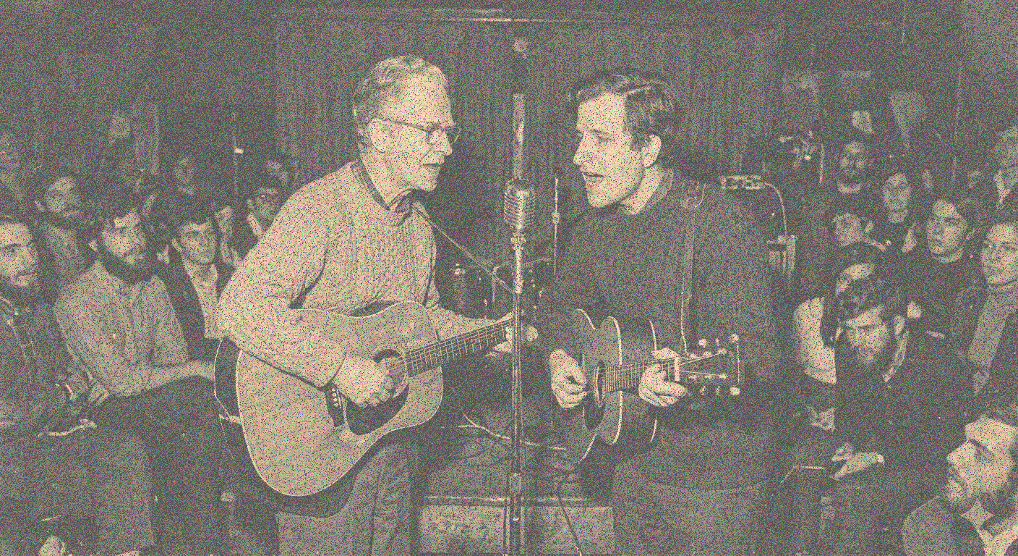
Image courtesy of the Archive.
The photo (above) may date to the early 1960s, and it documents an unknown event in a smallish room with a tiny stage and seating for perhaps two dozen listeners who apparently are mostly students. It’s just the kind of setting in which two rivals, after a cocktail or three, might well say something like, “What if we settled this through song?”
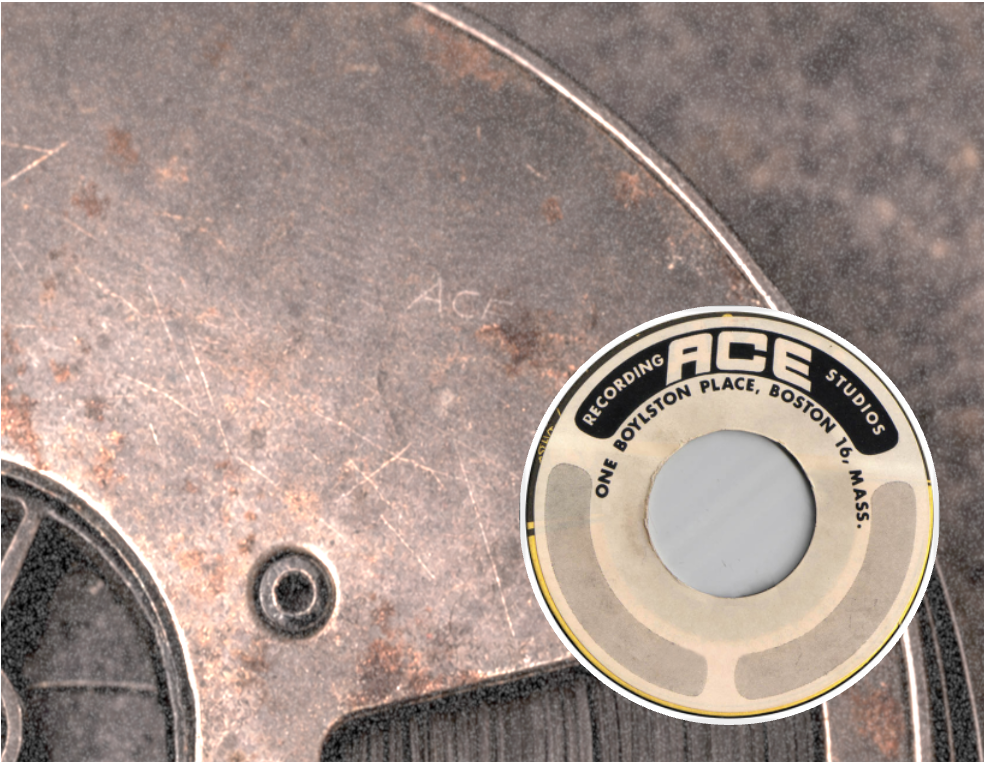
The recording, which you can hear at the bottom of this post, is too crisp and clean to be from a public performance. In light of the “demo” and “take 4” designations in the Archives, it rather seems to be from a studio session that could have followed the performance.
One clue: Scratched into the metal reel are the tiny letters “ACF” or “ACE.” If the latter, that could refer to Roxbury’s Ace Studios, which during the 1950s and 1960s produced popular-music hits like Freddy Cannon’s “Tallahassee Lassie” and Frankie Ford’s “Sea Cruise.”
For whatever it’s worth, the quality of the Skinner-Chomsky recording is quite consistent with the four-track technology that Ace Studios employed in the 1960s.
The song “Generative Divide” blends technical language and folk-poetic phrasing with unnerving confidence. Terms like mand, tact, verbal community, generative grammar, and unbounded use appear not as comic embellishments but as genuine lyrical content.
Against all probability it works. Chomsky, singing first, appears to acknowledge that some of his earlier critique may have been unnecessarily harsh. Skinner responds not with capitulation but with an explanation for his lack of a formal counterattack in print: namely, that he preferred to let programmatic work, empirical application, and scientific practice stand as his answer. This is followed not by reconciliation in any strict theoretical sense, but by something stranger and more beautiful: harmonized disagreement. It is difficult to overstate the intellectual violence this does to one’s expectations.
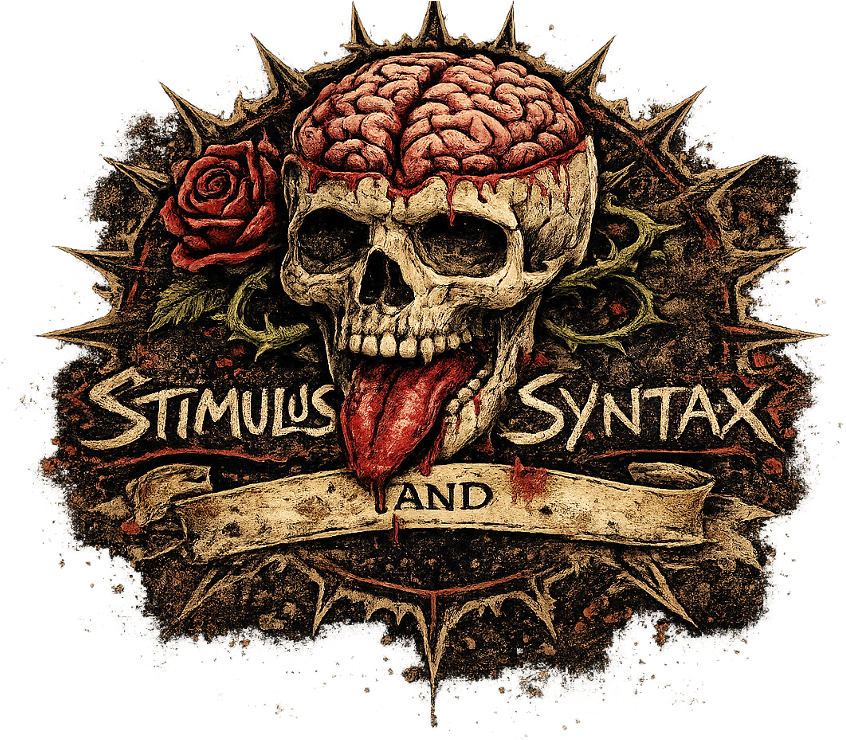
The band name deserves comment. Stimulus and Syntax is so on-the-nose that it would normally fail the test of plausibility. And yet one can easily imagine it first scrawled on a napkin as a joke at some faculty gathering… then discussed casually as a whimsical what-if… then suddenly taking shape as a project with a life of its own. The name captures the precise poles of the Skinner-Chomsky dispute: the outwardly conditioned and the inwardly structured, the observable contingency and the latent grammatical form. It is ridiculous. It is elegant. It is perfect.
The photo, which appears genuine and unretouched, verifies that a musical meeting of titanic minds actually took place. We cannot, however, prove that the voices in the recording belong to Skinner and Chomsky, particularly given the singers’ exaggerated folksy affectations. It’s well known that Skinner had a musical streak — in his youth he played saxophone in a jazz band (see pp. 138-141 in the autobiographical Particulars Of My Life) — so it’s plausible he could also have picked up guitar at some point (intriguing side note: daughter Julie Skinner Vargas later became an accomplished classical guitarist). Unfortunately, the B.F. Skinner Foundation tells us that there are no known recordings of Skinner in song that could validate the archived tape. The same appears to be true for Chomsky. In his later years Chomsky did contribute spoken voiceovers to a few musical projects, but these are not helpful in the present context.
Assuming the tape we discovered is genuine, it’s obvious that whatever surge of collegiality inspired Stimulus and Syntax did not last.
That a recording was made at all suggests Skinner and Chomsky contemplated sharing their song beyond the modest event in the photo. That the recording ultimately was sequestered away in an uncatalogued collection suggests they had second thoughts about how it might be received. Did they fear it would make them look unserious? That it would falsely convey that their positions could be reconciled? Or was the project simply overshadowed by more pressing priorities as the two mens’ careers shifted into overdrive in the 1960s? Unless additional relevant materials can be unearthed from the Archive, the world may never know. But baseball season is coming up. Soon we’ll be back in Boston giving this our best effort.
For now, there’s a performance photo and a tape, presumably but not certifiably connected. For us, that’s enough circumstantial evidence to suggest enormous scholarly implications, of which we’ll mention three.
- Our discovery should temper any tendency to narrate the Skinner–Chomsky relationship in exclusively adversarial terms. Clearly, there was enough mutual awareness—and perhaps enough mutual theatricality—to sustain at least one collaborative performance.
- Our discovery suggests that even the sternest disputes of 20th Century thought may have contained undercurrents of wit, play, and deeply impractical musical ambition that are not preserved in the scholarly record.
- Most importantly, this discovery confirms what many of us have long suspected: Academics will, given the slightest opportunity, form a band rather than process their disagreements normally.
The music world, as every audiophile knows, occasionally spawns acts that exert influence out of proportion to their commercial and popular success: Think Big Star, The Spiders, Booker Little, Odetta Holmes….
Sometime during the 1960s, Stimulus and Syntax burst into being, burned brightly for a one-night-only public appearance, and then extinguished into obscurity. The performance was so cosmic and unexpected, however, that we like to imagine that those lucky few in attendance were forever changed by the experience.
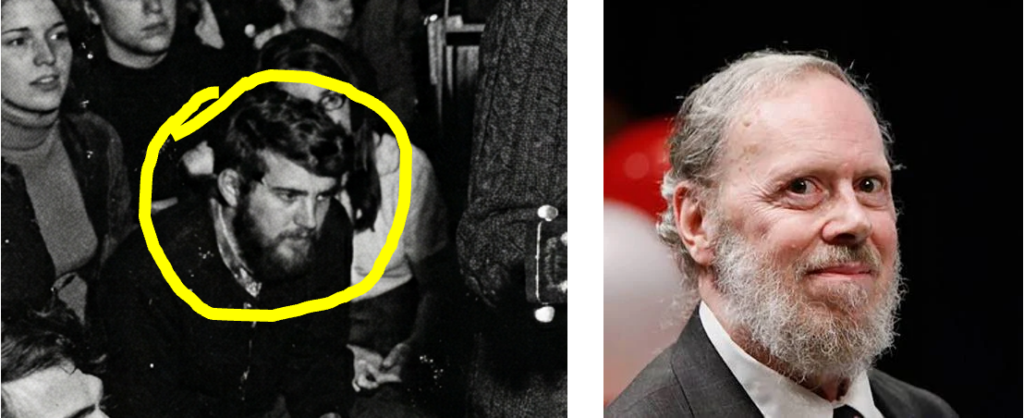
A possible case in point: Could the audience member highlighted at right be a young Dennis Ritchie (Harvard Class of 1963), who went on to develop the Unix operating system and C programming language? These tools exerted “sweeping influence on the modern world” by allowing humans to command the power of computers without knowing arcane assembly language. Such a seamless melding of Man and machine is precisely the kind of thing you’d expect from someone whose world view was imprinted upon by an unlikely musical integration of irreconcilable perspectives.
If in fact Stimulus and Syntax transformed those lucky listeners, and they passed their inspiration along to others, who in turn did the same — well, perhaps that one propitious performance launched an invisible legacy that’s every bit as far reaching as the published work for which Skinner and Chomsky are remembered.
And perhaps that provides hope for society as a whole. There is of course far too much rancor and division out there, too much internecine squabbling and tribal chest thumping. But if thinkers as opposed and opinionated as Skinner and Chomsky could find a way to co-exist, then maybe, just maybe, the rest of us can learn to get along as well.

The Generative Divide (Take 4)
sssss
Happy April Fool’s Day (poisson d’avril in France, Hunt the Gowk Day in Scotland; Dia das Mentiras in Brazil; Prima Aprilis in Poland; Humorina in Ukraine). For those who reside outside of heavily European-influenced countries: April Fools is an occasion on which you show people you love them by lying to them and/or subjecting them to sadistic tricks.
We have never visited the Harvard Archives and do not plan to. Honestly that sounds super boring, and anyway our anti-elitist hillbilly upbringings prevent us from giving Harvard the satisfaction of thinking we care about it. The text of this post was drafted by ChatGPT and edited by us. The Skinner-Chomsky photo and image of the cardboard carton were generated by Google Gemini and ChaptGPT, respectively. “Generative Divide” lyrics were authored by ChaptGPT, with music and vocals created by the Suno app.
The Stimulus and Syntax band logo is so apt and powerful that it created itself.
Oh, and for the record (See what we did there? Pun based on “record”?), having heard the speaking voices of Skinner and Chomsky we do not think we would like to actually hear them sing.