
Guest Post by Matthew Lewon and Michael Domjan
We recently published an article in Perspectives on Behavior Science on the relevance of a modern understanding of Pavlovian conditioning to applied behavior analysis (ABA), and how this might broaden thinking in ABA research and practice. In this post we provide a brief overview of some of the main points of the paper, with the hope that you will consider checking out the full paper (it’s open access).
Sound Check
You might wonder how the two of us came to collaborate on this project. We are an unlikely duo. Michael has been a Professor at the University of Texas at Austin since 1973, long before Matthew was born. Michael’s research during the past 50 years has focused exclusively on Pavlovian conditioning. He is also known for a textbook, Principles of Learning and Behavior, that has been a staple in college classes for decades. But, Michael is not a Board Certified Behavior Analyst (BCBA) and his only experience with applied work was a brief stint at Western Michigan University in the late 1960’s.
Matthew, in contrast, is a bona fide BCBA. He is Assistant Professor in the Department of Psychology and Clinical Director of Behavioral Education and Consulting Services at the University of Nevada, Reno. He accidentally discovered ABA during a summer internship at a residential institution for adults with intellectual and developmental disabilities in the late 1990s (this was among the last such institutions in the United States at the time). In his graduate training, he got interested in laboratory research and the philosophy of science. He has continued this work, largely in the domains of motivation and emotion, the contextual control of behavior, and learning processes in animal models of human conditions such as autism.
Michael and Matthew share an interest in music. Michael frequently plays the viola in a community orchestra whereas Matthew has been playing the guitar and singing with various bands over the years. (A diligent Google search may reveal embarrassing evidence of this.) During a guest lecture that Michael gave in Matthew’s graduate course (“Experimental Analysis of Behavior”), they discovered that they also shared an interest in how Pavlovian conditioning is taught and used in ABA. They ended up writing a paper about that because they both felt that Pavlovian conditioning has been superficially understood and underappreciated in ABA.
The Paper
Let us commence with an overview of the paper. In the broadest sense, we argue that an updated view of Pavlovian conditioning, beyond the traditional behavior analytic perspective, will provide new and useful ideas for ABA research and practice. We do not suggest that operant conditioning procedures are not important or useful. Rather, we suggest that incorporating what is now known about Pavlovian conditioning and its relation to operant procedures will expand the analytic tools available to ABA researchers and practitioners. Below is the highlight reel.
Historical Context
ABA today is dominated by practices derived from Skinner’s views on operant conditioning. The irony of this is that the first self-proclaimed behaviorist, John B. Watson, along with colleagues Rosalie Rayner and Mary Cover Jones, recognized and demonstrated the utility of procedures modeled on Pavlovian conditioning to understanding the acquisition of phobias and their treatment. Their work was the basis for various “exposure” procedures that are still prominent in behavior therapy today. We consider some of the historical developments that contributed to the predominance of operant procedures in ABA, and the relative exclusion of Pavlovian conditioning procedures. A major factor was the influence of Skinner’s writing on the distinction between Pavlovian and operant conditioning. He considered Pavlovian and operant conditioning to be fundamentally different, and regarded Pavlovian conditioning as only relevant to the conditioning of “glandular” and “physiological” responses — not how individuals interact with their environment. As discussed below, empirical evidence obtained since Skinner’s writings has shown that neither of these assertions is accurate. Nevertheless, the influence of his views prevails, possibly because much of the research contradicting Skinner’s views has been published and discussed outside of traditionally behavior analytic journals and textbooks. Another factor may have been the development of the BCBA credential, which is focused almost entirely on competence in operant conditioning principles and procedures. This operant emphasis in ABA credentialing is increasingly shaping what is taught in ABA graduate programs.
Relations Between Pavlovian and Operant Conditioning
The second section of the paper provides an overview of the various lines of research demonstrating that Pavlovian and operant conditioning processes are not as distinct or independent as they have been characterized in the behavior analytic literature. Skinner based his distinction between them on 1) the nature of the behavior being conditioned (as noted, he considered Pavlovian conditioning to be relevant only to glandular and physiological responses while operant conditioning was relevant to interactions with the external environment), 2) differences in conditioning procedures (stimulus-stimulus pairings versus behavior-consequence relations), and 3) the extent to which antecedent stimuli contribute to the occurrence of behavior (respondent behavior was considered to be elicited and entirely controlled by antecedent stimuli while operant behavior was emitted, with a looser connection to antecedent stimuli).
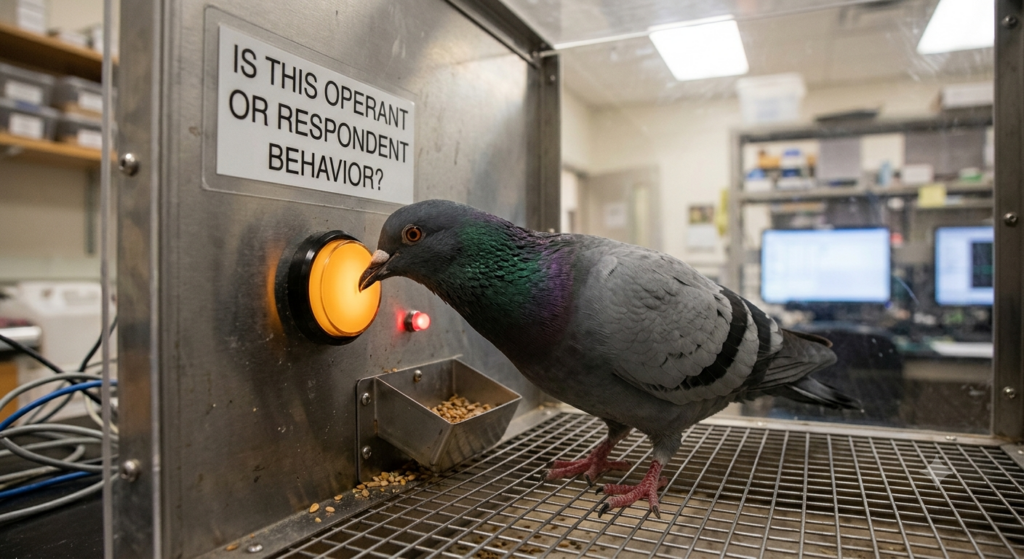
As we describe, these assumptions are no longer defensible. 1) Research on autoshaping has demonstrated that Pavlovian conditioning can produce skeletal conditioned responses like key pecking in pigeons and lever pressing in rats, the two most paradigmatic operant responses in the literature. 2) In addition to the behavior-consequence (B-C) relation, operant conditioning procedures inevitably involve a relation between antecedent stimuli and consequential stimuli (the A-C relation), which is a form of Pavlovian conditioning. It is therefore not possible to conduct an operant procedure without the involvement of Pavlovian learning. 3) Related to this, the inevitable A-C relations involved in operant procedures suggests that operant behavior begins to come under antecedent stimulus control at the outset of training, even when this control may not be evident. As such, the seemingly “probabilistic” nature of operant behavior is due to limitations of an observer’s perspective: the control by antecedent stimuli becomes clearer to an observer with extended training, but is there from the beginning.
Finally, Pavlovian-instrumental transfer (PIT) research has shown that Pavlovian conditioned stimuli (CSs) can elicit motivational or emotional states that affect behavior produced by operant contingencies, even when operant contingencies do not change. This is particularly important in the context of ABA, as discussed below.
Expanding the Analytic Toolbox of ABA
We’ve all had experiences where we were not as successful as we would like in obtaining desired clinical outcomes, or are confronted with research results that don’t jive with our expectations from traditional ways of thinking. The conceptual reorientation advocated in this paper does not completely disavow older ways of thinking. Instead, it offers new ways of approaching the issues we all care about in ABA but may have been confounded by. We’ll briefly mention two implications discussed in the final section of our paper here.
The first is related to motivational and emotional issues. As mentioned above, research on Pavlovian-instrumental transfer or PIT shows that CSs established through Pavlovian conditioning elicit motivational states that affect behavior apart from the operant contingencies we may arrange. In other words, what we consider to be operant behavior is substantially influenced by Pavlovian conditioned stimuli. Recognizing this might help ABA practitioners understand and better support individuals whose behavior reflects strong antecedent control, as in the case of those who have experienced trauma. Behavior related to what is described as trauma often appears to be related more to its immediate antecedent conditions (i.e., “triggers”) than to its consequences. PIT also provides practitioners with a means of managing motivational states, as with mood induction procedures described in the paper.
The second is in recognizing that Pavlovian relations between the various stimuli that comprise the antecedent and consequential contexts of behavior (A-C relations) always occur as a part of operant contingencies. This means that desirable or undesirable outcomes of operant procedures may be related to unrecognized A-C relations. We describe how acknowledging these may contribute to new strategies for discrimination training, the persistence of behavior in the face of changing conditions (“behavioral momentum” that may affect maintenance and generalization of behavior change), and new approaches for conducting functional behavior assessments.
Final Words
In closing, we thank you for reading, and we hope that this short overview will encourage you to check out the full paper and the literature cited in it.
Lewon, M., & Domjan, M. (2026). Toward a modern understanding of Pavlovian conditioning in applied behavior analysis. Perspectives on Behavior Science. https://doi.org/10.1007/s40614-026-00494-4
I love teaching RBTs how to use Pavlovian conditioning techniques to develop learning opportunities and establish/strengthen rapport between the clients and the RBTs. I find this topic (Pavlovian conditioning) fascinating and it has been a SUPER useful tool in my practice!
I really enjoyed this article! It gave me some fun ideas as to how we can teach generalization more effectively by analyzing the A-C relationship! I would love to talk more about this!